🧠 Are We Truly Free, or Living in a Managed Illusion?
Flat Earth
Author
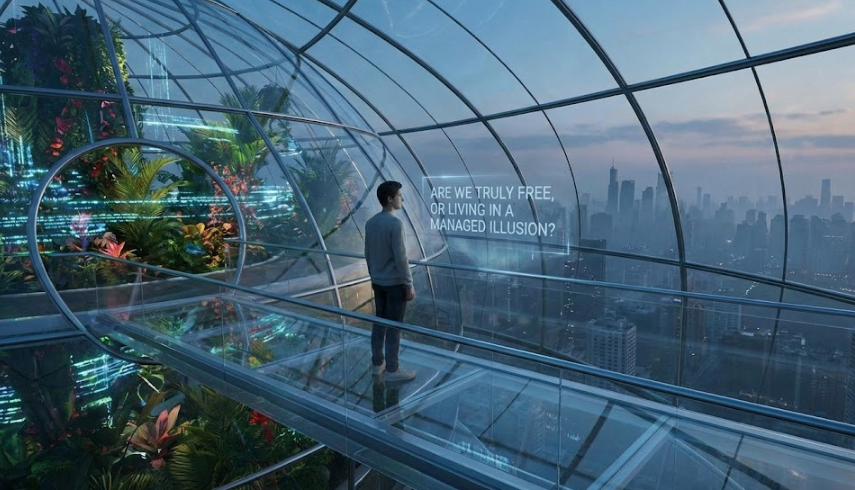
This is one of the most persistent and unsettling questions of the human experience. It gnaws at the edges of consciousness, usually striking during moments of routine—the daily commute, the endless scroll through social media, the realization that we desire the exact thing an advertisement just told us to desire.
The question creates a dichotomy: total autonomy versus total simulation. The reality, however, is likely far more complex. We are probably not Neo waking up in a vat of goo, nor are we fully sovereign beings whose choices arise ex nihilo (out of nothing).
Instead, we exist in a liminal space—a complex interplay where genuine agency battles against profound biological, societal, and technological conditioning. To understand if we are free, we must first understand the architecture of the “managed illusion.”
Part I: The Architecture of the Illusion
If life feels like a managed illusion, who are the managers? They are rarely shadowy cabals plotting in back rooms. Instead, the management is systemic, decentralized, and often internal.
1. The Biological Puppeteer
Before society even gets its hooks into us, biology sets the stage. Neuroscience suggests that what we perceive as conscious “choices” are often post-hoc rationalizations for decisions our subconscious brains made milliseconds earlier. We are beholden to neurochemistry—dopamine drives our desires, serotonin our moods, oxytocin our attachments.
We believe we freely chose a romantic partner, but how much of that was pheromones, evolutionary imperatives toward reproduction, and attachment styles forged in infancy? If the machinery of our brains dictates our impulses, “freedom” becomes merely the ability to sometimes veto the initial impulse.
2. The Cultural Narrative
We are born into a play that has been running for millennia, handed a script we didn’t write. Language itself is a framing mechanism; if we don’t have a word for a concept, it is immensely difficult to think it.
Our values, our definitions of success, our very sense of self are culturally constructed. We are conditioned to believe that owning a certain type of car signals success, or that a specific career path offers fulfillment. The “illusion” here is the belief that these are universal truths rather than temporary, societal agreements. We walk within the narrow corridors of accepted normalcy, mistaking the walls for the horizon.
3. The Algorithmic Cage
This is the modern manifestation of the “managed illusion,” and perhaps the most insidious. In the 21st century, the management has been automated.
We live in an attention economy where the most brilliant minds of a generation are paid to keep us scrolling. Algorithms do not just reflect our interests back to us; they actively shape them. By curating what information we see, they curate our reality. They nudge us toward polarization, outrage, and consumerism because those states generate the most engagement.
When your news feed, your product recommendations, and even your potential dating pool are determined by opaque mathematical formulas designed to maximize corporate profit, the idea of “free choice” becomes brittle. We are free to choose, but only from the menu they have printed.
Part II: The Resilience of Freedom
If the forces of biology, culture, and technology are so overwhelming, is freedom merely a comforting myth?
Not entirely. While absolute freedom—the ability to act wholly independent of influence—is an illusion, humans possess a unique capacity for reflective agency.
1. The Gap Between Stimulus and Response
Victor Frankl, a psychiatrist and Holocaust survivor, famously argued that even in the most extreme conditions of captivity, a final freedom remains: the ability to choose one’s attitude in any given set of circumstances.
Animals largely react to stimuli. Humans have a “gap” where we can observe the stimulus (the anger, the desire, the fear) and choose not to act on it. This consciousness—the ability to think about our own thinking (metacognition)—is the loophole in the matrix. It is the mechanism by which we can identify the programming and decide whether or not to run the code.
2. Creativity and Novelty
If we were simply managed automatons, human history would be stagnant. Yet, we constantly generate novelty. We create art that makes no evolutionary sense; we develop philosophies that challenge the status quo; we invent technologies that reshape the very world that shaped us.
This generative capability suggests a spark that isn’t wholly determined by inputs. We can combine old ideas into genuinely new ones. We can act against our own self-interest for moral reasons, something a purely utilitarian “managed” system should theoretically forbid.
Part III: The Synthesis—Freedom as a Practice
So, are we free or managed? The answer is both.
We are living in an illusion to the extent that we are unaware of the forces shaping us. The man who thinks he buys the sports car purely because he likes the engineering is in an illusion. The man who understands he is buying it because biology makes him crave status, and society has branded that car as a status symbol, is closer to freedom.
Freedom is not a binary state you possess; it is a muscle you exercise. It is a continuous process of:
-
Waking Up: Becoming aware of the biological impulses, cultural scripts, and algorithmic nudges influencing you at any given moment.
-
Questioning the Narrative: Interrogating your own desires. “Do I actually want this, or was I trained to want this?”
-
Conscious Resistance: Occasionally choosing the difficult path, engaging with uncomfortable ideas, and stepping outside the algorithm’s comfort zone just to prove to yourself that you can.
We are not truly free in the absolute sense, for we can never totally escape the context of our existence. But we are not hopelessly managed, either. We are participants in a complex negotiation with reality. The degree to which we are free is measured by the degree of our awareness. The unexamined life is indeed a managed illusion; the examined life is a fight for fragments of genuine liberty.