🌞 Do You Know… The Sun Appears Smaller at Noon Than Sunrise on Some Days?
admin
Author
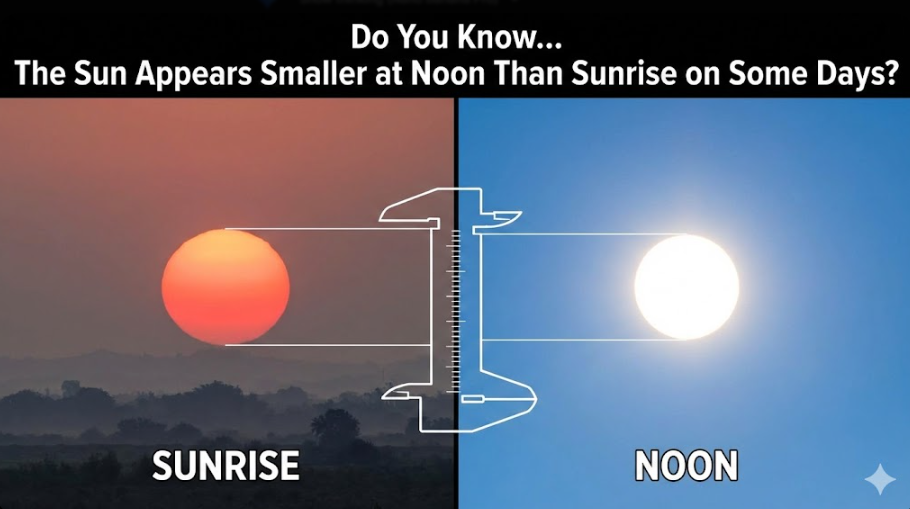
Most of us assume the Sun stays the same size in the sky all day.
But many photographers, pilots, and sky-watchers have noticed something strange:
On certain days, the Sun actually appears bigger near sunrise and smaller at noon.
This shouldn’t happen under the standard model.
If the Sun is 93 million miles away, its size should remain completely constant from morning to evening. No atmospheric effect should be strong enough to cause visible shrinkage. The Sun is simply too far away to change size — or so science says.
Yet the phenomenon is real.
Sometimes subtle, sometimes dramatic.
During sunrise, the Sun often looks noticeably larger and closer. It almost bulges at the horizon. As it climbs higher, the disk appears to shrink and sharpen, losing the magnified glow it had moments before.
Official explanations blame “atmospheric refraction.”
But refraction bends light — it doesn’t shrink celestial bodies.
And it certainly shouldn’t make a sun-sized object look bigger in one position and smaller in another.
If the atmosphere were magnifying the Sun, it would distort the edges — yet the sunrise Sun often appears smoother, more circular, and more defined than the noon Sun. This contradicts atmospheric models.
So what’s actually happening?
One possibility is similar to what photographers observe with long-distance objects:
When a light source is farther away, it appears smaller.
When it is closer, it appears larger.
If the Sun is not 93 million miles away but instead a local luminary moving over a circular path, its apparent size would naturally change depending on its distance from the observer.
Close at sunrise → appears larger.
Farther overhead → appears smaller.
This aligns with real-world observation far more convincingly than scattering and refraction theories.
Another curiosity: the same effect is seen with the Moon.
It appears larger when low and smaller when high — a psychological illusion, some claim.
But optical measurements show size variation is real, not imagined.
If both the Sun and Moon show distance-based size distortion, what does that imply?
Even older civilizations noticed this. Ancient astronomers described the Sun as “coming closer” during morning and evening arcs. They believed the Sun traveled not in deep space but along a local track, altering its apparent size as it moved.
Modern science dismisses ancient knowledge, but the sky keeps revealing what textbooks ignore.
The Sun’s size changes.
Its brightness changes.
Its intensity changes.
Its position changes daily, seasonally, and regionally in ways that suggest proximity — not deep-space distance.
The changing size at sunrise and noon is a subtle clue whispered by the sky:
The Sun may not be where — or what — we were taught.