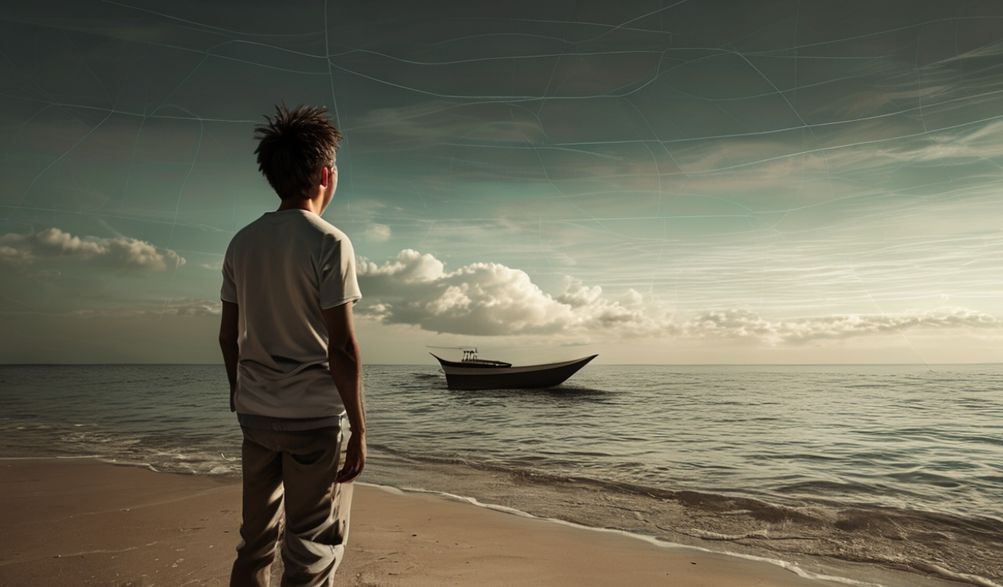
When it comes to navigating the great outdoors, few skills are as essential as distance estimation over water. Whether you’re a sailor, a fisherman, or simply someone who enjoys spending time by the ocean, being able to accurately gauge the distance between yourself and objects on the horizon is crucial for safety and success. However, as many people have discovered to their dismay, distance estimation over water can be a tricky and often unreliable business. In this article, we’ll delve into the fascinating world of distance estimation and explore the reasons why it can go haywire over water.
Historical Context: The Challenges of Distance Estimation Over Water
For centuries, humans have been attempting to navigate the world’s oceans and waterways, often with limited success. The challenges of distance estimation over water have been a major obstacle to safe and efficient navigation, with many sailors and travelers relying on crude methods such as dead reckoning and pilotage to estimate their position and distance from shore. The development of more sophisticated navigational tools, such as the sextant and chronometer, helped to improve the accuracy of distance estimation over water, but even these tools had their limitations. It wasn’t until the advent of modern technologies like radar and GPS that distance estimation over water became a more precise and reliable science.
Detailed Analysis of Distance Estimation Over Water
In order to understand why distance estimation over water can be so challenging, it’s essential to examine the various factors that come into play. The following sections will provide a detailed analysis of the key issues involved in distance estimation over water.
Section 1: The Role of Atmospheric Conditions
One of the primary factors that can affect distance estimation over water is the atmosphere. The air above the ocean can be prone to thermal layers, inversion layers, and other phenomena that can bend and distort light, making it difficult to accurately gauge distance. For example, on a hot day, the air near the surface of the water can become heated, causing it to expand and create a layer of warm air that can refract light and create a mirage-like effect. This can make objects on the horizon appear closer or farther away than they actually are, leading to errors in distance estimation over water.
Section 2: The Impact of Wave and Swell Patterns
Another factor that can impact distance estimation over water is the pattern of waves and swells. The ocean is never flat, and the constant motion of the waves can make it difficult to get a clear view of objects on the horizon. Additionally, the shape and size of the waves can create optical illusions, making it seem as though objects are closer or farther away than they actually are. For example, a large wave can create a “lensing” effect, where the curvature of the wave acts as a lens and magnifies the image of an object, making it appear larger and closer than it actually is.
Section 3: The Effects of Color and Contrast
The color and contrast of objects on the horizon can also play a significant role in distance estimation over water. The human eye is wired to respond to contrast, and when there is a lack of contrast between an object and its surroundings, it can be difficult to gauge its distance. For example, a dark-colored boat against a light-colored sky can appear closer than it actually is, while a light-colored boat against a dark-colored sky can appear farther away. Additionally, the color of the water itself can affect distance estimation, with darker or murkier water making it more difficult to see objects at a distance.
Section 4: The Influence of Psychological Factors
Psychological factors can also come into play when it comes to distance estimation over water. Humans have a tendency to perceive the world in a way that is influenced by their expectations and past experiences. For example, a sailor who is used to navigating in a particular type of water may overestimate or underestimate distances based on their familiarity with the area. Additionally, stress, fatigue, and other emotional factors can affect a person’s ability to accurately gauge distance, with tired or anxious individuals more likely to make errors in distance estimation over water.
Section 5: The Limitations of Technology
Finally, even with the aid of modern technology, distance estimation over water can still be a challenging task. While tools like radar and GPS can provide accurate distance measurements, they are not foolproof and can be affected by a range of factors, including signal interference, equipment malfunction, and operator error. Additionally, the use of technology can sometimes create a false sense of security, leading individuals to become complacent and less vigilant in their navigation, which can increase the risk of errors in distance estimation over water.
Counter-Arguments: Challenging the Notion of Distance Estimation Over Water
Some might argue that the challenges of distance estimation over water are overstated, and that with the right training and equipment, it is possible to accurately gauge distance in even the most difficult conditions. While it is true that experienced sailors and navigators can develop a high degree of skill and accuracy in distance estimation over water, the fact remains that the ocean is a complex and unpredictable environment, and even the most skilled individuals can be caught off guard by unexpected changes in the weather or other factors. Furthermore, the use of technology is not a panacea, and there are many situations in which distance estimation over water must be done without the aid of modern tools.
Conclusion: The Importance of Accurate Distance Estimation Over Water
In conclusion, distance estimation over water is a complex and challenging task that requires a deep understanding of the various factors that can affect it. From atmospheric conditions to psychological factors, there are many potential pitfalls that can lead to errors in distance estimation over water. By recognizing these challenges and taking steps to mitigate them, individuals can improve their skills and stay safe on the water. Whether you’re a seasoned sailor or just starting out, it’s essential to appreciate the importance of accurate distance estimation over water and to develop the skills and strategies needed to navigate the ocean with confidence. With practice, patience, and a healthy respect for the power of the sea, anyone can become proficient in distance estimation over water and enjoy the many rewards that come with exploring the world’s oceans and waterways.