Why the Big Bang Can’t Be True: A Flat Earth Perspective
admin
Author
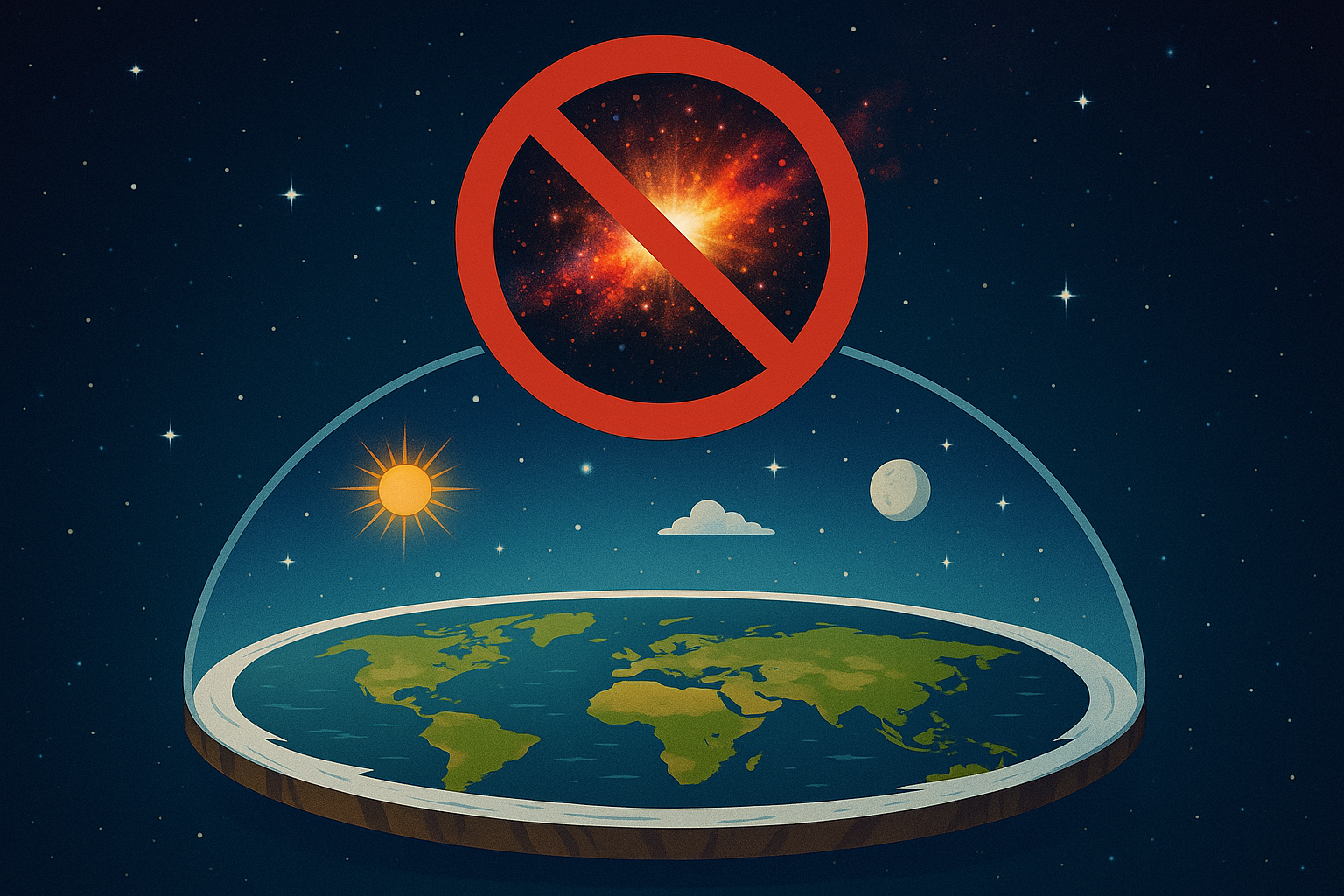
Introduction: The Story We’re Told
We’ve all heard it—“13.8 billion years ago, everything in the universe exploded from a dot smaller than an atom.” This is the standard narrative of the Big Bang theory. But is it fact—or just a theory dressed up as reality? Flat Earth thinkers argue the Big Bang is a philosophical belief, not a proven truth.
1. Something From Nothing?
The Big Bang begins with a paradox: everything came from nothing. According to modern cosmology, space, time, matter, and energy all appeared from nowhere. But how can nothing create something? This is not science—it’s a leap of faith.
Flat Earth researchers instead see evidence of a designed cosmos, not a cosmic accident. The skies above, with perfect cycles of sun, moon, and stars, point to intention—not chaos.
2. The Problem of Expansion
Big Bang cosmology says the universe is expanding like a balloon. But we do not observe galaxies rushing away with the precision expected. Astronomers use redshift interpretation as “proof,” yet alternative explanations for redshift exist, such as light losing energy over distance (“tired light”).
If space is not expanding, then the Big Bang collapses as an explanation.
3. The Age Dilemma
The Big Bang requires billions of years to allow stars, galaxies, and planets to form. Yet Flat Earth observations see a world that appears young and purposeful. The sun and moon keep perfect cycles, stars return season after season, and the Earth itself shows no sign of being billions of years old.
4. Cosmic Fine-Tuning
If the Big Bang were true, it had to happen with mathematical perfection—gravity, energy, and atomic forces all balanced within unimaginable precision. Even secular scientists admit this looks like fine-tuning. But instead of admitting a designer, they invent multiverse theories to explain it away.
Flat Earth thinkers see this as proof that the cosmos was built with purpose, not by chance explosions.
5. Why It Matters
The Big Bang isn’t just science—it’s philosophy. It tells humanity: “You are the result of an accident, spinning on a ball in endless space.”
But Flat Earth rejects this worldview. Instead, it affirms that we live in a designed, enclosed system, where the heavens declare meaning, not randomness.
Conclusion: Beyond the Bang
The Big Bang is filled with unanswered questions, paradoxes, and assumptions. It cannot be “proven” in a lab. For Flat Earth believers, it is a distraction from the truth: the universe is not expanding chaos, but a crafted order.
By rejecting the Big Bang, one embraces the idea of purpose, design, and meaning in creation—a cosmos built not by chance, but by intention.