Why Space Agencies Avoid Antarctica — The Hidden Geopolitical & Military Blockade
admin
Author
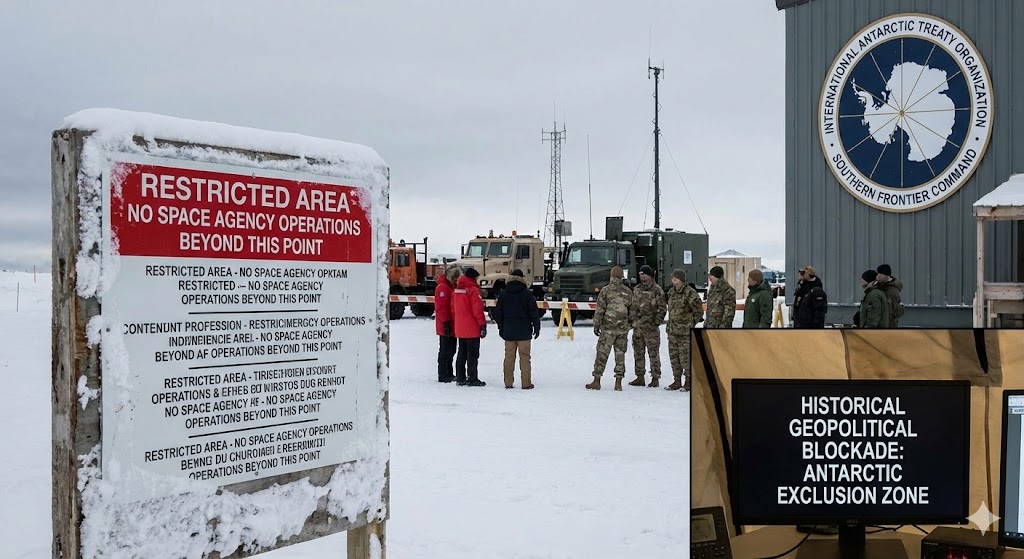
Why Space Agencies Avoid Antarctica at All Costs
Antarctica is the strangest continent on Earth. It has no cities, no native population, no commercial industry, and no independent access. You and I cannot travel freely there, buy land, or even explore beyond strictly monitored zones. Instead, Antarctica is governed by a multinational treaty so powerful and so unusual that it defies every standard of geopolitical logic.
But one mystery stands above the rest: every space agency in the world — NASA, ESA, Roscosmos, ISRO, JAXA, CNSA, and even private companies — avoids Antarctica entirely.
No rocket launches.
No satellite ground stations.
No exploration missions.
No flight paths crossing the southern frontier.
For an organization allegedly obsessed with exploring the unknown, space agencies seem bizarrely uninterested in the most mysterious place on Earth.
The roots of this avoidance reach back to a time before “outer space” was even part of public consciousness. In the early 20th century, Antarctica was a land of fierce national competition. Countries raced to claim territory, plant flags, and establish research stations. But everything changed after World War II. Suddenly, the push to conquer Antarctica stopped. Nations that had fought bitterly for dominance in other regions abruptly cooperated to freeze all territorial claims.
This shift coincides closely with Operation Highjump in 1946–47, the largest Antarctic military expedition ever launched. Led by Admiral Richard E. Byrd, Highjump involved thousands of troops, aircraft, and naval ships. Officially it was a training mission; unofficially, rumors persist that Byrd encountered something unexpected — something that altered global policy on Antarctica forever. When Byrd returned, his statements about a “new enemy” with extraordinary capabilities stunned the world, yet were quickly buried. Soon afterward, military interest in Antarctica evaporated.
Then came the Antarctic Treaty of 1959. It remains one of the most unusual agreements in human history. At the height of the Cold War, when nuclear powers distrusted one another to the brink of annihilation, twelve nations suddenly agreed — unanimously — to ban military activity, resource extraction, independent exploration, and territorial ownership across an entire continent. They created an international no-go zone larger than Europe. Every major power signed, and nearly every other country eventually joined.
The treaty is enforced by military patrols, satellite monitoring, and a network of heavily guarded research stations that ordinary civilians cannot approach. It’s not a tourist destination; it’s a fortress disguised as a science project.
So why does this concern space agencies?
Because Antarctica represents the last uncontrolled frontier of Earth — a place where one could test the limits of the world’s shape, measure long-distance water level, or attempt to reach the true southern boundary.
If Earth is larger, flatter, or fundamentally different from what official models claim, Antarctica is where the truth would reveal itself.
This explains why space agencies, despite having the budget and equipment to explore the most extreme environments imaginable, avoid Antarctica completely. Their rockets launch eastward, northward, westward — never south. Even satellite trajectories mysteriously avoid covering the South Pole. And ground-based tracking stations are located everywhere except where they could confirm or contradict orbital claims: Antarctica.
The geopolitical logic is simple.
If your global model is fragile, you must protect the edges.
Space agencies depend on maintaining the illusion of limitless space, curved horizons, orbiting satellites, and extraterrestrial distances. But Antarctica is the one place that could expose inconsistencies. A rocket launched south could reveal atmospheric boundaries. A satellite station placed on the Antarctic plateau could demonstrate whether satellites truly orbit or whether they rely on ground-based towers. A deep-south expedition could map a region the public has never fully seen.
Instead, every agency maintains a silent agreement:
Avoid Antarctica. Always. Without exception.
The “scientific research” narrative is a convenient shield. It allows nations to maintain military presence under the guise of geology and climate studies while ensuring the continent remains off-limits to independent exploration. The public accepts the story because Antarctica is distant, barren, and cold — an easy place to hide the truth.
Yet the secrecy persists. Space agencies that spend billions to land robots on Mars make no effort to explore the most southern parts of Earth. Satellites that allegedly photograph galaxies millions of light-years away seldom provide clear, uncut imaging of Antarctica’s interior. Private space companies that claim to innovate freely follow the same avoidance patterns as their government predecessors.
Antarctica is the final locked door on our world.
A door guarded by treaties, militaries, and institutions that mysteriously agree on almost nothing else.
And until someone opens that door without permission, the truth about what lies beyond the southern frontier will remain hidden behind ice, authority, and silence.