Why Satellites Never Orbit the Poles — The Missing Trajectories No One Talks About
admin
Author
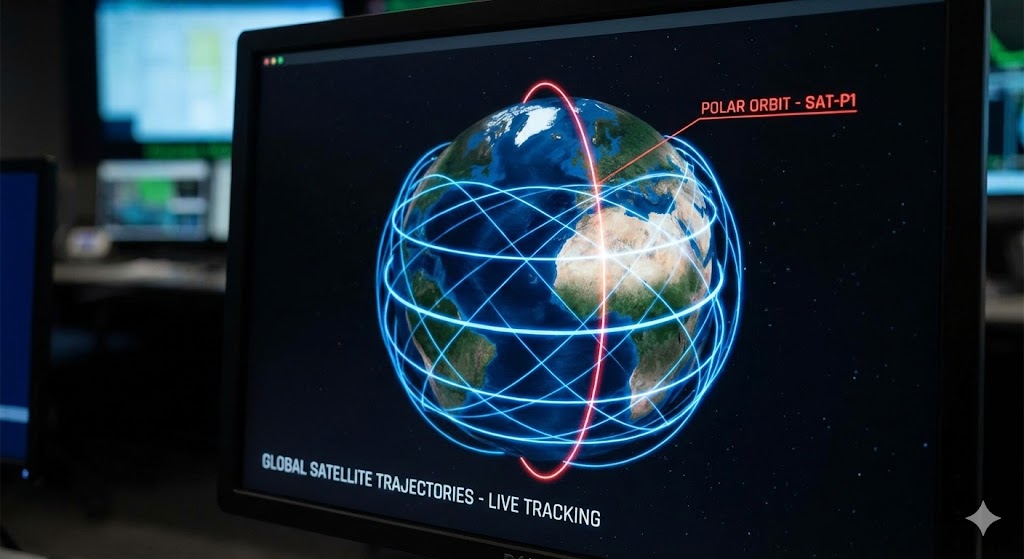
We are told that thousands of satellites encircle Earth in every direction: equatorial orbits, elliptical orbits, geostationary orbits, and polar orbits that supposedly sweep from the North Pole to the South Pole on every pass. But when you examine the official trajectory data from NASA, ESA, SpaceX, and military tracking networks, a strange pattern emerges — no satellite actually crosses both poles in a straight, clean, uninterrupted path.
The so-called “polar orbit” exists mostly in diagrams and animation, not in observable reality.
When satellite paths are plotted on maps — FAA charts, NORAD datasets, Starlink trackers, military telemetry, ESA dashboards — the lines curve, twist, or detour before reaching either pole. The southern regions are especially avoided. Every orbit bends away, arcs sideways, or terminates in a different latitude band. The clean, elegant north-to-south swipes shown in textbooks simply don’t appear in live data.
This absence is impossible to ignore once noticed. Even Starlink’s megaconstellation, which claims near-total global coverage, leaves a conspicuous void around the poles. Weather satellites, GPS networks, Earth-observation craft, spy satellites, even alleged “sun-synchronous” orbits — all mysteriously avoid flying directly over the southern polar region. NASA claims this is due to “operational challenges,” but the explanation falls apart under scrutiny. The poles should be the simplest area to cover if satellites truly orbit a globe. Gravity would not weaken there. Atmospheric density would not suddenly change. The laws of orbital mechanics do not forbid passing over either pole. And yet, somehow, every nation avoids it.
When analyzing launch patterns, the same pattern appears again. No major space agency launches rockets directly toward the poles. Not NASA. Not SpaceX. Not Roscosmos. Not China. Not India. No one. Instead, rockets launch eastward, maximizing velocity using Earth’s alleged spin. But if a true polar orbit were necessary — and space agencies say it is — there should be regular southbound launches. Instead there are none. The launches that claim to produce “polar orbits” actually veer east or west, then curve dramatically, avoiding the deep south.
The excuses offered are thin: harsh weather, communications issues, poor visibility. But weather does not stop space agencies from landing rovers on Mars, operating telescopes in vacuum, or sending probes into the outer solar system. Communication issues do not prevent contact with probes supposedly billions of miles away. Yet somehow, a satellite cannot simply pass over Antarctica?
The truth becomes clearer when examining flight patterns of aircraft and rockets. Airplanes never fly over the poles except in highly controlled, pre-cleared routes. Commercial jets avoid Antarctica entirely. Military aircraft only cross with permission, escort, and emergency provisions. And rockets — the machines allegedly capable of piercing the vacuum of space — refuse to head south.
It is as though a boundary exists.
One that cannot be crossed.
One that is off-limits, guarded, and quietly protected.
If the Earth is not a sphere but a plane with an outer boundary, this avoidance makes sense. There would be no “South Pole” — only a perimeter, a frontier that cannot be flown beyond because it forms the outer edge of our known world. Any satellite designed to circle above a flat Earth would follow patterns consistent with what we see: east–west loops, angled north–south paths, curved tracks that avoid an unreachable southern region.
This would also explain why Antarctica — the alleged southern pole — is governed by a military-backed treaty forbidding free exploration. It explains why no civilian aircraft fly over it. It explains why rockets curve away before reaching deep south latitudes. And it explains why satellite tracking maps, when viewed carefully, display an unmistakable blank zone at the bottom of the world.
The avoidance is systematic, global, and perfectly coordinated.
It is not random.
It is not accidental.
It is policy.
If satellites truly orbited a globe in all directions, polar passes would be routine. Instead, the poles remain empty — a blind spot in the largest technological network ever created. The missing trajectories speak louder than official statements. They reveal a secret stitched into the fabric of modern space programs: the world is not what we are told, and the boundaries above Antarctica must not be approached.
Until a satellite is shown passing directly over both poles — openly, consistently, and verifiably — the absence remains an unmistakable sign that something is being hidden at the southern edge of our map.
And perhaps, something far bigger than satellites.