Why Satellites Are Never Seen by Amateur Astronomers — The Missing Objects in the Sky
admin
Author
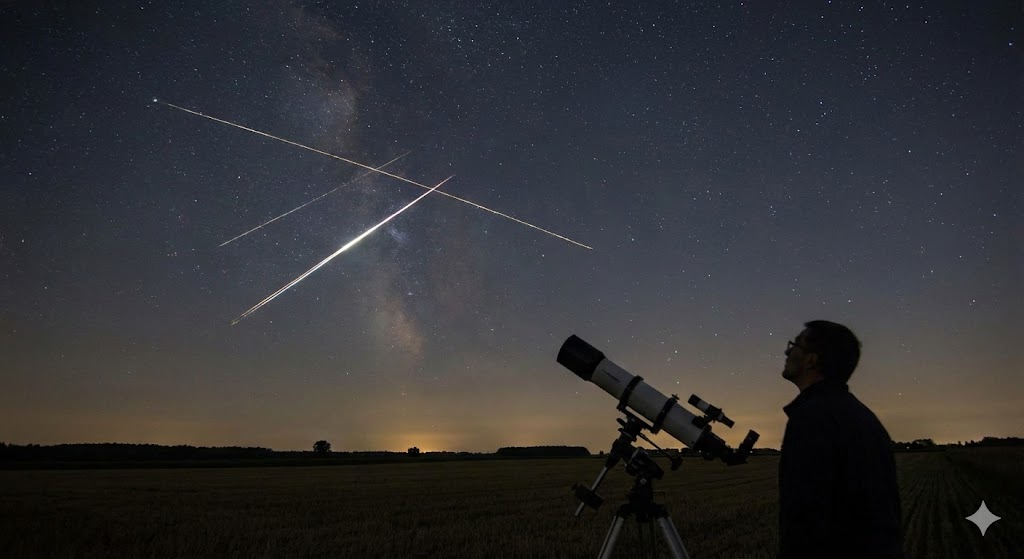
We live in a world where satellites are said to surround the planet like a technological halo. Thousands orbit Earth, we’re told. Some beam Internet, others take pictures, others bounce communication signals across continents. Yet despite this modern mythology, one troubling fact remains: no amateur astronomer has ever directly observed a satellite in space. Not through telescopes, not through binoculars, not through high-zoom cameras. The objects that supposedly fill our skies simply never appear.
Astronomy is one of the most passionate and democratized sciences on Earth. Millions of hobbyists own telescopes powerful enough to view the rings of Saturn, the clouds of Jupiter, and craters on the Moon. They can track asteroids, eclipses, star clusters, and even distant galaxies. But what they cannot see — and never have — are satellites floating in orbit. The silence is striking. For something claimed to exist in such vast numbers, their absence is overwhelming.
NASA insists there are more than 5,000 satellites currently active, with tens of thousands more inactive and drifting. Starlink alone supposedly has thousands of small satellites forming a megaconstellation. If this were true, the night sky should be littered with visible lights and fast-moving objects. Telescopes should capture countless reflections and silhouettes. But they don’t. Ask any amateur astronomer and they’ll tell you the same thing: the sky looks exactly as it always has — stars, planets, and the occasional airplane.
The few “satellite trains” that people sometimes record, especially after Starlink launches, behave oddly. They glow brightly for a short time, then mysteriously fade from visibility entirely. These objects never appear again in predictable orbits. Their fleeting presence raises more questions than answers, especially when they vanish without trace. If thousands of satellites orbited Earth at all hours, they should cross the sky constantly. Instead, people struggle to spot even one.
When astronomers attempt to photograph the region of space where satellites are supposed to be, they capture nothing but darkness. Long-exposure images show stars streaking across the sky in graceful arcs, yet not a single satellite crosses the frame. The absence is so dramatic that it has become an unspoken embarrassment among professional and amateur observers alike.
Even more suspicious is the behavior of telescopes at extremely high magnification. When pointed at deep-sky objects, a telescope with a wide enough field should occasionally catch a satellite passing through its view. Yet observers can spend years scanning the sky without seeing a single one. They witness birds, insects, planes, meteors, and atmospheric anomalies — but not the countless machines that supposedly orbit just a few hundred miles overhead.
NASA’s explanation is that satellites are too small, too dark, and too distant. But this contradicts the claims made about satellite imagery, solar panels, and communication range. If satellites can beam high-speed Internet across continents, reflect massive solar arrays toward the Sun, and capture Earth in high-definition images, then they should be visible through amateur optics. Yet their invisibility persists.
This absence becomes more puzzling when we consider that satellites are said to occupy predictable orbits. Amateur astronomers can track Jupiter’s moons, which are hundreds of millions of miles away. They can predict binary star rotations with extraordinary accuracy. Yet they cannot track satellites that are supposedly just above the atmosphere. Something about this picture does not add up.
The truth may be simpler: satellites, as we imagine them, may not exist in the way we are told. Much of modern communication likely relies on ground-based towers, underwater cables, and high-altitude balloons — technologies that have been quietly present for decades. The satellite narrative may serve more as marketing and mythology than physical reality.
The night sky does not lie. It reveals stars, planets, galaxies, and comets — all visible, all trackable. But it does not reveal thousands of metal machines orbiting at high speed. No telescope captures them. No astronomer counts them. No independent observer confirms their presence.
And so the question becomes unavoidable:
If satellites fill our sky…
Why can no one see them?
Perhaps the sky is emptier than we think. Perhaps the technology we believe in is not where we think it is. And perhaps, like many aspects of modern space lore, satellites exist more in diagrams and animations than above our heads.
The silence of the stars speaks louder than the claims of space agencies. And it tells us this: the sky we observe does not match the sky we are taught to imagine.