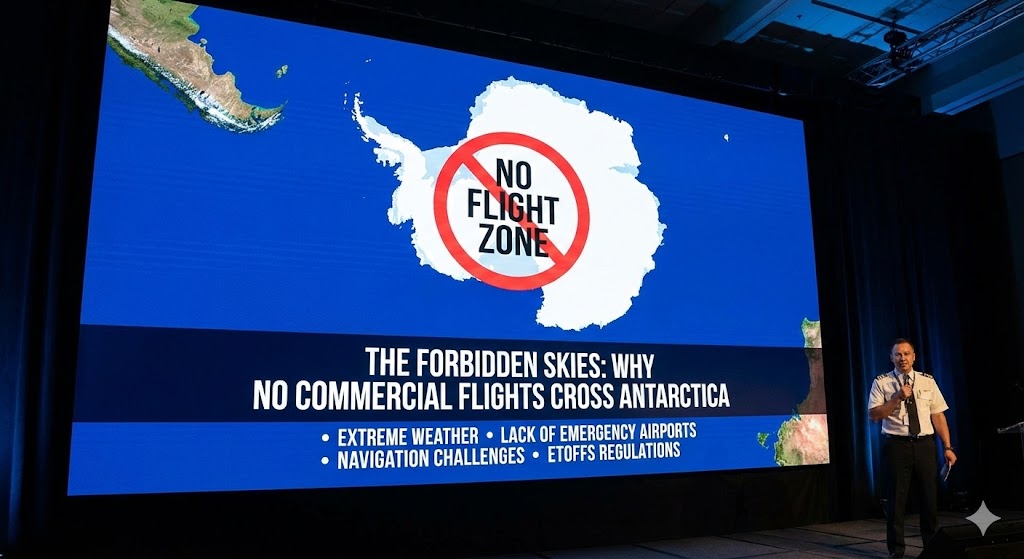
If the world is a globe, one simple fact should be obvious: flying over Antarctica would be the most efficient way to travel between continents in the Southern Hemisphere. A straight line across the South Pole would dramatically shorten routes between countries like Australia, South Africa, Argentina, and New Zealand. Yet despite decades of technological advancement, modern jets, global navigation systems, and safe long-haul aircraft, no commercial airline on Earth flies over Antarctica.
In an age when planes cross oceans, mountains, deserts, and war zones, the complete absence of regular passenger flights over an entire continent is astonishing. The skies over Antarctica remain empty, untouched, and mysteriously avoided. The question is: why?
Airlines provide several explanations, and on the surface they may seem reasonable — extreme cold, lack of emergency airports, poor weather, and navigation difficulties. But these excuses quickly fall apart under scrutiny. Commercial aircraft routinely fly over regions far colder than Antarctica’s coastlines. They cross the Arctic, Siberia, Greenland, and the Himalayas. Some routes even take them over uninhabited oceans where emergency landings would be impossible. If extreme conditions were a true barrier, half of today’s long-haul routes would not exist.
Fuel freezing? Modern jet fuel is engineered to withstand temperatures far below what planes experience on transpolar routes. Emergency landing concerns? Airlines fly nonstop for 16–18 hours over open water with no diversion airports in sight. Dangerous weather? Antarctica has predictable summer windows with calmer conditions — yet no flights occur even then.
The deeper we investigate, the clearer it becomes that these reasons are convenient, not convincing.
The truth is that airlines avoid Antarctica not because they cannot fly there, but because they must not fly there. The continent is surrounded by strict airspace rules, international restrictions, and flight path limitations that do not exist anywhere else on Earth. Any airline wanting to cross the South Pole faces a wall of bureaucratic and political barriers so dense that the route becomes impossible, regardless of the plane’s capability.
This paradox raises more questions than answers. Why would nations restrict air travel over a region supposedly covered in nothing but ice? Why should a frozen desert require special permission and multilayered approval that surpasses even war zones and nuclear facilities? And why has no airline, no matter how daring or innovative, ever pushed to open such a dramatically shorter and more profitable route?
Flat Earth researchers argue that the reason is simple: crossing Antarctica would expose inconsistencies in the globe model. A direct flight across the South Pole would reveal distances that do not match official figures. It could expose the shape of the continents in ways that contradict modern maps. And if Antarctica is not a continent at the bottom of a sphere, but rather the ring of ice surrounding the world, then polar routes would reveal a world much larger than we are taught — or perhaps structured in a way that mainstream models cannot explain.
There is also the question of navigation. GPS systems behave strangely at the extreme south, and flight tracking becomes unreliable or unavailable. Maps of Antarctica are notoriously inaccurate, distorted, and incomplete. Aviation authorities discourage polar routes not because of weather, but because of “unpredictable magnetic behavior.” Yet aircraft routinely fly over the magnetic North without issue. Why is the South different?
Then there’s the Antarctic Treaty, the world’s only agreement that forbids free travel, free exploration, and free access to an entire continent. A treaty signed by nations that usually disagree on everything — war, borders, politics — somehow agreed unanimously that Antarctica must remain off limits. In such a restricted environment, flights that pass overhead would violate the controlled secrecy of the region.
Commercial airlines are businesses, not scientific organizations. They follow rules, and the rules around Antarctica are designed to keep people — and aircraft — far away. The result is a no-fly zone hiding in plain sight, protected by excuses that collapse when compared with the reality of modern aviation.
In the end, the absence of commercial flights over Antarctica is not a matter of technology or safety. It is a matter of control. Someone has decided that the skies over Antarctica must remain empty, silent, and undisturbed. And perhaps the greatest clue lies not in what airlines say, but in what they do not say — that the forbidden skies of Antarctica may be hiding the true nature of our world, one flight path at a time.