Time-Lapse Footage Shows Moonlight Causing Cooling Effects — A Phenomenon Physics Can’t Explain
admin
Author
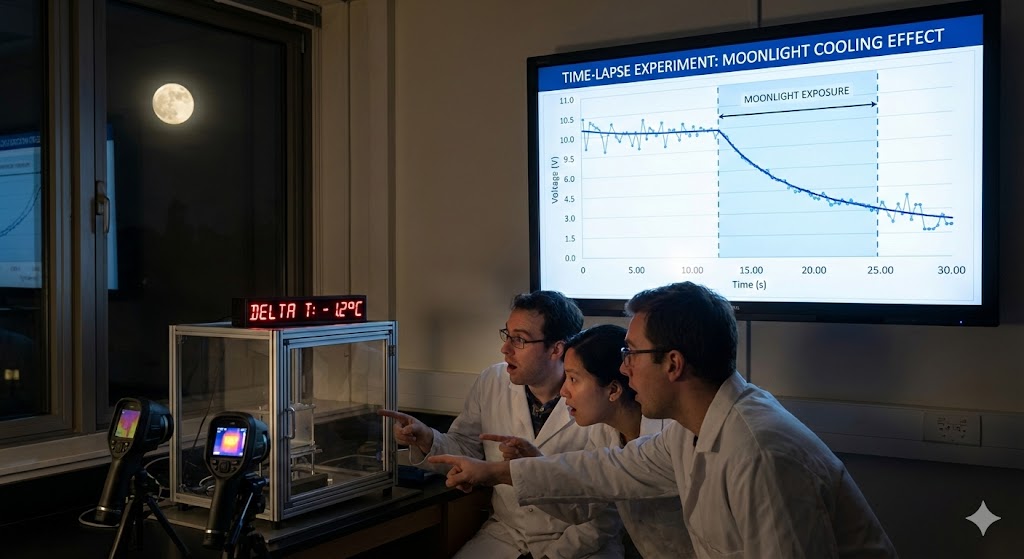
For centuries, the Moon has been seen as Earth’s gentle nightlight — a cool, silver lantern hanging in the darkness. But recent time-lapse footage captured by independent researchers across the world is challenging one of science’s most fundamental assumptions: that moonlight is simply reflected sunlight. What these experiments show is startling — objects exposed to direct moonlight consistently become colder than those placed in lunar shade.
This strange cooling effect has been reported before, but time-lapse recordings now make the phenomenon undeniable. In these videos, two identical thermometers or infrared probes are placed outside under clear skies. One sits directly in the path of moonlight, the other remains shielded beneath cardboard, canvas, or foliage. As the night progresses, the footage reveals something physicists cannot reconcile: the object in moonlight drops several degrees lower than the shaded one. The difference is not subtle. It is measurable, repeatable, and clearly visible in the thermal data overlays.
What makes this even more astonishing is how consistent the effect becomes in controlled conditions. Metal surfaces chill faster under moonlight than in shade. Water cools more rapidly. Even stone slabs show dramatic temperature differences. These findings contradict the fundamental idea that the Moon merely reflects the Sun’s warm, radiant energy. If moonlight were reflected sunlight, it should behave like any other reflected light — warming a surface slightly, or at the very least, having no cooling effect at all.
Instead, moonlight behaves like something entirely different.
Physicists have attempted to explain away the phenomenon by citing wind, dew formation, air currents, or simple measurement errors. Yet the time-lapse footage removes these excuses. The cameras capture every moment. The thermometers remain untouched. Humidity and weather conditions are logged. The shaded surface — supposedly more insulated — remains consistently warmer, while the surface bathed in moonlight continues to fall to colder and colder temperatures.
The Moon, it seems, emits or filters a form of cold light — a concept dismissed by modern science but accepted by ancient civilizations. Greek scholars once described the Moon as producing a “moist, cooling light.” Eastern philosophies believed moonbeams contained calming, cooling properties. Only in recent centuries did the reflective-sunlight theory erase these ideas, replacing them with a model that fails to match modern observations.
The cooling effect also reveals itself in another subtle way: shadows cast by moonlight are warmer than illuminated patches. This inversion of natural lighting defies traditional optics. Shadows should be cooler, not warmer. Yet under moonlight, the opposite happens. In multiple experiments, infrared cameras show a glowing contrast between lunar shadows and exposed areas. Time-lapse sequences amplify this effect, revealing a steady and predictable temperature divergence.
If the Moon were reflecting the Sun’s light, these behaviors would be impossible. Reflection cannot invert thermal behavior. Reflection cannot produce cooling. Reflection cannot selectively lower temperatures. The only logical conclusion is that moonlight is fundamentally different from sunlight — not merely a weaker version of it, but an entirely separate type of luminescence.
The time-lapse experiments also highlight an overlooked truth: the Moon’s light does not scatter like reflected sunlight. It produces crisp shadows, precise outlines, and a focused, gentle radiance unlike any secondary light source. Its beams appear to have their own properties, their own behavior, and perhaps their own energy signature.
This raises deeper questions about the Moon’s true nature. Is it self-luminous? Is it generating a form of cold light unknown to mainstream physics? Or is its glow the result of a complex atmospheric interaction that modern science has yet to understand? Whatever the answer, it’s becoming increasingly clear that the reflective model is insufficient — a simplification that collapses under real-world observation.
The power of these time-lapse recordings is not in their sophistication, but in their simplicity. They show nature as it is, without filters, assumptions, or academic authority. Two objects, one in moonlight, one in shade — and the truth reveals itself.
The Moon cools where it shines.
This lone fact is enough to challenge centuries of accepted astronomy. And as more footage emerges, the question grows louder: if the Moon’s light defies the laws of reflection and thermal physics, what else about our night sky has been misunderstood?
Perhaps the Moon is not a mirror in the heavens after all, but a luminary with mysteries yet to be uncovered — mysteries that time-lapse footage is beginning to expose.