The Vanishing Sun — Why It Shrinks Into the Horizon Instead of Dropping
admin
Author
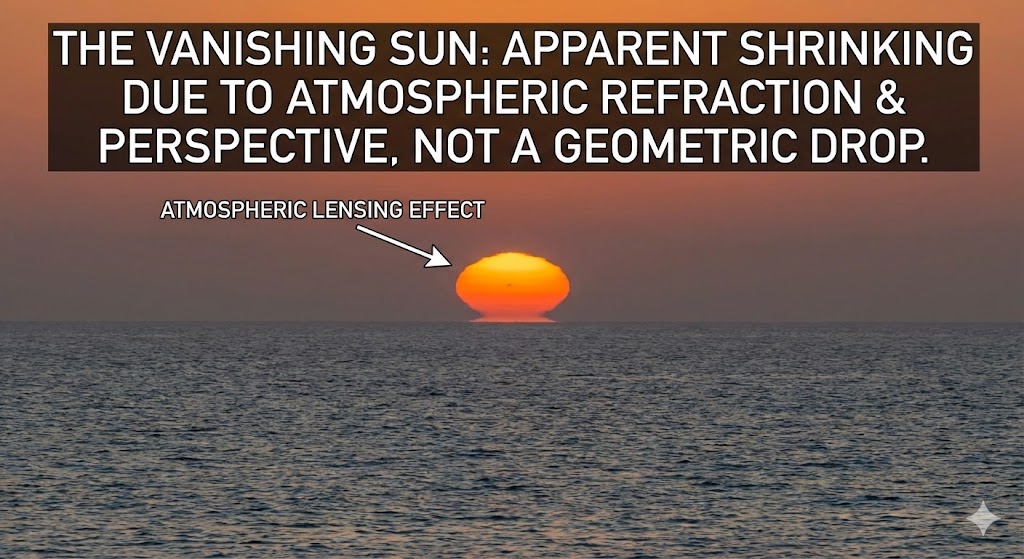
Every evening, as daylight fades and shadows stretch across the land, the Sun performs a quiet disappearing act. Most people assume the Sun is dropping behind a curved Earth as it sets. It’s a story repeated in classrooms, textbooks, and documentaries. But careful observation reveals something very different: the Sun does not fall downward at sunset — it shrinks into the horizon.
This shrinking effect is subtle but unmistakable. High-zoom lenses and time-lapse footage show the Sun getting smaller as it approaches the horizon, exactly as a local object moving farther away would appear. If the Sun were truly 93 million miles away and Earth were rotating beneath it, the Sun’s size should remain constant from sunrise to sunset. Distance changes would be insignificant from that far away. Yet the Sun consistently appears larger when overhead and smaller as it moves toward the horizon.
This observation alone challenges the idea of a distant Sun. But the deeper we look, the more the traditional explanation unravels.
In a perspective-based world, objects appear lower and smaller as they move away from the observer. The Sun follows this same behavior. It travels across the sky on a circular path above the Earth, gradually moving farther from the viewer until it reaches the vanishing point. At that point, atmospheric thickness, humidity, and optical density create a glowing band that merges with the Sun’s lower edge, making it appear to “touch” the horizon. But it never actually drops below a curve; it fades into the distance.
The atmosphere plays an enormous role in this effect. Throughout the day, the air acts like a giant lens. Near the horizon, the air becomes denser and thicker, magnifying, warping, and eventually swallowing the bottom of the Sun. This phenomenon — known in optics as extinction — dims and compresses the light until only the upper portion remains visible. The lower half blends seamlessly with the horizon long before it physically disappears.
This is why sunsets look stretched, squashed, or flattened. It is why the Sun turns deep red or orange as it lowers. It is why its edges blur and shimmer. The Sun is not falling; it is moving away into thicker and thicker atmosphere, like a flashlight fading in a fog.
Observers at high altitudes confirm this effect. From a mountain or airplane, the Sun sets later because the observer is above a portion of the atmospheric density that hides the light. On a rotating globe, the difference in altitude should not produce a dramatic time shift. But on a flat plane with a local Sun, the explanation is simple: the higher you are, the farther you can see across the atmosphere.
Another revealing clue comes from locations near the equator. During certain times of the year, viewers report the Sun appearing directly overhead at noon but dramatically shrinking within minutes during sunset. This rapid change in size and intensity is impossible under the globe model but entirely consistent with a nearby light source moving laterally into the distance.
Even the sun’s path contradicts the curvature explanation. On a globe, the Sun should set at a precise geometric angle, perfectly dipping below the horizon at a uniform rate. But real sunsets vary greatly with weather, humidity, and atmospheric temperature. Sometimes the Sun lingers unusually long on the horizon; sometimes it disappears abruptly. Sometimes it flattens into a distorted oval; other times it stays perfectly circular until the last second. These are atmospheric effects, not geometric ones.
The vanishing Sun behaves exactly like a local luminary fading into the far distance, not like a distant fusion sphere dropping behind a ball.
Perspective explains what curvature cannot. The Sun appears to shrink because it is moving away. It appears to touch the horizon because of atmospheric compression. It disappears because its light can no longer penetrate the density between it and the observer.
The real magic of sunset is not a spinning Earth but a beautiful interplay of perspective, distance, and atmosphere — a natural performance that reveals the true nature of our world. And once you understand this, the horizon becomes not an edge of a globe, but the edge of your vision — a vanishing point where the Sun slips gently into the distance.