The Shadow Library of Timbuktu: How Ancient Knowledge Was Hidden in the Desert
admin
Author
The Forgotten City of Knowledge
Centuries ago, Timbuktu in Mali was more than a name whispered with mystery — it was a thriving hub of knowledge, wealth, and trade. By the 15th and 16th centuries, Timbuktu had become a beacon of scholarship, home to scholars, poets, and astronomers. Its libraries held hundreds of thousands of manuscripts, handwritten books that contained ideas about medicine, astronomy, law, mathematics, religion, and philosophy.
These manuscripts weren’t just relics — they were evidence that Africa’s intellectual tradition stretched back further than many imagined, rivaling the great libraries of Alexandria or Baghdad.
But history almost erased them.
A Threat of Fire and Ruin
In 2012, as militant extremists advanced on Timbuktu, they began burning shrines, monuments, and anything that represented cultural heritage. Their aim was to wipe out what they saw as “un-Islamic” — and the manuscripts, which contained everything from astronomy to mysticism, became prime targets.
To the militants, they were heresy. To the world, they were irreplaceable treasures.
As the extremists approached, librarians, scholars, and everyday citizens realized they had a choice: watch centuries of wisdom go up in flames, or risk their lives to save it.
The Secret Smuggling Operation
What happened next was nothing short of heroic.
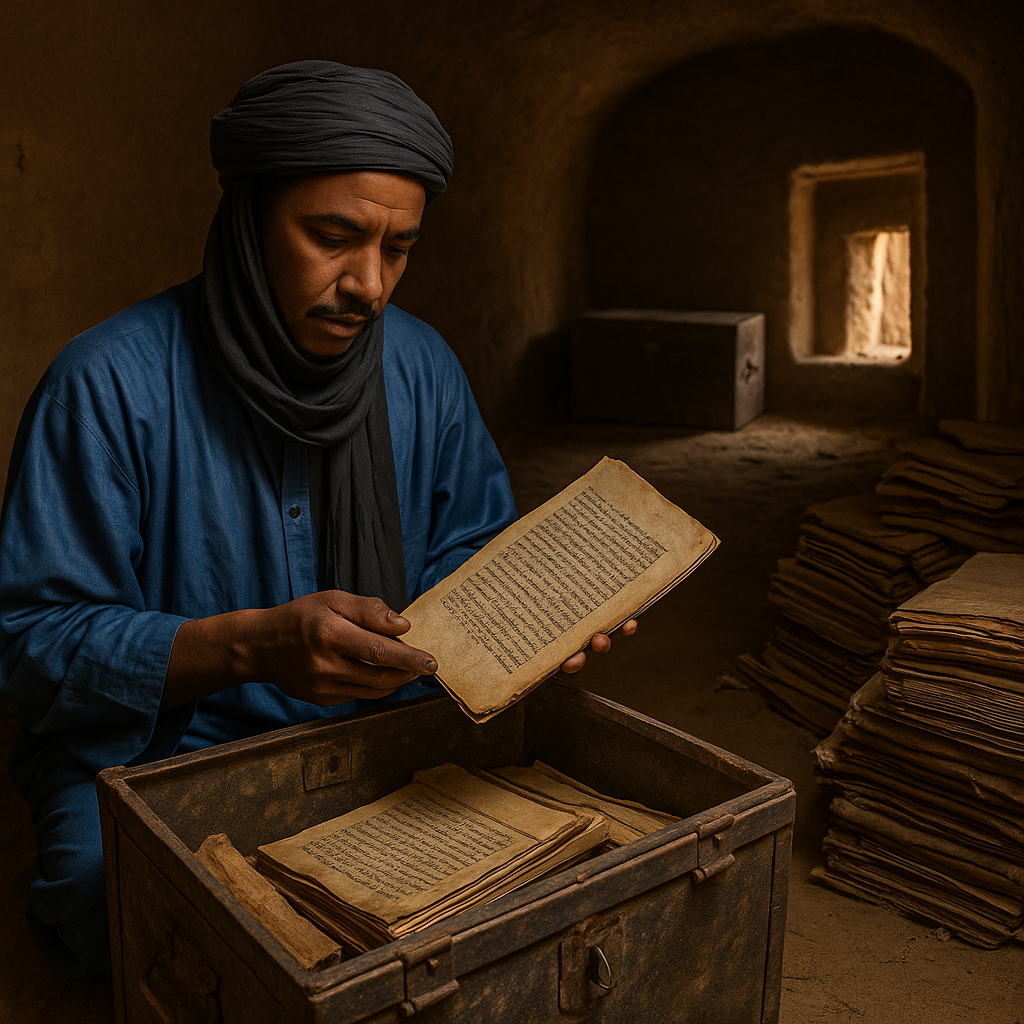
Led by Abdel Kader Haidara, a mild-mannered librarian with a fierce devotion to Timbuktu’s heritage, ordinary Malians launched a covert mission. Using metal trunks, footlockers, and old rice sacks, they quietly packed up manuscript after manuscript.
At night, families carried them through alleyways. By day, they disguised them among trade goods. Some were loaded into canoes and smuggled down the Niger River. Others were hidden in dusty attics, under floorboards, or inside desert homes.
It was dangerous work. At any point, discovery by the extremists could mean death. But the people of Timbuktu pressed on, driven by a shared belief: these manuscripts belonged not only to Mali, but to humanity.
The Shadow Library
By the time the extremists began burning libraries, the real treasures were already gone. Tens of thousands of manuscripts had vanished — not destroyed, but hidden.
This network of secret hiding places became known as “The Shadow Library of Timbuktu.”
Even today, many of these manuscripts remain scattered in secret stashes across Mali. Some are still being carefully restored, digitized, and catalogued. But many remain fragile, crumbling, their ink fading with the desert heat.
What Was Saved
Among the rescued works are treatises on:
-
Medicine — early writings on surgery, anatomy, and herbal cures.
-
Astronomy — charts of stars and calculations centuries ahead of Europe.
-
Law and Philosophy — debates on ethics, governance, and justice.
-
Mysticism and Poetry — writings on spirituality, love, and human nature.
Together, they represent a forgotten chapter of African history: proof of an intellectual tradition that challenged stereotypes of Africa as a “dark continent.”
Knowledge in the Shadows
The Shadow Library of Timbuktu is more than a story of old books. It’s a story of people who refused to let their culture, history, and identity be erased.
When fire threatened to consume centuries of knowledge, ordinary Malians fought back not with weapons — but with courage, secrecy, and faith in the written word.
The manuscripts of Timbuktu remind us that knowledge is as fragile as paper, but as powerful as fire.