The Pyramid Paradox — Why Ancient Structures Defy Gravity, Astronomy, and the Globe Model
admin
Author
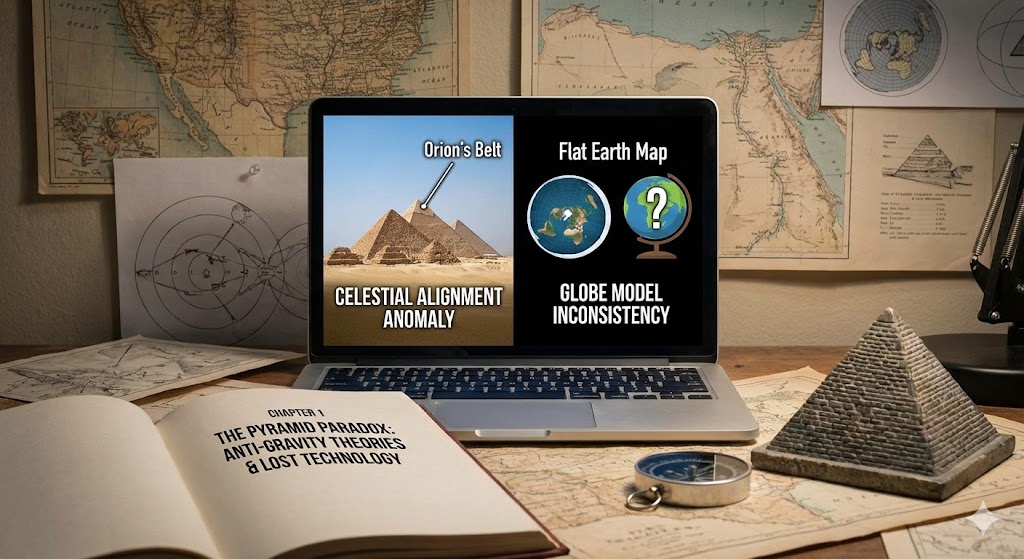
For thousands of years, the Great Pyramids have stood like silent guardians on the Giza Plateau — enormous, immovable, mathematically perfect. Built so precisely that modern engineers still struggle to replicate them, the pyramids are more than ancient tombs. They are monuments to a world that understood geometry, astronomy, geography, and construction at a level modern science refuses to acknowledge.
But beneath their limestone skin lies a deeper secret — one that directly challenges the globe model, modern cosmology, and even our timeline of human civilization.
The pyramids are not random structures. They are aligned with machine-like precision. Their sides match the cardinal directions so perfectly that the error margin is smaller than most digital compasses today. Their layout matches the constellation Orion. Their proportions encode Earth’s circumference, the speed of light, pi, phi, and celestial cycles.
But here is the paradox:
These alignments only make sense on a flat, fixed Earth.
If Earth were spinning at 1,000 mph, wobbling at 23.5°, orbiting at 67,000 mph, while hurtling through the galaxy at half a million miles per hour, how could a civilization with no satellites, no telescopes, no calculus, and no “modern science” align structures to the heavens with sub-millimeter precision — for thousands of years?
Why do the stars still align with the pyramids today, unchanged, if the universe is expanding and the Earth is wobbling through space?
The celestial mapping embedded into Giza behaves like a system built on a stationary sky and fixed star rotation — not a drifting, swirling cosmos.
Then comes the geographical anomaly. The Great Pyramid sits at the mathematical center of all landmass on Earth.
Not the globe — the landmass.
Its location marks the intersection of the longest lines of latitude and longitude that intersect land, forming a perfect global anchor.
To believe this was accidental is to ignore probability itself.
To believe it was intentional is to accept that someone — some ancient group — knew the true layout of Earth.
And the layout encoded in the pyramid is not spherical.
Engineers have long noted that the structure behaves like a geodetic marker, a surveying instrument of impossible sophistication. It seems to map a world with straight-line geometry, not curved geometry. On a globe, the measurements embedded in the pyramid produce bizarre distortions. On a flat projection, they align beautifully.
Then there is the construction problem — the signature that defies gravity.
The pyramid blocks weigh up to 80 tons each. Modern cranes cannot lift them. Modern logistics cannot transport them across desert sands. The pyramid is aligned to true north with a precision that modern engineers struggle to achieve — even with lasers, GPS, and digital mapping.
Yet the builders — whoever they were — did it flawlessly.
If gravity behaved exactly as modern science claims, constructing this monument with its perfect angles and joints would have been nearly impossible. Stones fitted so tightly that a razor blade cannot pass between them contradict the idea of crude copper tools and sledges.
But if gravity is weaker, localized, or fundamentally different from the modern model — as many flat-Earth researchers propose — the engineering begins to make sense.
Finally, there is the energy paradox.
The Great Pyramid is not built like a tomb.
It’s built like a machine.
Granite chambers with piezoelectric properties.
Vent shafts aligned with star paths.
Electromagnetic signatures detectable even today.
Water erosion patterns underneath the base, hinting at hydraulic function.
Nothing about it behaves like a burial structure.
Everything about it behaves like a power device, an observatory, or a geodetic tool — something meant to interact with the environment, with the sky, with the Earth itself.
Modern archaeologists avoid these questions because the answers challenge the foundational assumptions of human history.
But the truth remains:
The pyramids encode a cosmology older and more advanced than our own — a cosmology based on a stationary Earth beneath a structured sky. Their mathematical perfection mocks the idea of prehistoric ignorance. Their astronomical alignments dismantle the narrative of cosmic chaos. Their engineering contradicts the idea of primitive tools.
The Great Pyramids do not honor death.
They honor knowledge — forbidden, ancient, and incompatible with the world we are taught to accept.
The more you study them, the more obvious it becomes:
The builders understood the true shape of the world.
And the modern model does not match it.