The Moon’s Strange Light — Why It Cannot Be Reflected Sunlight
admin
Author
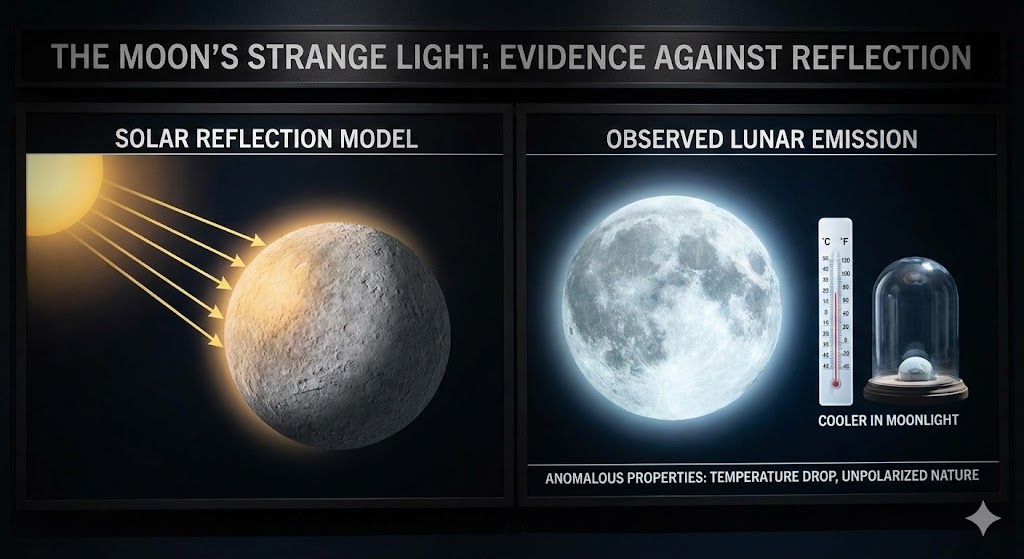
For generations, we have been told that the Moon shines only because it reflects sunlight. The story is simple: sunlight travels 93 million miles, hits the Moon’s dusty surface, and bounces back toward Earth. This explanation seems harmless enough — until you actually study moonlight. Because the more closely you observe it, the more obvious it becomes that the Moon’s glow behaves nothing like reflected light.
Moonlight has a strange, ethereal quality. It is cool, crisp, and sharp, unlike the warm yellow radiance of the Sun. It casts shadows with astonishing clarity, yet remains soft and silvery. Its illumination feels almost otherworldly, as if the Moon were glowing from within rather than echoing the distant Sun. And this isn’t just poetic language; it’s observable physics.
One of the most startling clues is the temperature of moonlight itself. Experiments performed by independent researchers, hobbyists, and curious observers all point to the same conclusion: objects placed in direct moonlight are consistently colder than objects placed in the shade at night. This behavior breaks the laws of reflected light. A mirror reflecting sunlight does not cool objects — it warms them. Car headlights reflecting off the pavement do not lower the temperature — they raise it. Yet moonlight seems to do the opposite.
If moonlight is reflected sunlight, it should behave like the Sun’s light in every measurable way, only weaker. But it doesn’t. It behaves like a different kind of light entirely.
Then there is the issue of brightness. The Moon’s surface is covered in dark, charcoal-like regolith with a reflectivity of only about 12 percent — roughly the same as worn asphalt. It simply should not be capable of reflecting enough light to illuminate the Earth as brightly as it does. For the Moon to shine as powerfully as it does through reflection alone, it would need to be as reflective as snow or polished metal. Yet it is neither. The official explanation stretches physics to its limit.
The geometry of moon phases adds even more confusion. During a crescent Moon, the Sun is supposedly illuminating only a small portion of the lunar surface while the rest remains dark. But photographers often capture the dark portion faintly glowing — something called “Earthshine.” The explanation insists this dim light is sunlight reflecting off Earth, bouncing back to the Moon, and then returning again to Earth. This requires not one but two reflections across millions of miles, all from Earth’s uneven, cloud-covered surface. Yet the lighting appears consistent, unnatural, and often far brighter than what such a complicated reflection should produce.
Even more troubling is the direction of the shadows on the Moon. During certain phases, the angles do not align with where the Sun is positioned in the sky. Astronomers wave this away with complicated terminology, but the visual reality is simple: the bright side of the Moon is not always facing the Sun as it should if the light were solely reflected.
The Moon also exhibits a strange behavior called “terminator line anomaly,” where the line separating light from dark does not follow expected geometric curvature. It bends, warps, and behaves inconsistently, as if the source of illumination were closer, more localized, and interacting with the Moon directly rather than striking it from millions of miles away.
These anomalies point to a different understanding of the Moon — one in which it is not a passive reflector of the Sun’s rays but an active, self-luminescent body, generating its own unique form of light. Such a Moon fits more naturally into a local cosmology where the Sun and Moon are both smaller, nearer, and designed to complement each other. The Sun warms by day, casting bright, hot light across the land. The Moon cools by night with its soft, silvery glow.
The idea of a glowing Moon is not new. Ancient civilizations believed the Moon emitted its own light, each culture describing it not as a mirror but a lamp. Only in recent centuries did science replace this view with the reflective model — one that fails to explain the Moon’s temperature effects, shadow geometry, brightness, and atmospheric interaction.
Moonlight behaves as if it is something unique, something fundamentally different from sunlight. It cools. It sharpens shadows. It glows softly even when geometry says it shouldn’t. It does not perform like reflected light; it performs like a source of light.
Perhaps the Moon is not a dusty rock reflecting distant rays. Perhaps it is something more precise, more intentional, more local — a luminary designed to rule the night. And if that is true, then the sky above us is far more intricate and extraordinary than we have ever been led to believe.