The Missing Spin — Why Earth’s Alleged 1,000 mph Rotation Leaves No Detectable Evidence
admin
Author
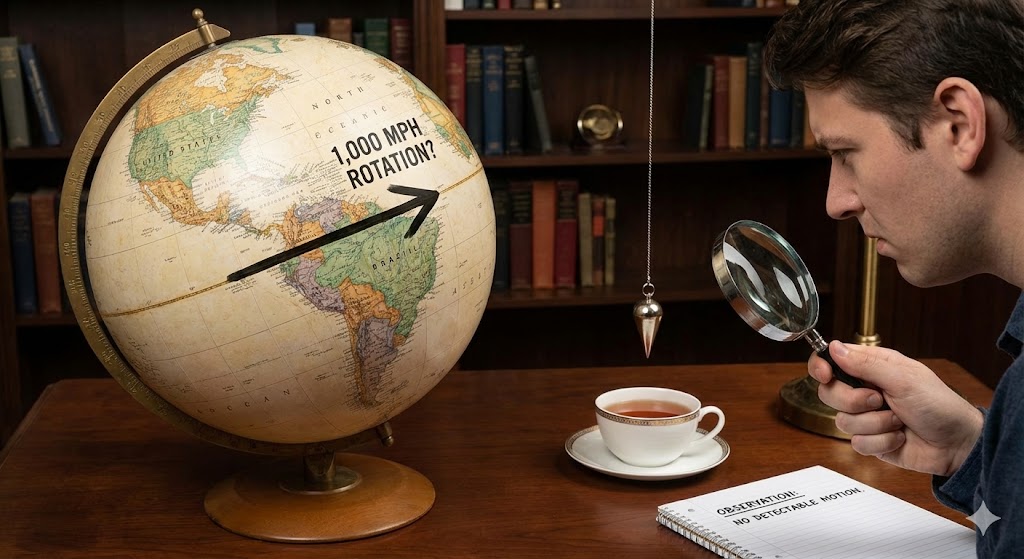
For over a century, schoolbooks, documentaries, and space agencies have repeated a single extraordinary claim: Earth spins at nearly 1,000 miles per hour at the equator. It rotates so rapidly that every point on the surface is hurtling eastward faster than a jetliner. And yet the world beneath our feet feels motionless, silent, completely still.
This contradiction lies at the heart of one of the greatest assumptions in modern science. If our planet truly spins at such an enormous speed, the evidence should not be subtle — it should be overwhelming. We should feel movement. We should measure drift. Every object, every aircraft, every body of water should reveal the world’s rotation in unmistakable ways. Instead, nothing does.
The absence is not just curious. It is foundational. There is no experiment in everyday life that detects or confirms a 1,000 mph spin. There is no sense of motion. No bending of the horizon. No displacement of the atmosphere. No measurable deflection that matches what physics predicts. The world behaves exactly as it would if it were stationary.
Consider water — one of the most sensitive mediums on Earth. Lakes do not bulge or drift. Rivers do not bend eastward. Oceans do not slosh against continents. A spinning globe should exhibit enormous centrifugal effects, especially at the equator. Yet water rests perfectly level, unmoved by any supposed rotation. It mirrors stillness, not motion.
Gyroscopes tell the same story. These instruments, capable of detecting even the tiniest rotational force, remain steady and unmoved. High-precision gyros used in aviation and engineering detect vehicle rotation instantly but show no response to Earth’s alleged spin. If the ground beneath a plane or laboratory truly rotated at 1,000 mph, the gyro should reveal it. Instead, it behaves as though the world is still.
Pilots, too, experience a silent contradiction. A plane flying 500 mph east or west should be dramatically affected by the Earth’s rotation beneath it. Traveling east should shorten flight times, while traveling west should double them. Yet flights obey no such pattern. An aircraft leaving New York for London does not race ahead with the Earth’s spin, nor does the return flight struggle against a 1,000 mph headwind. The atmosphere, we are told, “rotates with the Earth” — but this explanation introduces more problems than it solves. How does the atmosphere remain perfectly attached to a spinning globe without friction? Why does wind ignore this rotation entirely? Why do balloons drift unpredictably if the air is supposedly tied to the ground’s motion?
Even long-range artillery exposes the missing spin. A shell fired north or south should land miles off target due to the Coriolis effect, but battlefield records show no such dramatic deviations. The corrections that exist are small enough to be attributed to wind, temperature, and barrel wear. If Earth truly rotated at high speed, every artillery table, every submarine torpedo calculation, and every naval operation would require massive adjustments. They do not.
Weather patterns also defy rotational expectations. A spinning ball generates specific circulation systems and predictable turbulence. But hurricanes, cyclones, and jet streams behave irregularly, inconsistently, and in ways that do not match a smooth 1,000 mph rotation. The atmosphere moves chaotically, not uniformly. It obeys local thermal forces, not global spin forces.
And then there is human perception. We feel motion constantly — in cars, elevators, boats, and airplanes. When you accelerate, your body knows it. When you turn, you feel the curve. When you rotate, your inner ear responds immediately. Yet on a world rotating at Mach 1.3, there is no sensation whatsoever. The ground does not move beneath us. Buildings do not lean. Trees do not bend westward. Birds do not compensate for spin. Snipers do not recalibrate aim for a rotating battlefield. Water towers, skyscrapers, suspension bridges, and delicate instruments experience no rotational stress.
The world offers no hint of the enormous movement we are told defines our planet. Even time-lapse footage of the night sky shows the opposite story — stars circling above us with elegant precision, as if the heavens move and the Earth remains still. Every culture prior to the modern era described a stationary world not because they lacked intelligence but because direct observation supported that conclusion.
The missing spin is not a minor oversight — it is a foundational contradiction. If Earth truly rotated at 1,000 mph, the evidence would be everywhere. Instead, the silence is absolute. Everything behaves as though Earth is fixed, stable, motionless — the unmoving plane described by centuries of engineers, astronomers, sailors, and civilizations.
The question is no longer “Why can’t we feel the spin?”
The question is: Why does nothing — not water, not air, not machines, not physics — show that the spin exists at all?
Until that evidence appears, the world remains what it appears to be: still, grounded, and stationary beneath the sky.