The Lost Golden Age — Evidence of Ancient Civilizations More Advanced Than Ours
admin
Author
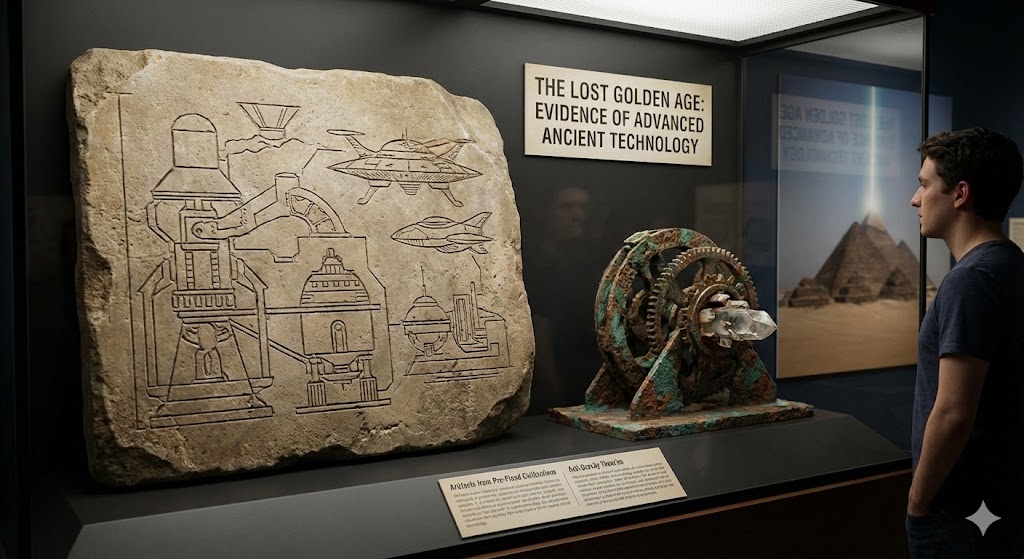
Modern history paints a simple story: humans began as primitive hunters and gradually developed into the technologically advanced societies we have today. Civilization, we are told, is only six thousand years old. But scattered across Earth are ruins, monuments, and mathematical masterpieces that don’t fit this narrative. They whisper of an older world — a forgotten age when humanity possessed tools, knowledge, and engineering abilities that rival, or surpass, our own.
This is the Lost Golden Age, buried under layers of politics, academic pride, and selective archaeology.
All around the world stand impossible structures — megaliths weighing hundreds of tons, foundations carved from single stones, joints so flawless that even modern lasers struggle to replicate them. Ancient Egypt’s core masonry uses blocks that no modern crane can lift. The Osirion at Abydos shows machining marks a thousand years “too early.” Peru’s Sacsayhuamán fortress contains stones shaped like puzzles, fitted with such precision that a blade cannot slip between them.
These monuments do not behave like the work of primitive societies. They behave like the remnants of an advanced world with knowledge of materials science, mathematics, and energy systems long forgotten.
Perhaps the most famous enigma lies at Göbekli Tepe, a site older than the pyramids by 7,000 years. Carved pillars weighing up to 20 tons form precise stone circles with astronomical alignments. According to mainstream history, humans at that time were supposed to be simple hunter-gatherers. Instead, they built a temple complex so sophisticated that even modern engineers marvel at its geometry.
Then we turn to ancient maps — Piri Reis, Oronteus Finaeus, Buache — all showing coastlines and landmasses with precision impossible for their time. Some depict Antarctica ice-free, as if drawn long before it froze. Others map the continents with spherical-level accuracy centuries before the invention of telescopes or chronometers.
Where did this knowledge come from?
Who measured these coastlines?
How did medieval cartographers draw lands we only confirmed in the 19th century?
The pattern is unmistakable: the knowledge did not originate with them. They inherited it.
As we look further back, deeper patterns emerge — evidence of catastrophic resets that wiped civilizations off the map. Flood myths appear in nearly every culture. Descriptions of advanced, pre-diluvian societies echo across Sumerian tablets, Hindu scriptures, and Native American oral traditions. They speak of ages when humanity harnessed energy from the Earth, when the stars served as precise calendars, when architecture aligned with celestial grids.
These are not the stories of “primitive” people. They are the fragmented memories of something older, grander, lost.
Modern academia dismisses these clues because accepting them would require rewriting everything — human timelines, technological progression, even our understanding of Earth’s past. It would mean acknowledging that ancient people were not evolving upward from ignorance, but recovering from the ashes of a once-great world.
We see the fingerprints of this forgotten civilization in the uniformity of ancient myths, in the global alignment of sacred sites, in the repeating geometry of temples oceans apart. We see it in unexplained precision — pi, phi, square roots, astronomical cycles encoded in stone by cultures allegedly lacking mathematics.
We see it in the global obsession with the sky — civilizations building structures that mirror constellations, track solstices, and reflect cosmic order. They were not guessing. They were measuring.
But perhaps the greatest mystery is how these civilizations fell. The evidence suggests not a slow decline, but sudden collapse — natural catastrophes, planetary upheaval, floods, earthquakes, perhaps even cosmic events. After each reset, survivors rebuilt with fragments of knowledge, gradually losing the sophistication of their ancestors but preserving traditions, symbols, and architectural patterns.
What we call “ancient history” is not the beginning of human civilization.
It is the aftermath.
The real story lies beneath the ruins, beneath the myths, beneath the academic silence — a story of an age when humanity understood the world far better than we do now. A time when our ancestors worked with a mastery we have forgotten, guided by principles we no longer teach, aligned with celestial mechanics we barely grasp.
The Golden Age did not disappear.
It was buried.
And piece by piece, it is resurfacing.