The Horizon Doesn’t Lie: Why “Water Always Finds Its Level” is the Ultimate Reality Check
admin
Author
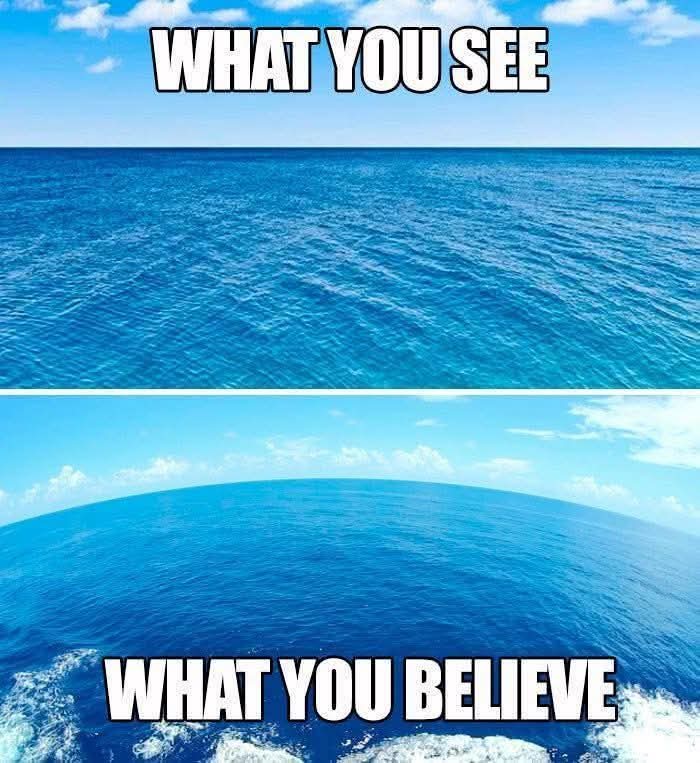
If you stand on a beach and look out at the ocean, your eyes tell you one thing: the horizon is a perfectly straight, horizontal line. There is no dip, no curve, and certainly no “leaning” water. Yet, the mainstream narrative insists that you are standing on a massive ball, spinning at 1,000 mph, where the water is somehow curved into a giant sphere.
The image above perfectly captures the cognitive dissonance required to be a “globturd.” On top, we have What You See: a flat, level horizon that matches every physical observation humans have ever made. On the bottom, we have What You Believe: a fish-eye lens nightmare where the water humps up in the middle.
The Law of Physics: Water Doesn’t Curve
The most basic property of water is its ability to remain level. Whether it’s in a glass, a bathtub, or the Pacific Ocean, the surface of a liquid at rest always seeks a flat, horizontal plane.
-
The Level Test: If you take a spirit level to the beach, it will show you that the horizon is 0° flat.
-
The “Curvature” Math: According to the globe model, the Earth should curve at a rate of 8 inches per mile squared ($8 times text{distance}^2$). Yet, we can see ships, lighthouses, and distant city skylines that should be hundreds of feet “below the curve” if the Earth were a ball.
-
The Fish-Eye Fraud: Every time a “high altitude” balloon or a NASA camera shows a curved Earth, it’s using a wide-angle (fish-eye) lens. Notice how the “curve” changes and even flips upside down as the camera tilts? That’s optics, not geography.
Why Do People Still Believe the Curve?
It’s called “indoctrination.” From the moment we enter kindergarten, we are given a spinning globe to play with. We are told to ignore the evidence of our own senses—that the ground feels stationary and the horizon looks flat—in favor of “complex math” and CGI photos from space agencies that admit their images are composites.
When you look at the ocean, you aren’t seeing the top of a ball; you are seeing the limit of your own perspective. The horizon is simply where the sky meets the Earth at your eye level. As you go higher, the horizon rises with you. On a ball, you’d have to look down to see the horizon as you gained altitude. But you don’t.