The Great Ocean Bulge Mystery: Why the Whole World is NOT Getting Swept Away (And the Moon is a Good Guy)
admin
Author
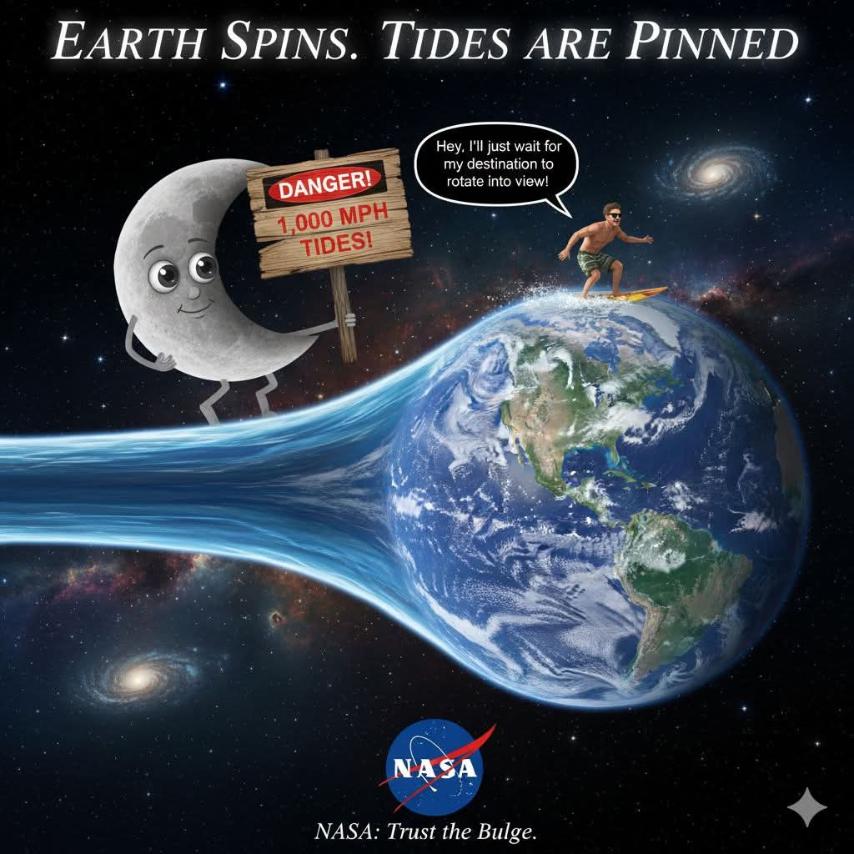
You see some wild things online. Case in point: a meme recently going around that claims Earth’s rotation makes the tides incredibly dangerous. Picture a smug cartoon Moon holding a sign that says, “DANGER! 1,000 MPH TIDES!” and a clueless surfer being swept across the planet.
This is the classic “tide bulge” model. It’s an idea that gets traction because it sounds plausible at first, but it completely falls apart when you look at how things actually work.
So let’s crack this mystery open and explain why we can all enjoy a safe beach day without getting dragged 1,000 miles in an hour.
The Misleading Meme: What It Gets Wrong
The premise of this popular “flat earth” or general-science-denier argument goes like this:
-
The Earth is roughly 24,000 miles around and rotates once a day.
-
That means someone on the equator is moving at over 1,000 mph.
-
If the Moon’s gravity creates a “bulge” of water, and that water is “pinned” (the meme says “pinned,” they mean “staying in place relative to the Moon”), then the solid Earth must rotate through this huge, stationary pile of water.
-
Therefore, the water must rush over the land at 1,000 mph! Run for your lives!
This sounds terrifying. It’s also completely and scientifically wrong.
Here is the one simple fact that shatters this entire argument: The entire Earth—the oceans, the atmosphere, and you—are all part of a single, rotating system.
Let’s Use a Simple Analogy: A Merry-Go-Round
Imagine you’re on a large merry-go-round, representing Earth. It’s spinning. You’re standing on it, not flying off. Why? Because you’re moving at the same speed as the floor beneath you. You’re part of that system. Your relative speed to the merry-go-round is zero.
Now, imagine there’s a small magnetic puck sitting on the floor of the merry-go-round, and someone is standing outside holding a super-strong magnet that pulls that puck towards it.
The gravity from the Moon is like that external magnet. It pulls on the Earth, but especially on the oceans because they’re fluid. This creates the tidal bulges. So far, the model is on the right track.
The mistake in the meme is thinking that the water is somehow disconnected from the Earth, just sitting there stationary like an obstacle in a race.
Water vs. Spinning Sphere: The Reality of Friction
Water is fluid, not solid, but it still has properties. Two of the most important are viscosity (its thickness or resistance to flow) and friction.
-
Internal Friction: Water molecules “stick” together. Try to swirl your finger quickly through a glass of water, and you’ll feel resistance. You can’t instantly move just one part of the water; the rest wants to drag along with it.
-
Friction with the Seabed: The oceans aren’t sitting on a slick surface. The ocean floor is rough, with ridges, mountains, and different depths. As the solid Earth rotates, the ocean is powerfully dragged along with it by friction with the seabed.
The water isn’t a “pinned” obstacle the land crashes into. It’s more like a blanket of water draped over a spinning ball. The blanket spins with the ball. The Moon’s gravity just puts a slight pinch, or stretch, in the blanket as it spins.
What Actually Creates the Tides?
So, if we aren’t smashing into a wall of water at 1,000 mph, how do we get high and low tide?
This is where the real science is fascinating. The Moon doesn’t create one big “pile” of water. It creates complex, circular waves that move across the ocean basins.
As the Earth spins, the points directly under (and opposite to) the Moon experience the strongest “pull.” The Moon’s gravity doesn’t just lift the water, it also pulls it sideways. This creates very long, very low waves that move through the entire ocean. These tidal waves (not to be confused with tsunamis!) are thousands of miles long but only a few feet high out in the open ocean.
Tides are the result of these massive, circular tidal waves sloshing around. They are heavily influenced by the shape of ocean basins, coastlines, and underwater geography. This is why some places, like the Bay of Fundy, have massive 50-foot tidal ranges, while others, like the Mediterranean, have tides of just a few inches.
Conclusion: Don’t Fret the Tides (But Maybe Don’t Surf Tsunami Waves)
Tides are a powerful, reliable, and predictable force of nature. They are also incredibly complex and are definitely not the result of Earth smashing through a stationary ocean.
The Moon isn’t a danger zone. It’s a gravitational regulator that, among other things, keeps our oceans from stagnating. So, keep the funny memes coming, but always remember that a 1,000 mph tide is only a reality in a world where friction doesn’t exist—which is not the world we live in. Enjoy the surf!