The Global Megalith Network — Evidence of an Ancient Earth-Wide Power Grid
admin
Author
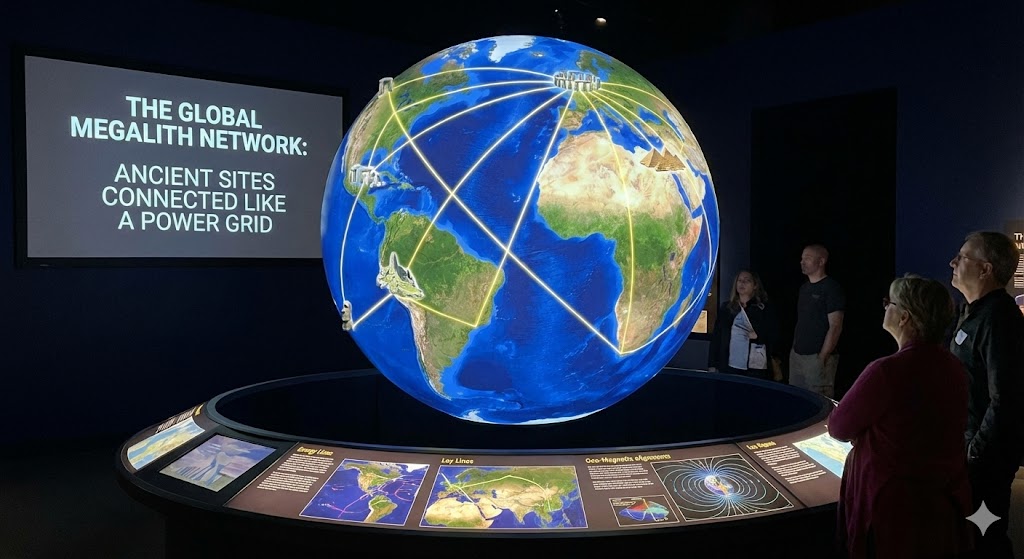
Scattered across continents, separated by oceans and time, the world’s megalithic sites seem at first glance like isolated achievements of unrelated cultures. Stonehenge in England. The Pyramids of Egypt. The Nasca Lines of Peru. The stone terraces of Easter Island. The Serpent Mound in North America. The temples of Angkor. The alignments of Machu Picchu. The obelisks of Axum.
But when you look deeper — when you measure, map, and compare — something extraordinary emerges:
These sites are not random.
They are connected.
Aligned.
Structured.
Part of a global design.
A network that spans Earth like invisible circuitry.
Researchers have long noticed the uncanny phenomenon of ley lines — straight paths linking ancient monuments across vast distances. Dismissed as coincidence by conventional historians, these alignments are too consistent, too mathematically precise, too globally distributed to ignore.
The most stunning example sits at 30°N latitude: the Great Pyramid of Giza. On this same parallel lie other megalithic structures and ancient power centers, as if arranged along an energetic highway. The placement is not arbitrary. It matches Earth’s geometric proportions, divides landmasses evenly, and interacts with magnetic anomalies modern science still struggles to explain.
When these sites are connected on a map, they form a pattern eerily reminiscent of a digital grid, a system of nodes and pathways, each point feeding into the next. Egypt links to Easter Island in a straight line that continues across the Pacific, touching Nazca, Cusco, Ollantaytambo, and Machu Picchu — all sites known for advanced stonework and unexplained magnetic anomalies.
Across the Atlantic, another line runs through Stonehenge, Newgrange, the French Carnac stones, and onward toward North Africa. In Asia, similar alignments tie Angkor Wat to the Great Wall of China and ancient Siberian observatories.
These alignments were not accidental. They required architecture, surveying, mathematics, and a knowledge of Earth’s geometry that allegedly did not exist for thousands of years — unless the history we know is wrong.
But even more intriguing is the purpose behind these placements. Many megalithic sites exhibit electromagnetic properties. Stones with high quartz content, chambers aligned to solstices, shapes that amplify sound, water channels beneath structures, and layouts resembling circuitry. The Great Pyramid continues to produce electromagnetic hotspots detectable by modern instruments. Stonehenge resonates at harmonic frequencies linked to Earth’s natural vibrations.
The ancients were not building monuments.
They were tuning Earth itself.
Imagine a global civilization — or a network of cultures sharing inherited knowledge — building a planetary energy grid. Sites positioned at geometric intersections. Structures acting as amplifiers, collectors, or capacitors. Ley lines as conduits. Megaliths as nodes managing energetic flow.
This is not fantasy. It is physics.
Quartz vibrates.
Geometry amplifies.
Earth resonates.
Water conducts.
The idea that ancient people only worshipped the Sun or buried their kings in gigantic tombs is a childish simplification. Their architecture behaves like technology — silent machines turned to stone.
The Nazca Lines, for instance, only make sense from the sky. Why draw perfectly straight, miles-long lines if not to map, direct, or channel energy? Why do so many megaliths sit atop geomagnetic hotspots? Why does each site appear to “speak” the same architectural language despite being continents apart?
They were either connected through a global civilization — or they shared a scientific inheritance from a forgotten age.
Modern cities are wired with electrical grids. Ancient civilizations wired the planet with a geometric grid.
Look at the distribution of these sites from space. They form a mesh — an elegant, purposeful structure. Not random. Not tribal. Not primitive. But architectural, mathematical, and planetary in scope.
What happened to this network?
Why was it abandoned?
Who built it — and what were they powering?
Natural disasters?
A global reset?
Loss of knowledge following a cataclysm?
Every ancient myth speaks of a great fall, a flood, a breaking of the world. Afterward, survivors rebuilt with fragments of memory — temples here, pyramids there — echoes of the once-great grid.
But the alignment remains.
The geometry persists.
And the stones still hum with forgotten energy.
We live among the ruins of a planetary machine.
A global network built by hands far more advanced than we dare admit.
And piece by piece, the map of that ancient power grid is re-emerging — not from textbooks, but from the stones themselves.