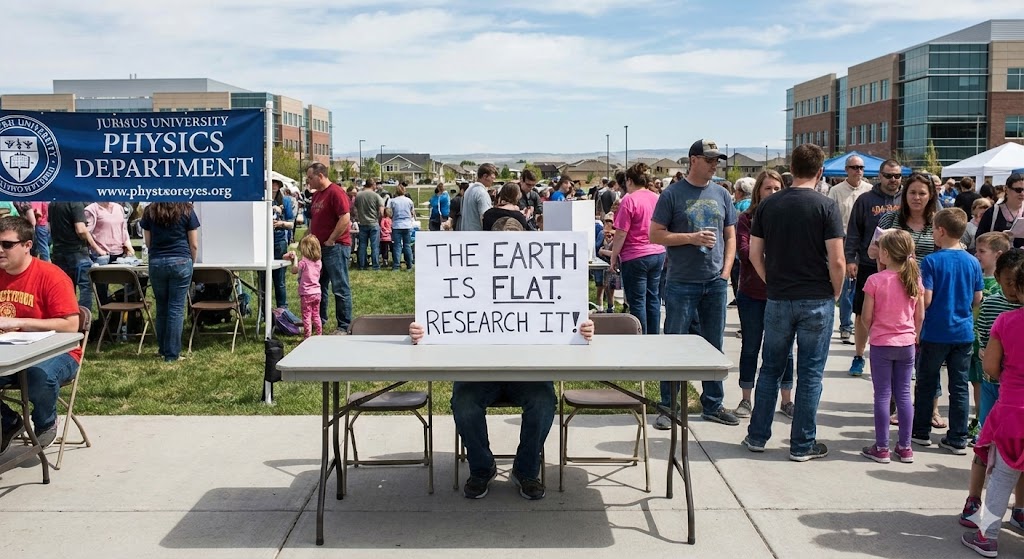
The concept of a flat earth belief has been a topic of fascination and debate for centuries, with many assuming it to be a relic of the past. However, in modern America, this ideology has seen a resurgence, with a growing number of individuals embracing the notion that the Earth is flat, rather than an oblate spheroid. This phenomenon has left many scientists, experts, and the general public bewildered, prompting a deeper investigation into the world of flat earth believers. As we delve into the realm of flat earth belief, it becomes increasingly clear that this ideology is not just a harmless eccentricity, but a complex and multifaceted phenomenon that warrants closer examination.
Historical Context of Flat Earth Belief
The idea of a flat Earth has been around for thousands of years, with ancient civilizations such as the Babylonians, Egyptians, and Greeks all subscribing to this notion. However, with the advent of scientific discoveries and technological advancements, the concept of a spherical Earth became widely accepted. The ancient Greek philosopher Aristotle is credited with being one of the first to propose a spherical Earth, based on observations of the Earth’s shadow during lunar eclipses. This idea was later reinforced by other prominent thinkers, including Eratosthenes, who accurately calculated the Earth’s circumference. Despite the overwhelming evidence supporting a spherical Earth, the flat earth belief persisted, often in the form of pseudoscientific theories and conspiracy narratives.
Understanding the Flat Earth Belief in Modern America
In recent years, the flat earth belief has experienced a significant resurgence in popularity, particularly in the United States. This phenomenon can be attributed to a combination of factors, including the rise of social media, the proliferation of conspiracy theories, and a growing distrust of institutions and authority figures. Many modern flat earth believers point to perceived inconsistencies in the spherical Earth model, such as the existence of the horizon, the behavior of water, and the lack of visible curvature. However, these claims are often based on flawed assumptions, misinterpretations of scientific data, and a fundamental lack of understanding of the underlying physics and astronomy.
The Role of Social Media in Promoting Flat Earth Belief
Social media platforms have played a significant role in the dissemination and popularization of flat earth ideology. Websites such as YouTube, Facebook, and Twitter have provided a fertile ground for flat earth believers to share their ideas, connect with like-minded individuals, and recruit new adherents. The algorithms used by these platforms often prioritize sensational and provocative content, which can contribute to the spread of misinformation and the amplification of conspiracy narratives. Furthermore, the anonymity and echo chambers created by social media can foster a sense of community and shared identity among flat earth believers, making it more difficult for them to consider alternative perspectives and evidence-based information.
The Influence of Celebrity Endorsements on Flat Earth Belief
Celebrity endorsements have also contributed to the growing popularity of flat earth ideology. High-profile figures such as Kyrie Irving, Tila Tequila, and B.o.B have all publicly expressed support for the flat earth belief, often citing personal research and intuition as the basis for their claims. These endorsements can have a significant impact on the perception and credibility of flat earth ideology, particularly among young and impressionable audiences. However, they also highlight the dangers of misinformation and the importance of critical thinking, as many of these celebrity endorsements are based on flawed assumptions and a lack of scientific understanding.
Section 1: The Pseudoscience of Flat Earth Belief
One of the most striking aspects of flat earth belief is its reliance on pseudoscientific theories and unproven assumptions. Many flat earth believers point to the existence of the horizon as evidence for a flat Earth, arguing that the apparent flatness of the horizon is inconsistent with a spherical Earth. However, this argument ignores the fundamental principles of perspective and the behavior of light, which can create the illusion of a flat horizon even on a spherical Earth. Additionally, flat earth believers often cite the lack of visible curvature as evidence for a flat Earth, despite the fact that the curvature of the Earth is only visible from high altitudes or with the aid of specialized equipment.
Section 2: The Conspiracy Narratives Surrounding Flat Earth Belief
Flat earth belief is often accompanied by a range of conspiracy narratives, which posit that governments, institutions, and other powerful entities are actively working to suppress the truth about the shape of the Earth. These narratives often involve claims of fake moon landings, manipulated satellite imagery, and controlled media outlets. However, these claims are typically based on flawed assumptions, unverifiable sources, and a lack of evidence. Furthermore, the existence of these conspiracy narratives highlights the deep-seated mistrust and paranoia that often accompany flat earth belief, as well as the dangers of uncritical thinking and the spread of misinformation.
Section 3: The Psychological and Sociological Factors Driving Flat Earth Belief
Research has shown that flat earth belief is often driven by a combination of psychological and sociological factors, including a desire for control, a need for community, and a sense of rebellion against authority. Many flat earth believers report feeling a sense of empowerment and self-importance from challenging the dominant narrative and embracing a contrarian worldview. Additionally, the flat earth community often provides a sense of belonging and social support, which can be particularly appealing to individuals who feel marginalized or disenfranchised. However, these factors can also contribute to a lack of critical thinking and a reluctance to consider alternative perspectives, as well as a tendency to cling to flawed assumptions and ideologies.
Section 4: The Educational and Intellectual Implications of Flat Earth Belief
The resurgence of flat earth belief has significant implications for education and intellectual discourse. The proliferation of pseudoscientific theories and conspiracy narratives can undermine the teaching of evidence-based science and critical thinking, particularly in schools and universities. Furthermore, the rejection of established scientific knowledge and the embracing of unproven assumptions can create a culture of anti-intellectualism, where expertise and authority are dismissed in favor of personal opinion and intuition. This can have far-reaching consequences, not only for the individual, but also for society as a whole, as it can contribute to a lack of informed decision-making and a diminished capacity for critical thinking.
Section 5: The Cultural and Social Consequences of Flat Earth Belief
The cultural and social consequences of flat earth belief are multifaceted and far-reaching. The rejection of established scientific knowledge and the embracing of conspiracy narratives can contribute to a sense of polarization and division, as well as a lack of trust in institutions and authority figures. Additionally, the flat earth community often perpetuates a range of harmful and discriminatory ideologies, including anti-Semitism, racism, and sexism. Furthermore, the proliferation of pseudoscientific theories and conspiracy narratives can undermine the credibility of science and the scientific method, contributing to a culture of misinformation and confusion.
Counter-Arguments and Criticisms of Flat Earth Belief
Despite the growing popularity of flat earth ideology, there are numerous counter-arguments and criticisms that highlight the flaws and inconsistencies of this belief. One of the most significant criticisms is the lack of empirical evidence supporting the flat earth model, as well as the overwhelming evidence for a spherical Earth. This includes the existence of time zones, the behavior of ships and aircraft, and the observations of the Earth’s shadow during lunar eclipses. Additionally, the flat earth model is often incompatible with basic principles of physics and astronomy, such as the law of gravity and the behavior of celestial bodies.
- The existence of time zones, which would not be possible on a flat Earth
- The behavior of ships and aircraft, which would not be able to navigate and communicate effectively on a flat Earth
- The observations of the Earth’s shadow during lunar eclipses, which can only be explained by a spherical Earth
- The existence of gravity, which would not be possible on a flat Earth
- The behavior of celestial bodies, such as the planets and stars, which can only be explained by a spherical Earth
Conclusion: The Enduring Legacy of Flat Earth Belief
In conclusion, the flat earth belief is a complex and multifaceted phenomenon that warrants closer examination and critical analysis. While it may seem like a harmless eccentricity to some, the flat earth belief has significant implications for education, intellectual discourse, and the broader culture. As we move forward in an increasingly complex and interconnected world, it is essential that we prioritize evidence-based knowledge, critical thinking, and informed decision-making. By doing so, we can work to create a more informed and enlightened society, where pseudoscientific theories and conspiracy narratives are rejected in favor of empirical evidence and established scientific knowledge. Ultimately, the enduring legacy of flat earth belief serves as a reminder of the importance of critical thinking, intellectual curiosity, and the pursuit of knowledge in the face of misinformation and uncertainty.