The “Dead Internet” Feeling: Why Everything Online Suddenly Feels Fake, Repetitive, and Staged
admin
Author
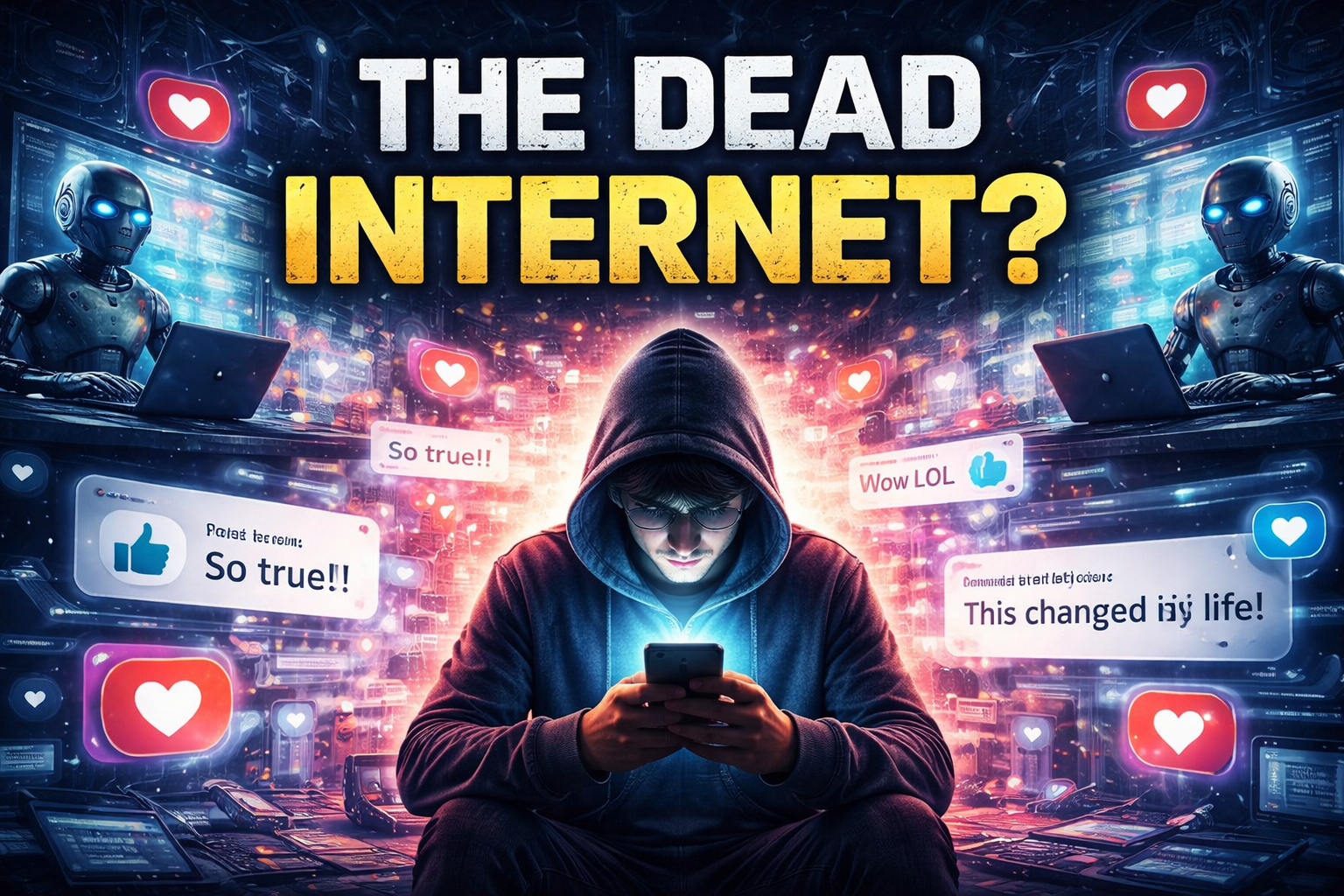
You’ve probably felt it even if you’ve never had a name for it. You open Facebook, TikTok, YouTube, or X, and the internet is still loud—full of videos, opinions, arguments, and “breaking” updates—but something inside it feels strangely empty. It’s not just that you’re bored. It’s the feeling that you’re watching a performance more than a conversation. The same formats repeat like a loop, the same phrases show up across different accounts, and the comment sections often feel like they were written from one template. People call it the “Dead Internet” feeling, and viral as it sounds, the reality behind it is more subtle—and in many ways more unsettling—than a single conspiracy claim.
A big part of why the internet feels different is because it stopped being a space for discovery and became a system for distribution. Years ago, you’d stumble onto random communities and weird personal sites, and each corner felt like it had its own voice. Now most of what we see comes through a handful of feeds that decide what should be seen and what should disappear. Those feeds aren’t designed to show the world as it is. They’re designed to keep you watching. The algorithm doesn’t ask, “Is this true?” It asks, “Will this hold attention?” And attention has patterns—anger holds attention, fear holds attention, status holds attention, and identity-based conflict holds attention. So the feeds learn the emotional triggers that keep you scrolling and then quietly build a world around them.
That’s where the repetition begins. When one format “works,” it gets copied relentlessly. You’ll see the same opening line, the same reaction face, the same background music, the same “Wait till the end…” hook, and the same structure repeated across thousands of posts. Some of this is normal human behavior—people copy what’s popular. But the scale is what changes the feeling. The modern internet rewards repeatability so strongly that creativity becomes risky. A creator can spend days making something original and watch it die, then spend ten minutes copying a proven template and watch it explode. Over time, even real humans start posting like machines, because the system trains them to.
Then there’s the bot layer, which most people underestimate because they imagine bots as obvious spam. Today, bots are designed to look like normal accounts. They have profile pictures that seem real, bios that sound casual, and comment styles that mimic human tone. They don’t always push obvious scams. Sometimes their job is simply to create the illusion of agreement. A post can look more credible if it has a wave of “Finally someone said it” comments, or a cluster of accounts repeating the same emotional reaction. Humans are social creatures; we read the room before we decide what to believe. So if the room is filled with artificial voices, the crowd’s “mood” can be shaped without most people noticing.
This is why comment sections often feel staged. You’ll notice suspicious patterns: lots of short comments with similar wording, accounts that reply instantly at all hours, and emotional responses that appear before anyone has had time to actually process the content. In some cases it’s automation. In other cases it’s engagement farms—real people paid to comment and react at scale, following scripts. In both cases the goal is the same: inflate importance, manufacture social proof, and push a piece of content into wider visibility. Once the post gets boosted by artificial engagement, real users see it trending and assume it must be meaningful. Manufactured popularity becomes real popularity, and that’s how narratives can be injected into culture without looking like they were planted.
AI adds another level to the weirdness, not because AI is evil, but because it makes mass production effortless. A single operator can generate thousands of posts, headlines, thumbnails, and comments that appear human enough to blend in. Even if most content is still made by real people, a growing share of the internet’s “texture” can be synthetic—filler that looks like conversation but isn’t. This creates a paradox: the internet can feel dead even when it’s busy. The feed is alive with activity, but much of that activity may be industrial, automated, or incentivized in ways that strip out the messy, unpredictable quality that makes human spaces feel real.
The most uncomfortable part is what this does to trust. When you can’t easily tell what’s human, you start doubting everything. Videos can be edited to imply things they never showed. Photos can be generated. Voices can be cloned. Comment sections can be flooded. Even “news” can be packaged as entertainment, and entertainment can be packaged as fact. In that environment, people don’t necessarily become more logical. Often they become more tribal. They stop asking, “Is this true?” and start asking, “Is this ours?” Belief becomes a team sport, because teams feel safer than uncertainty. And when that happens, the internet becomes less like a library of information and more like a battlefield of identities.
It’s important to say this plainly: the “Dead Internet” feeling doesn’t require a single grand secret plan to be real. It can emerge naturally from incentives. Platforms want time-on-screen. Creators want views. Marketers want conversion. Political actors want influence. All of those groups benefit from content that triggers emotion and spreads fast. So the system evolves toward whatever is easiest to replicate and hardest to ignore. That’s why outrage headlines multiply, why fear-based narratives spread like wildfire, and why nuance dies quickly. A calm, balanced explanation doesn’t travel as far as a shocking claim that makes people argue in the comments.
Still, the viral question remains, and it’s the one that makes people sit up at night: if a large portion of what you see is optimized, engineered, and sometimes automated, how many of your opinions were truly chosen by you? The feed doesn’t just show content; it shapes mood. Mood shapes belief. Belief shapes behavior. When you spend hours inside a curated emotional tunnel, it changes what feels normal, what feels urgent, and what feels “obvious.” That’s not sci-fi. That’s basic psychology, scaled up by technology.
So what can you do about it? The most powerful move isn’t paranoia—it’s awareness. Pay attention to the patterns that signal manufactured reality: sudden waves of identical comments, accounts with no personal history, content that triggers intense emotion while offering little substance, and trends that explode everywhere with the same script. Slow down before you share. Ask what the post is trying to make you feel, and who benefits if you feel that way. And most importantly, rebuild a small part of your online life around spaces that still feel human—real friends, smaller communities, long-form writing, and creators who don’t speak like templates.
Maybe the internet isn’t “dead.” Maybe it’s been industrialized. And when a space gets industrialized, it stops feeling like a conversation and starts feeling like a factory—loud, efficient, repetitive, and optimized for output. That’s why so many people crave anything that feels raw and real now. Because deep down, we can all sense it: the feed is moving, but something in it is wearing a mask.