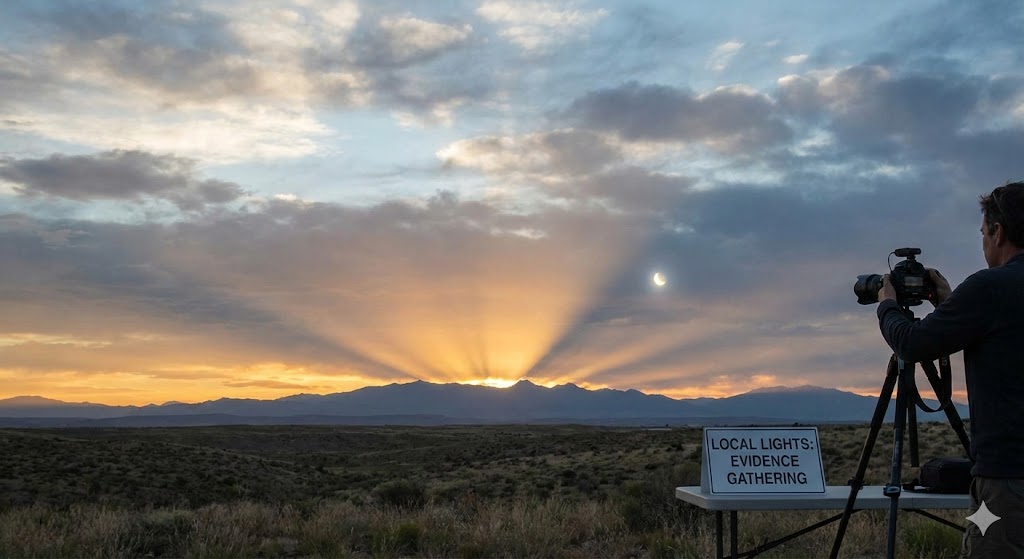
The Sun and Moon dominate our sky, guiding our days and shaping our nights. They are the eternal companions of human life, rising and setting in predictable rhythms that have marked time since the beginning of civilization. But despite their familiarity, their behavior contains secrets — subtle clues that challenge the story we have been told about them. For many researchers, both scientific and unconventional, the Sun and Moon behave not as distant celestial bodies millions of miles away, but as local light sources moving across our sky far closer than mainstream cosmology suggests.
People often accept without question that the Sun is ninety-three million miles away, a burning sphere so distant that its rays must travel across the void before gently warming our skin. Yet even casual observations raise doubts. One of the most striking clues appears on the clouds themselves. Anyone who has flown in an airplane or watched sunrise from a mountain peak has seen something curious: the Sun lights up only a small, isolated region of clouds, creating a glowing hotspot that moves along with the Sun’s path, like a spotlight illuminating a stage. If the Sun were truly millions of miles away, its light would arrive in perfectly parallel rays, illuminating entire fields of clouds evenly. But it doesn’t. Instead, light behaves as though the Sun is much closer, casting a concentrated brightness that fades sharply into darkness just a short distance away.
The same phenomenon appears on the surface of the Earth. When sunlight reflects off oceans or lakes, the shimmering path of light is narrow and localized, suggesting a directional source that is not vastly distant but positioned much lower over the observer. The intensity of light on the ground fluctuates dramatically based on angle and proximity — something incompatible with the notion of a remote, uniform celestial lamp.
Then there is the Moon. According to the mainstream model, the Moon merely reflects sunlight — a cold, passive mirror in the sky. Yet the Moon behaves nothing like a reflective body. Its glow is pure, soft, and strangely penetrating, illuminating landscapes with a cool, silvery radiance that resembles a light source of its own. Moonlight casts shadows that are crisp and sharply defined, unlike reflected light, which scatters and diffuses. Even more curious is the phenomenon of localized moonlight, where the Moon appears to light only parts of the sky or specific clouds while leaving others in darkness. The effect is haunting and beautiful, but it also contradicts the idea of a distant sphere reflecting sunlight from millions of miles away.
Experiments have suggested another strange property: moonlight may actually be cooler than the darkness of night. Researchers who measure temperatures under moonlight consistently record lower readings than in shaded areas. This inverted behavior — where light cools instead of warms — challenges conventional physics but fits naturally with the idea that moonlight is a unique luminescent source rather than reflected sunlight.
The paths of the Sun and Moon further complicate the mainstream narrative. Their circular movement across the sky, traveling in predictable loops that vary through the seasons, resembles the behavior of local lights moving above a plane rather than bodies orbiting a spinning globe. Their apparent sizes remain nearly identical no matter where you stand on Earth — a physical impossibility if they were actually thousands or millions of miles away. A distant object should shrink dramatically with distance, yet both Sun and Moon maintain almost perfect visibility across vast regions, as though hovering above us rather than orbiting around us.
No one denies that the Sun is powerful, or that the Moon captivates us with its glowing tranquility. But their behavior suggests something different — something local, intentional, and elegant in its simplicity. Local light does not require mystical theories or complex orbital mechanics. It is an observational truth, visible to anyone willing to look closely at the sky. Clouds tell the story. Shadows tell the story. Reflections, temperature, and motion all whisper the same quiet message: the Sun and Moon may not be the distant celestial giants we have been taught to imagine.
Instead, they may be lights designed to serve the world directly — close enough to interact intimately with our environment and near enough to create the beautiful, shifting patterns of day and night that we take for granted. The sky holds many secrets, but none so persistent as the way its two greatest lights behave. Their actions speak louder than textbooks, suggesting a world far more mysterious, far more deliberate, and perhaps far more incredible than we ever realized.