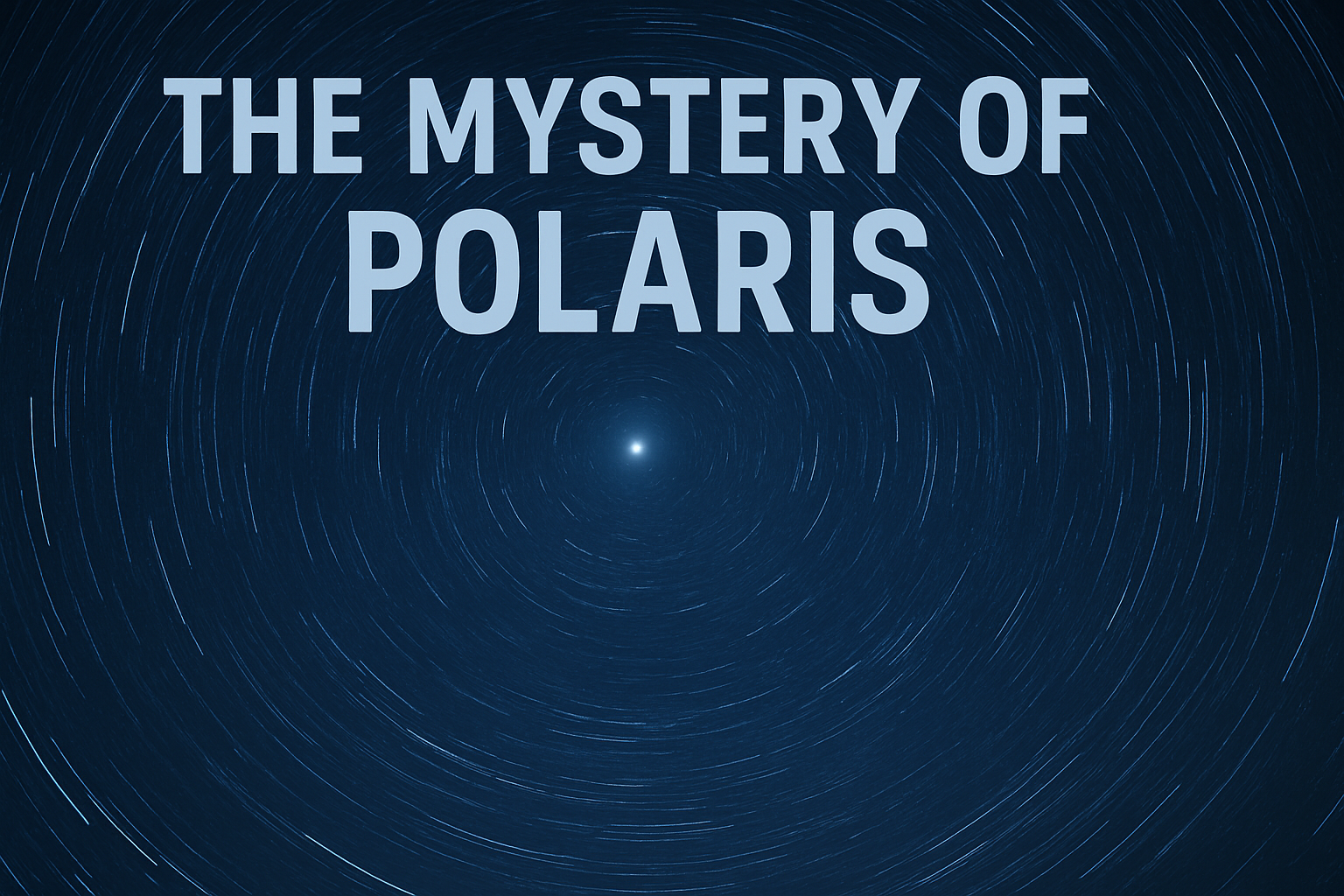
For centuries, travelers, explorers, and sailors have used the North Star — Polaris — as their guiding light. Unlike the other stars in the night sky, which appear to drift in great arcs as the hours pass, Polaris holds steady, fixed directly above the northern horizon. Its unwavering position has made it a symbol of direction, stability, and truth.
But here lies the mystery: if Earth is spinning at roughly 1,000 miles per hour, orbiting the sun at 67,000 miles per hour, and racing through the galaxy at half a million miles per hour — how does Polaris never move? Astronomers explain it away by saying Polaris is “so far away” that the motion of Earth doesn’t matter. Yet over thousands of years, even the slightest wobble or tilt should create a visible shift. And still, Polaris shines from the same position as recorded in ancient times.
On a globe model, the Earth’s tilt and precession should cause Polaris to gradually drift out of alignment. In fact, official science claims it will no longer be the North Star in a few thousand years. Yet old star maps, navigation logs, and cultural records from hundreds of generations ago all point to the same North Star we see today. Its constancy defies the idea of a wobbling, spinning, and drifting planet.
To many critical thinkers, this raises questions: could Polaris’ stability point to a stationary Earth beneath a fixed, rotating sky dome? Why would one star remain the anchor of our skies in a universe said to be constantly expanding and changing?
Polaris challenges the official story. It invites us to look up, wonder, and question the foundations of what we’ve been told. Perhaps the greatest truth is hidden in plain sight — shining from above, unshaken, unmoving, and eternal.