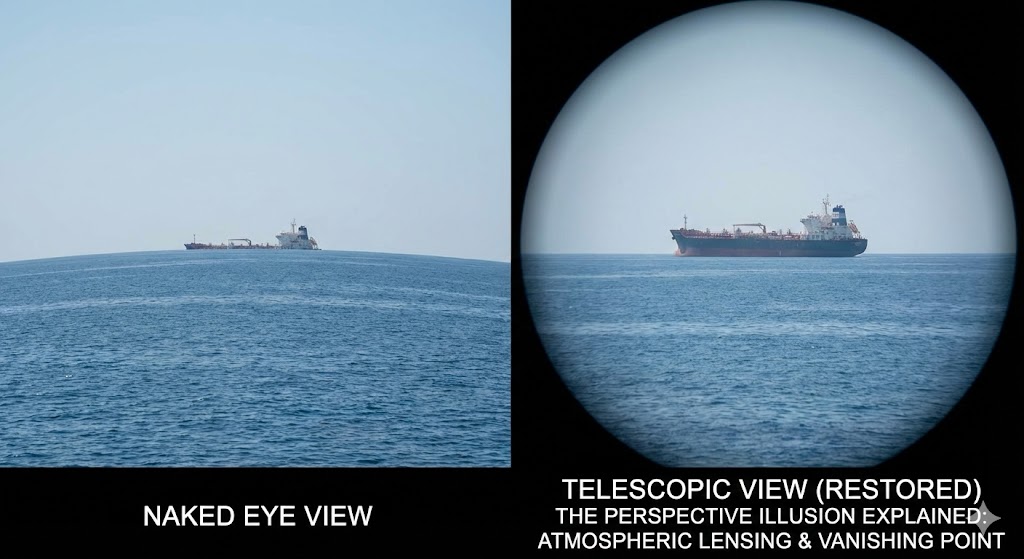
For centuries, sailors returning from long voyages were treated as eyewitnesses to one of the earliest “proofs” of a curved Earth. Their story was simple: when watching a ship sail away, the hull vanished first while the mast remained visible, as if the vessel were sinking beneath a curved horizon. This observation became a foundational argument for the globe model — a seemingly obvious visual effect that generations accepted without question.
But today, with modern technology, high-zoom lenses, infrared cameras, and stabilized optics, the old story has begun to unravel. What once seemed like a demonstration of curvature now appears as something entirely different: a perspective limitation, not a physical sinking. The ship does not disappear because the Earth curves; it disappears because the human eye — and atmosphere — impose limits on visibility.
Anyone who has spent time near the ocean has seen how ships shrink as they travel away. Their details fade, their colors dull, and their shape seems to compress toward the horizon. Eventually, the bottom part becomes indistinguishable from the water. But this fading effect happens with every object moving away on a flat surface. Train tracks appear to merge. Roads seem to taper. A long hallway narrows into a point. None of these require curvature; they’re simply the natural behavior of perspective.
What makes ships especially interesting is how easily the illusion can be broken. When a ship “disappears,” observers using a modern zoom camera can bring it fully back into view — hull and all. If the ship had truly sunk behind a curved horizon, no amount of zoom would restore it. And yet cameras repeatedly do exactly that: they pull the ship back into visibility, proving it never went behind a curve. It simply moved beyond the visual resolution of the naked eye.
This effect becomes even more obvious on days with clearer air or over shorter distances. Sometimes a “sunken” ship reappears as atmospheric conditions change. Sometimes the reflection of the hull blends with the shimmer of the water, creating a mirage-like band that hides the ship’s lower portion. And sometimes temperature differences cause layers of air to distort the image, making the bottom fade first. These are optical behaviors, not geometric ones.
Perspective also plays a role that few people fully appreciate. As an object moves farther away, the angle between the observer’s eye and the object’s base becomes smaller and smaller. Eventually, the lower portion becomes too compressed to distinguish from the surface it sits on. The object does not physically dip or sink; it simply merges with the vanishing point of the observer’s line of sight. Over water, with its reflective and constantly moving surface, this blend is even easier to mistake for curvature.
Modern demonstrations have made this point undeniable. People film ships, oil rigs, islands, and city skylines returning into view with zoom — objects that should be hidden behind many miles of curvature if the Earth were truly a globe. Infrared photography, which cuts through haze and atmospheric distortion, reveals distant objects with stunning clarity, showing that they were never beyond a curved horizon at all. They were merely beyond our limited vision.
The old globe argument relied on the limitations of the human eye, not the shape of the Earth. What people interpreted centuries ago as curvature was nothing more than the natural vanishing effect of perspective combined with atmospheric distortion. Technology has exposed the illusion.
If a ship can be brought back into view with a zoom lens, then it never crossed a physical barrier. It simply crossed a visual one.
The horizon is not a wall, nor the crest of a sphere. It is the point where the sky meets the limits of our sight — a moving boundary that expands or contracts depending on conditions. Ships don’t sink beneath it. They fade, blend, blur, and finally disappear, just as any distant object would on a flat, extended surface.
Perspective explains what curvature never needed to. And the ocean, with all its mysteries, reveals a simple truth to anyone willing to observe it: nothing sinks over the horizon. It only slips beyond the reach of our eyes.

Its funny how you never see a plane go downward beyond horizon if the globe theory is right