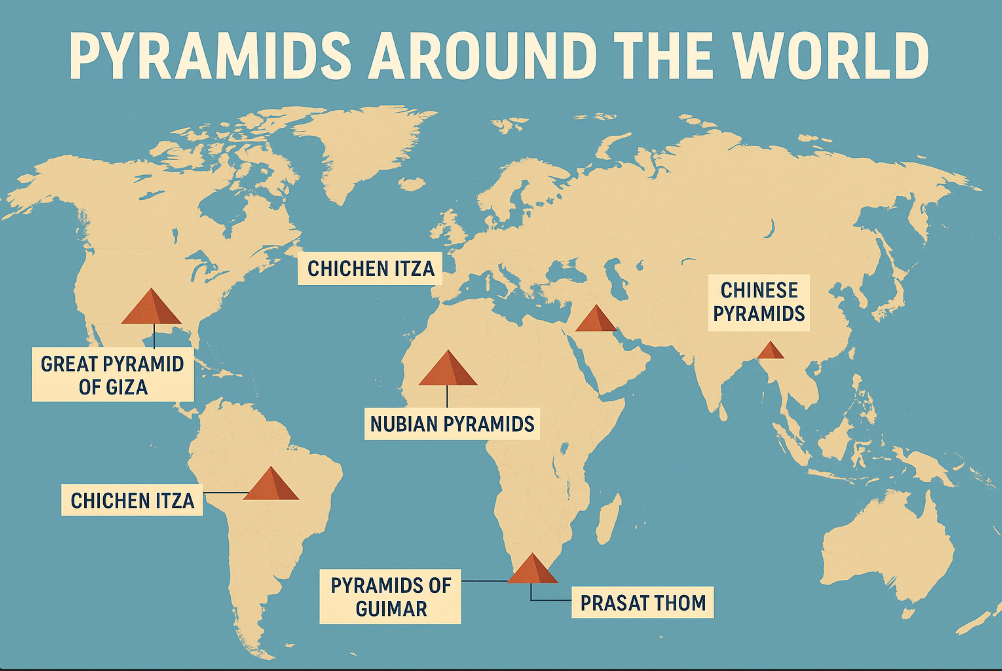
Introduction: The Shape That Defies Time
Pyramids are among the most striking and enduring symbols of human civilization. What’s fascinating is that cultures separated by oceans and centuries—from Egypt to Mesoamerica to Asia—built strikingly similar pyramid structures. Did these cultures arrive at the same design independently, or is there a deeper connection?
1. The Egyptian Pyramids: Kings of Stone
The Great Pyramid of Giza is the most famous of all. Built as a tomb for Pharaoh Khufu around 2580 BCE, it consists of over 2.3 million limestone blocks. Nearby stand the pyramids of Khafre and Menkaure, as well as the Step Pyramid of Saqqara—considered the world’s first monumental stone building.
These structures were not just tombs; they embodied astronomical alignments, mathematical precision, and spiritual symbolism.
2. Nubian Pyramids of Sudan
South of Egypt lie the lesser-known Nubian pyramids, built by the Kingdom of Kush between 800 BCE and 300 CE. Steeper and narrower than Egypt’s pyramids, they served as tombs for kings and queens. Over 200 of these pyramids still stand today, though many remain overlooked by history.
3. The Pyramids of Mesoamerica
Across the Atlantic, the Maya and Aztec civilizations built step-pyramids as temples to their gods.
-
Chichen Itza (Mexico): El Castillo (Temple of Kukulcán) is famous for its serpent-shadow illusion during the equinox.
-
Teotihuacan (Mexico): The Pyramid of the Sun and the Pyramid of the Moon dominate the ancient city’s sacred avenue.
-
Mayan Pyramids in Guatemala: Deep in the jungles, towering pyramids like those of Tikal rise above the trees.
Unlike Egyptian pyramids, these were primarily used for ceremonies, sacrifices, and astronomical purposes.
4. The Chinese Pyramids
In central China’s Shaanxi province lie dozens of pyramid-like burial mounds, including the Mausoleum of the First Qin Emperor (famous for the Terracotta Army). These earthen pyramids, though less striking in shape, reveal that China too adopted pyramid forms to honor emperors and gods.
5. The Cambodian Pyramids
In Cambodia’s Koh Ker site (10th century CE), the Prasat Thom temple complex includes a seven-tiered pyramid rising from the jungle. Though less famous than Angkor Wat, it shows Southeast Asia also embraced pyramid construction.
6. European Pyramids
Even Europe has pyramid-like structures:
-
Canary Islands: The Pyramids of Güímar in Tenerife, linked to ancient agricultural practices.
-
Bosnian Pyramid Claim: In Visoko, Bosnia, a hill known as the “Bosnian Pyramid of the Sun” has sparked debate—natural formation or man-made?
Why Pyramids Everywhere? Coincidence or Connection?
The big question: why did cultures separated by thousands of miles and years all build pyramids?
-
Practical Design: A pyramid shape is stable, easy to build, and lasts centuries.
-
Spiritual Symbolism: The pyramid may represent a “stairway to the heavens,” connecting Earth to sky.
-
Lost Ancient Knowledge? Some theorists suggest a shared global civilization or cross-cultural contact in ancient times.
Conclusion: Humanity’s Universal Shape
Whether in the sands of Giza, the jungles of Central America, or the hidden valleys of China, pyramids stand as a reminder of humanity’s shared quest for eternity and connection to the cosmos. Their similarity across cultures is either a brilliant coincidence—or evidence that ancient civilizations may have been more connected than we think.