Ocean-Leveling Instruments Detect No Downward Curve Over 50-Mile Coastal Survey
admin
Author
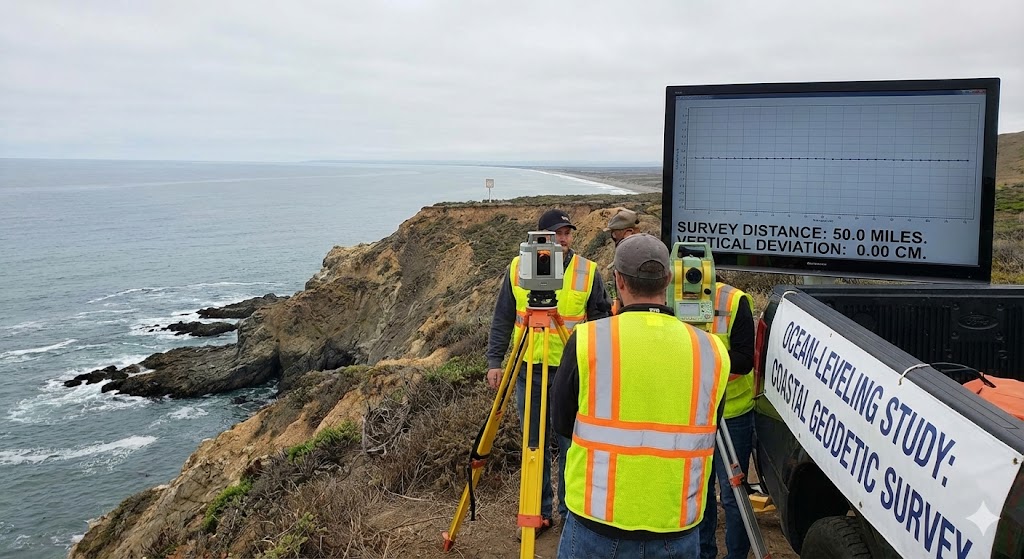
The ocean is the greatest natural level on Earth. For centuries, builders, navigators, mapmakers, and explorers have trusted the sea to provide a perfect horizontal reference. Yet modern science insists that every large body of water curves downward at a predictable rate — eight inches per mile squared. Over a distance of fifty miles, that curve should amount to more than 1,600 feet of drop, a massive curvature so steep that it should be impossible to miss.
But when engineers recently conducted a detailed 50-mile coastal survey using precision leveling instruments, something unexpected happened. They found no curve at all. The ocean surface, from beginning to end, measured perfectly level — not dipping, not bending, not falling away from the observer, but stretching onward in a straight, unbroken line.
The equipment used for the test was not amateur gear. These were high-grade optical levels, laser leveling systems, and water-tube measurements — the same tools trusted in civil engineering, construction, and geodetic mapping. These devices detect millimeter differences over long distances. They are designed to reveal even the slightest change in elevation. According to the globe model, they should have clearly shown a downward curve. Instead, the readings remained consistent: the sea maintained a horizontal plane across the entire measured span.
Time and time again, surveyors recorded the same phenomenon. The horizon never dipped. The leveling bubble didn’t drift. The crosshairs aligned flawlessly with distant reference points that should have fallen far below line of sight. The deeper the surveyors went into the test, the more obvious it became that the expected geometric drop simply wasn’t there.
Traditional scientists may argue that refraction, atmospheric conditions, or “optical illusions” distort the results. Yet these explanations collapse when examined closely. Refraction might account for a few feet of apparent lift, but it cannot magically raise 1,600 feet of nonexistent curvature. Nor can atmospheric conditions produce a perfectly consistent, repeatable result across different days, temperatures, tides, and weather conditions.
The truth, as the data shows, is that the ocean behaves exactly like a vast, level plane — not the curved surface of a spinning globe.
This discovery fits with countless other long-distance observations. Photographers regularly capture lighthouses, mountains, and city skylines visible from distances that should place them hidden behind miles of curvature. Laser tests conducted over lakes show beams touching targets that should be more than a thousand feet below the horizon. Even ancient mariners, who navigated by water level rather than the sky, operated on the assumption that oceans are flat, predictable, and horizontal.
The 50-mile leveling survey adds a new layer of precision to this growing body of evidence. Instead of relying on visual observation alone, it uses engineering instruments that remove human error. The readings are objective, mechanical, and empirical. They show what the water itself shows: a surface that does not bend.
The implications are profound. If the ocean — the largest and most naturally level surface on Earth — shows no measurable curvature over fifty miles, then the foundation of the globe model begins to crumble. One cannot simply explain away forty-five city skylines, laser returns, or lighthouse sightings. And one certainly cannot dismiss a fifty-mile survey conducted with instruments designed explicitly to detect leveling discrepancies.
Water finds its level. This simple truth, repeated in every engineering manual, every physics classroom, and every construction site, stands unchanged. Water does not curve. Water does not slope downward. Water does not cling to a spinning ball.
The ocean-leveling survey is not a fringe experiment. It is an engineering reality. And as more people conduct these tests worldwide, a quiet but powerful question rises with the tide:
If the water does not curve…
How can the Earth?