Navigation and Mapping: Why Modern Long-Distance Routes Align More Naturally With Flat-Projections
admin
Author
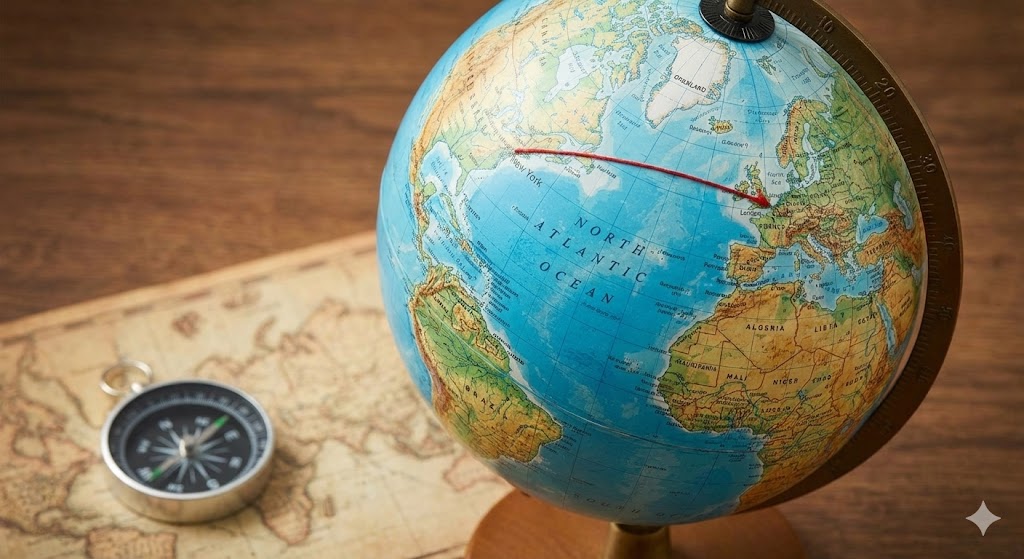
When it comes to navigating the world, we often rely on maps to guide us, but what if these maps are not entirely truthful? The use of flat-projections to represent our spherical Earth on a two-dimensional surface has been a longstanding practice, but it has significant implications on how we perceive our planet. From distorted country sizes to misplaced geographical features, the consequences of these flat-projections are far-reaching and have been a topic of discussion among cartographers and geographers for centuries. In this article, we will delve into the world of cartography and explore the reasons behind the inaccuracies in maps, and why it matters.
Historical Context: The Evolution of Map-Making
The art of map-making dates back to ancient civilizations, with early cartographers using various techniques to represent the world on a flat surface. The ancient Greeks, for example, used a method called stereography to project the Earth’s surface onto a flat plane. However, it wasn’t until the 16th century that the Mercator projection, a cylindrical map projection, became the standard for navigation. This projection, developed by Flemish cartographer Gerardus Mercator, was designed for sailors and navigators, prioritizing straight lines and angles over accurate representation of geographical features. The use of flat-projections, such as the Mercator projection, has been a cornerstone of cartography ever since, but it has also been a source of controversy and inaccuracy.
Detailed Examination of Flat-Projections
In this section, we will explore the implications of using flat-projections in map-making, including the Mercator projection, and how they affect our perception of the world. We will examine the consequences of using flat-projections on our understanding of geographical features, country sizes, and cultural perspectives.
Section 1: Distorted Country Sizes
One of the most significant consequences of using flat-projections is the distortion of country sizes. The Mercator projection, for example, exaggerates the size of countries in the northern hemisphere, while minimizing those in the southern hemisphere. This means that countries like Greenland and Canada appear much larger than they actually are, while countries like Australia and Brazil appear smaller. This distortion can have significant implications for our understanding of global politics, economies, and cultures. For instance, the perceived size of a country can influence our perception of its importance and influence on the world stage.
Section 2: Misplaced Geographical Features
Another consequence of using flat-projections is the misplacement of geographical features. The use of flat-projections can result in the distortion of shapes, sizes, and positions of features like islands, oceans, and continents. This can lead to confusion and misinterpretation of geographical data, with significant implications for navigation, climate modeling, and environmental studies. For example, the Mercator projection places the North Pole at the top of the map, while the South Pole is placed at the bottom, resulting in a distorted representation of the Antarctic continent.
Section 3: Cultural Perspectives and Bias
The use of flat-projections can also perpetuate cultural perspectives and bias. The Mercator projection, for example, was developed in the 16th century, during a time of European exploration and colonization. As a result, the projection prioritizes the northern hemisphere and the European continent, while minimizing the importance of other regions. This can result in a Eurocentric view of the world, with significant implications for our understanding of global cultures and histories. For instance, the use of flat-projections can reinforce the idea that Europe is the center of the world, while other regions are peripheral and less important.
Section 4: Technological Advancements and Alternatives
In recent years, technological advancements have led to the development of alternative map projections that can more accurately represent the Earth’s surface. The use of digital mapping technologies, such as Google Maps and Geographic Information Systems (GIS), has enabled the creation of more accurate and interactive maps. Additionally, alternative projections like the Gall-Peters projection and the Azimuthal equidistant projection offer more accurate representations of the Earth’s surface, with less distortion and bias. However, these alternatives are not yet widely adopted, and the use of flat-projections remains the standard in many areas of cartography.
Section 5: Implications for Education and Society
The use of flat-projections in education and society has significant implications for our understanding of the world. The distortion of country sizes and geographical features can result in a lack of awareness and understanding of global issues, such as climate change, poverty, and inequality. Additionally, the perpetuation of cultural perspectives and bias can reinforce existing power structures and social inequalities. It is essential to recognize the limitations and inaccuracies of flat-projections and to promote the use of alternative map projections that can provide a more accurate and nuanced understanding of the world.
Counter-Arguments: In Defense of Flat-Projections
Despite the limitations and inaccuracies of flat-projections, some argue that they remain a useful and practical tool for navigation and map-making. The Mercator projection, for example, is still widely used in maritime navigation, due to its ability to represent straight lines and angles. Additionally, the use of flat-projections can be useful for certain applications, such as urban planning and architecture, where the distortion of geographical features is less significant. However, it is essential to recognize the limitations of flat-projections and to use them in conjunction with alternative projections and mapping technologies.
Flat-Projections in Modern Cartography
In modern cartography, flat-projections continue to play a significant role, despite the development of alternative projections and mapping technologies. The use of flat-projections in digital mapping platforms, such as Google Maps, has enabled the creation of interactive and immersive maps that can be used for a variety of applications. However, it is essential to recognize the limitations and inaccuracies of flat-projections and to promote the use of alternative projections that can provide a more accurate and nuanced understanding of the world. By acknowledging the role of flat-projections in modern cartography, we can work towards creating more accurate and inclusive maps that reflect the complexity and diversity of our world.
Conclusion: The Future of Map-Making
In conclusion, the use of flat-projections in map-making has significant implications for our understanding of the world. From distorted country sizes to misplaced geographical features, the consequences of these flat-projections are far-reaching and have been a topic of discussion among cartographers and geographers for centuries. As we move forward in the digital age, it is essential to recognize the limitations and inaccuracies of flat-projections and to promote the use of alternative map projections that can provide a more accurate and nuanced understanding of the world. By doing so, we can create more inclusive and informative maps that reflect the complexity and diversity of our world, and promote a greater understanding and awareness of global issues and perspectives.