If Earth is truly a sphere, shouldn’t that CANAL be curving away beneath you?
admin
Author
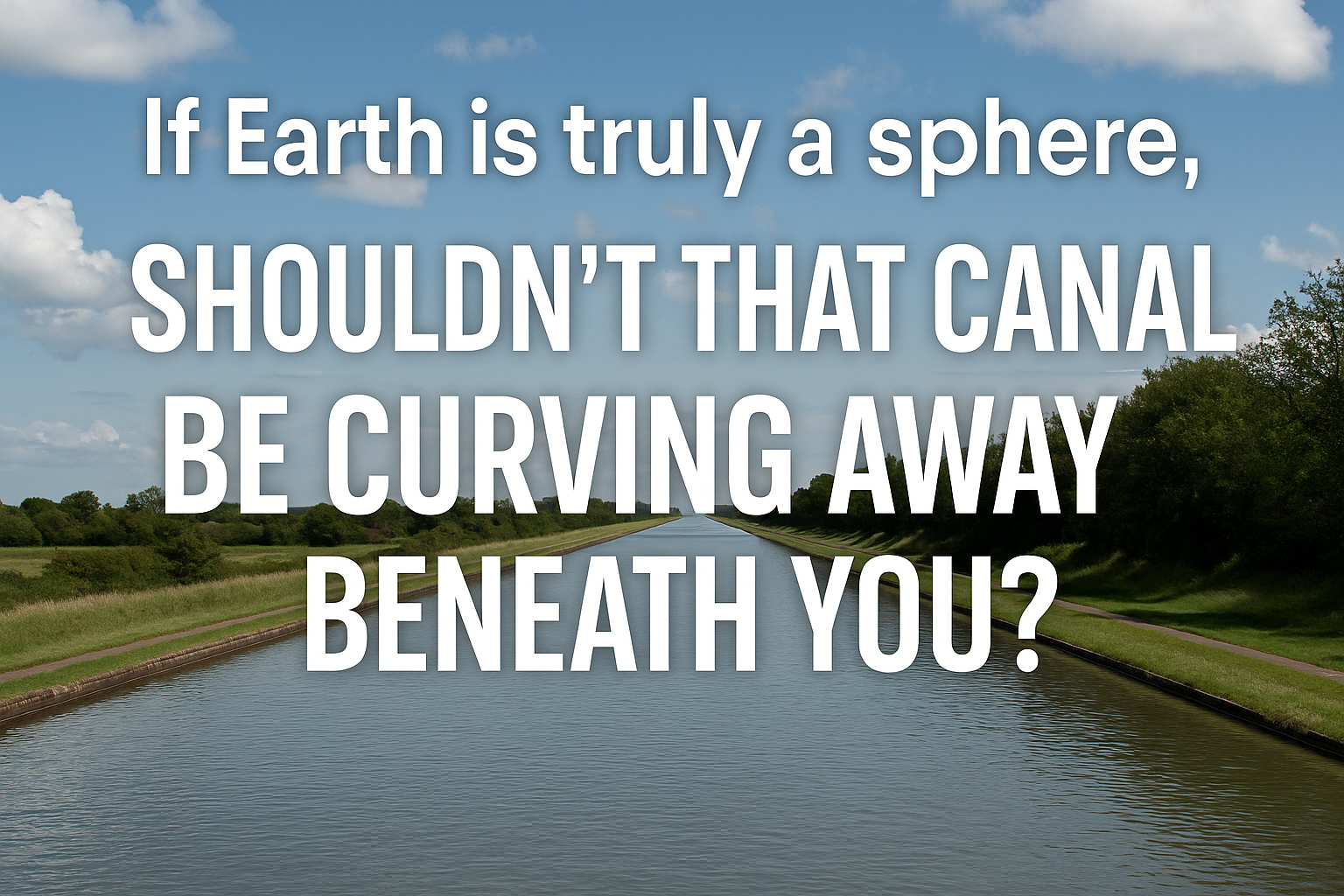
If Earth Is Truly a Sphere, Shouldn’t That Canal Be Curving Away Beneath You?
When discussing the shape of the Earth, one common question arises: if Earth is truly a sphere, shouldn’t canals and other long, flat water bodies visibly curve downward with the planet’s curvature? This question often sparks curiosity and confusion, especially among those exploring the evidence behind the Earth’s roundness. In this article, we’ll explore why canals appear flat to the human eye, how Earth’s curvature really works, and what scientific principles explain this phenomenon.
—
Understanding Earth’s Curvature
Earth is an oblate spheroid, meaning it’s mostly spherical but slightly flattened at the poles and bulged at the equator. Its average diameter is approximately 12,742 kilometers (7,918 miles), which means the surface curves gradually over large distances.
How Much Does Earth Curve?
To understand the curvature, it helps to quantify it. The Earth curves approximately 8 inches per mile squared. This means:
– After 1 mile, the surface drops about 8 inches.
– After 2 miles, it drops about 32 inches (because 2² = 4, and 4 × 8 inches = 32 inches).
– After 3 miles, it drops 72 inches (3² = 9; 9 × 8 inches = 72 inches), and so forth.
This formula, while simplified and having limitations over large distances because of atmospheric refraction and other effects, provides a rough idea of Earth’s curvature.
—
Why Canals Seem Flat: The Scale of Curvature and Perspective
If the Earth is curved, why don’t canals or flat water surfaces appear to curve downward?
The Gradual Curve Over Large Distances
Earth’s curvature is very gradual. For example, a canal that stretches 10 miles would drop by about 66.7 feet due to curvature, which might seem significant, but this drop is distributed over a very long distance. When standing at one end of a canal and looking toward the other, your line of sight is tangent to the surface of the Earth and follows the curve. This means the horizon and the canal’s surface appear flat to you because your viewpoint and the surface itself curve together.
Human Perception and The Horizon Line
The horizon always appears flat because your eyes perceive the line where Earth’s surface meets the sky. Since the Earth curves gradually and your viewpoint moves along with the surface, this horizon looks like a straight line. So, even long canals don’t appear to curve downward in a way our eyes can easily discern.
—
The Role of Water and Gravity
Water in canals and other bodies is level — but what does “level” really mean?
Water’s Surface and Equipotential Lines
Water seeks the lowest possible gravitational potential, creating a surface that is perpendicular to the direction of gravity at every point. This surface is called an equipotential surface. On a spherical Earth, this equipotential surface is curved to match the planet’s shape.
Thus, although the canal’s water surface appears flat locally (meaning small segments look flat), when viewed as a whole over large distances, it conforms to Earth’s curvature. This means the canal’s surface is actually curved — but the curvature is subtle and difficult to perceive without precise instruments.
—
Scientific Experiments and Evidence
Numerous scientific experiments have demonstrated Earth’s curvature, using canals, lakes, and other bodies of water.
The Bedford Level Experiment
One of the most famous experiments is the Bedford Level experiment, conducted in the 19th century on the Old Bedford River in England — a straight canal about 6 miles long. Early experimenters observed the water surface and tried to detect curvature.
Initial observations suggested a flat surface, leading some to question Earth’s shape. However, later refinements, considering refraction (bending of light) and other optical effects, confirmed that the water surface does curve consistent with a spherical Earth.
Modern Measurements
Today, laser ranging, GPS, and satellite data provide precise measurements showing Earth’s curvature. Instruments such as theodolites and laser levelers detect subtle drops in elevation consistent with the planet’s roundness even over canals.
—
Optical Illusions and Refraction
One reason canals might appear flat or even slightly concave is atmospheric refraction.
How Refraction Affects Our View
Refraction occurs when light rays bend as they pass through layers of air with different temperatures and densities. Over long water surfaces, cooler air near the water and warmer air above can bend light downward, sometimes making objects beyond the horizon appear higher or lower than they really are.
This phenomenon can mask or distort the visual perception of curvature.
—
Why Don’t You See the Curve?
To recap, several factors contribute to why the curve of a canal is not visually obvious:
1. Scale: Earth’s curvature happens over thousands of miles; over a few miles of canal, the drop is too gradual to “see” easily.
2. Perspective: Your eye and the canal’s surface follow the same curve, creating a flat horizon.
3. Refraction: Optical effects bend light and distort perception.
4. Equipotential Surface: Water level aligns with gravity, making water surfaces appear “flat” locally but curved globally.
—
Conclusion
The question “If Earth is truly a sphere, shouldn’t that canal be curving away beneath you?” highlights a common misunderstanding about scale, perception, and the nature of Earth’s curvature. While canals and other water bodies may appear flat to the naked eye, this is due to the vast size of the planet, the subtlety of its curvature, and how light travels through the atmosphere.
Scientific evidence—from classic canal experiments to modern satellite measurements—consistently confirms that Earth is a sphere. The surface of water bodies like canals does curve along with the planet, even if that curvature isn’t immediately visible.
Understanding these principles helps clarify why Earth’s roundness is not always obvious but remains an unambiguous fact supported by centuries of observation and scientific inquiry.
—
Keywords: Earth curvature, canal curvature, flat Earth myth, Bedford Level experiment, water surface curvature, atmospheric refraction, equipotential surface, spherical Earth evidence