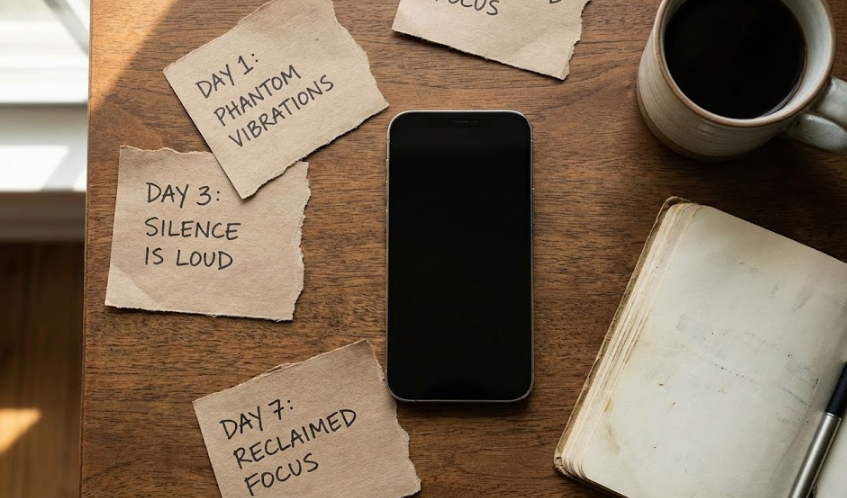
Last week I caught myself doing something I didn’t even decide to do.
I was in the middle of reading something important. My phone buzzed. I didn’t think. My hand moved automatically. Screen unlocked. App opened. Minutes disappeared.
And the scary part wasn’t that I got distracted.
It was that my brain treated that distraction like a reflex — like someone else had installed a button inside me.
So I ran a simple experiment: I turned off every notification for 7 days.
No banners. No sounds. No lock-screen previews. Nothing.
I didn’t delete apps. I didn’t go “offline.” I just removed the thing that calls you back to your phone every few minutes and pretends it’s urgent.
Here’s what happened.
The Rules I Followed
To keep it fair, I used three rules:
-
All notifications OFF (social media, email, news, shopping apps, everything).
-
I could still use my phone — but only when I chose to.
-
I checked messages at set times (morning, afternoon, night).
That’s it. No complicated system. Just one big change: I stopped letting my phone interrupt me.
Day 1–2: The “Phantom Buzz” Phase
The first two days were the weirdest.
Even though my phone was silent, my brain kept “hearing” it.
-
I reached for it while waiting for something to load.
-
I checked it after small moments of boredom.
-
I opened it without knowing why.
It felt like my mind was scanning for a reward that wasn’t coming.
This is the part most people ignore: it’s not always the phone that’s addictive — it’s the anticipation. The possibility that something “important” might appear.
Once that possibility disappears, you start noticing how often you were living in a constant state of waiting for interruption.
Day 3–4: My Mind Got Quieter
Around day 3, I noticed something simple but powerful:
My thoughts started finishing.
Normally, a notification breaks your thinking into fragments. You start something, get pulled away, return, forget what you were doing, start again, repeat.
With notifications gone, my brain stopped being dragged across tasks.
I could sit with one thing longer.
I wasn’t suddenly a “perfect productive person.” But I felt less mentally scattered — like someone lowered the background noise in my head.
Day 5: I Found Extra Time I Didn’t Know Existed
By day 5, I realized I wasn’t gaining time by “working harder.”
I was gaining time because I stopped paying micro-fees all day long.
Each notification costs you:
-
attention
-
recovery time
-
mental energy
-
emotional stability (depending on the message)
Even a quick glance can turn into a chain:
notification → open phone → check one thing → check another → scroll → lose 10 minutes → feel guilty → repeat later
When the first link disappears, the whole chain collapses.
That’s when you understand: notifications aren’t just alerts — they’re doorways.
Day 6–7: The Big Lesson — Most “Urgent” Things Were Never Urgent
This was the most important part.
When I checked messages at specific times, I expected to find a pile of emergencies.
But I didn’t.
Most things could wait. Almost everything that felt urgent was simply designed to feel urgent.
That’s the true trap: notifications don’t just deliver information. They create a false sense of priority.
Your phone is basically saying:
“Drop what you’re doing. This is more important.”
But it rarely is.
And when you let that happen 20–50 times a day, your life starts being organized by whatever interrupts you the most — not by what matters most.
What It Revealed About Notifications
This week taught me that notifications do three things quietly:
1) They train your brain to crave interruption
Your focus becomes fragile because your brain expects to be pulled away.
2) They control your schedule without asking
Your day becomes reactive, not intentional.
3) They reduce the quality of your attention
Even when you “return” to work, your mind doesn’t fully return. It’s partly waiting for the next buzz.
That’s why people feel tired even after a day with “no heavy work.” They weren’t lifting weights — they were being mentally yanked around.
If You Want to Try It (Simple Version)
You don’t need to be extreme. Start with this:
Step 1: Turn off everything except humans
Keep only:
-
calls (optional)
-
messages from family/team (optional)
-
critical alerts (bank/security)
Step 2: Set 2–3 check-in times
Example:
-
9:00 AM
-
2:00 PM
-
8:00 PM
Step 3: Remove lock-screen previews
Even without sound, previews pull your attention.
Step 4: If it’s important, people will reach you
Real urgency finds a way. Algorithms don’t deserve that power.
Step 5: Do it for 3 days first
3 days is enough to feel the difference.
The Question Nobody Asks
The biggest change wasn’t productivity.
It was self-respect.
Because every time you ignore a notification, you are quietly saying:
“My attention is mine.”
And attention is your life in minutes.
So here’s my question for you:
Which app is the hardest one for you to silence — and why?