How the Great Pyramid of Giza Was Built: Theories and Debates
admin
Author
Introduction: A Monument of Mystery
Rising 146 meters above the sands of Egypt, the Great Pyramid of Giza has captivated humanity for over 4,500 years. Built during the reign of Pharaoh Khufu (around 2580–2560 BCE), it was the tallest man-made structure in the world for nearly four millennia. But how was such a massive monument constructed using Bronze Age tools and no wheels, cranes, or iron machinery? The answer has eluded historians for centuries, sparking both scholarly research and wild speculation.
Mainstream Theories of Construction
1. The Ramp Theories
The most widely accepted explanations revolve around ramps:
-
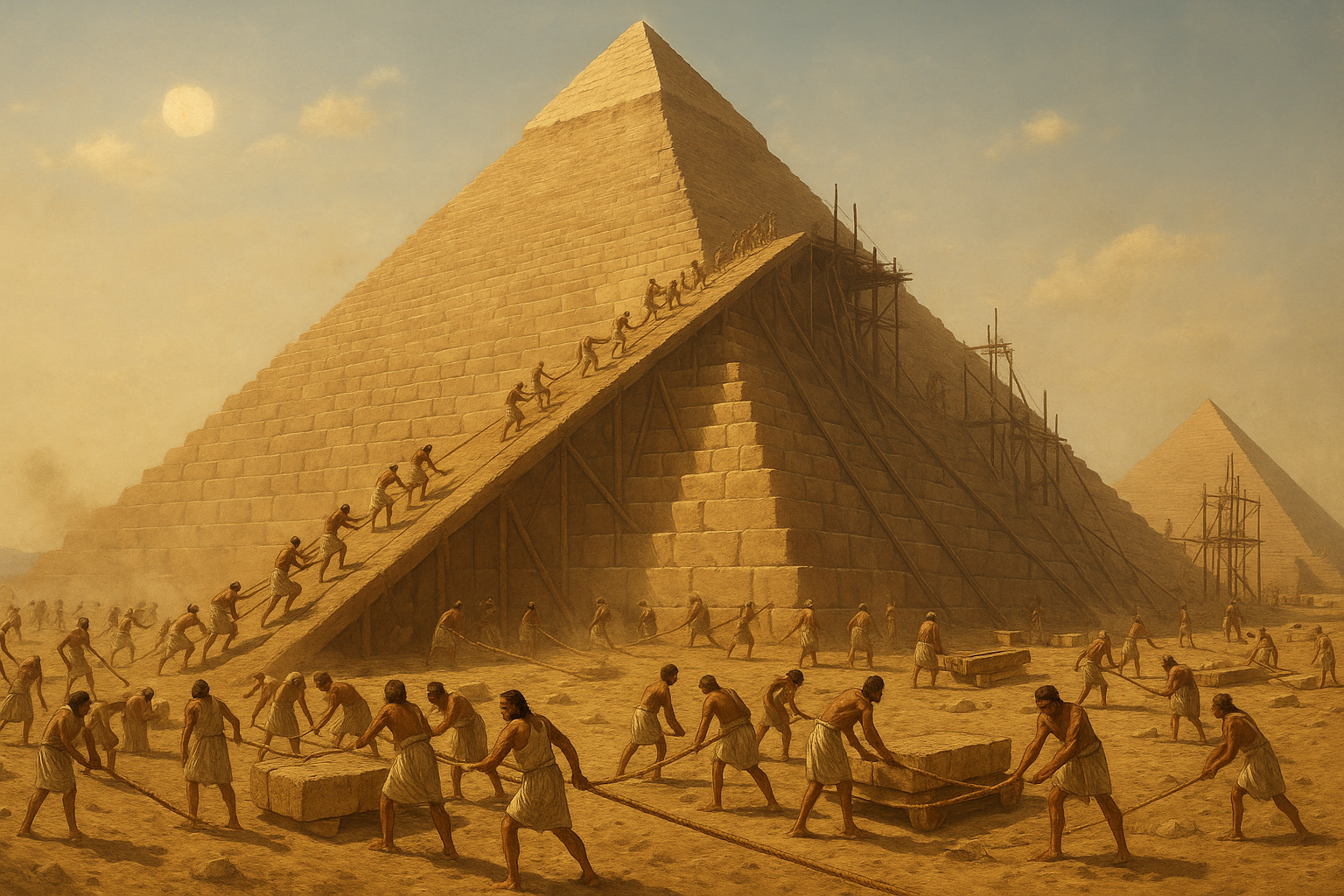
Straight Ramp Theory: Workers may have built a massive ramp leading directly to the construction site. However, the ramp would need to be almost a mile long to keep a manageable incline—requiring more material than the pyramid itself.
-
Spiral Ramp Theory: Another idea suggests a ramp that wrapped around the pyramid. This would reduce material but makes precision placement of heavy stones at higher levels harder.
-
Internal Ramp Theory: French architect Jean-Pierre Houdin proposed an internal spiral ramp built inside the pyramid’s walls, hidden beneath the stone. This idea explains the pyramid’s clean exterior but lacks direct archaeological proof.
2. Lever and Pulley Systems
Some scholars suggest the Egyptians used wooden levers and primitive pulley-like systems to “walk” massive blocks upward step by step. This would reduce the need for a giant ramp but require extraordinary manpower and organization.
3. Counterweight Methods
Other engineers propose counterweights—giant bags of sand or stones used to balance blocks up inclined planes. Though plausible, it’s difficult to scale this method for 2.3 million limestone blocks.
Alternative & Fringe Theories
Water Shaft Theory
Some engineers suggest canals and flotation were used. Stones could have been floated on boats along canals and raised into place with water locks. While appealing, little archaeological evidence supports large-scale water channels.
Lost Technology Hypothesis
Fringe theories argue that ancient Egyptians possessed forgotten technologies—advanced tools, lost machines, or even external help (e.g., “alien intervention”). While lacking evidence, these ideas remain popular in documentaries and pop culture.
Evidence from Archaeology
-
Workers’ Village: Excavations near Giza reveal evidence of thousands of skilled laborers, not slaves. They lived in organized communities with bakeries, breweries, and medical facilities.
-
Quarry Marks: Red ochre inscriptions on blocks show workers’ gang names, confirming Egyptians cut and hauled the stones themselves.
-
Experimental Archaeology: Modern teams have successfully moved multi-ton blocks using sledges, wooden tracks, and lubricated sand—demonstrating the Egyptians didn’t need high-tech tools.
Conclusion: A Feat of Ingenuity
The Great Pyramid of Giza is a triumph of human ambition, mathematics, and engineering. While debates continue about whether ramps, levers, or more creative solutions were used, the overwhelming evidence points to the genius of ancient Egyptians—skilled workers using simple tools, careful planning, and incredible cooperation.
The mystery may never be fully solved, but perhaps that is what keeps the Great Pyramid alive in our imagination: not just as a tomb of a king, but as a symbol of the enduring human drive to build the impossible.
Paul Hai
February 9, 2026Search for Giza Pyramids Racks and Pinions theory.