The Earth’s atmospheric layers play a crucial role in shaping our perception of the world around us. From the way we see colors and shapes to the apparent distances of objects, the atmosphere has a profound impact on our visual experience. However, this influence is not always immediate or obvious, and it often takes a closer look to appreciate the complex ways in which the atmosphere deceives our eyes. In this article, we’ll delve into the fascinating world of atmospheric optics, exploring the various mechanisms by which the atmosphere alters our perception of reality.
For centuries, scientists and philosophers have been aware of the atmosphere’s ability to deceive our senses. From the ancient Greeks to modern-day researchers, the study of atmospheric optics has been an ongoing pursuit, driven by a desire to understand the complex interactions between light, matter, and our visual perception. One of the earliest recorded observations of atmospheric deception dates back to the 16th century, when the Italian scientist Giambattista Della Porta noted the apparent bending of light as it passed through the Earth’s atmosphere. This phenomenon, known as refraction, would later become a key area of study in the field of atmospheric optics.
As our understanding of the atmosphere and its properties has grown, so too has our appreciation for the ways in which it influences our visual experience. The development of new technologies and research methods has enabled scientists to study the atmosphere in greater detail, revealing a complex and dynamic system that is capable of producing a wide range of optical effects. From the stunning displays of the aurora borealis to the more subtle distortions caused by atmospheric refraction, the atmosphere’s impact on our visual perception is a rich and fascinating topic that continues to capture the imagination of researchers and the general public alike.
Atmospheric Layers and Their Role in Shaping Our Visual Experience
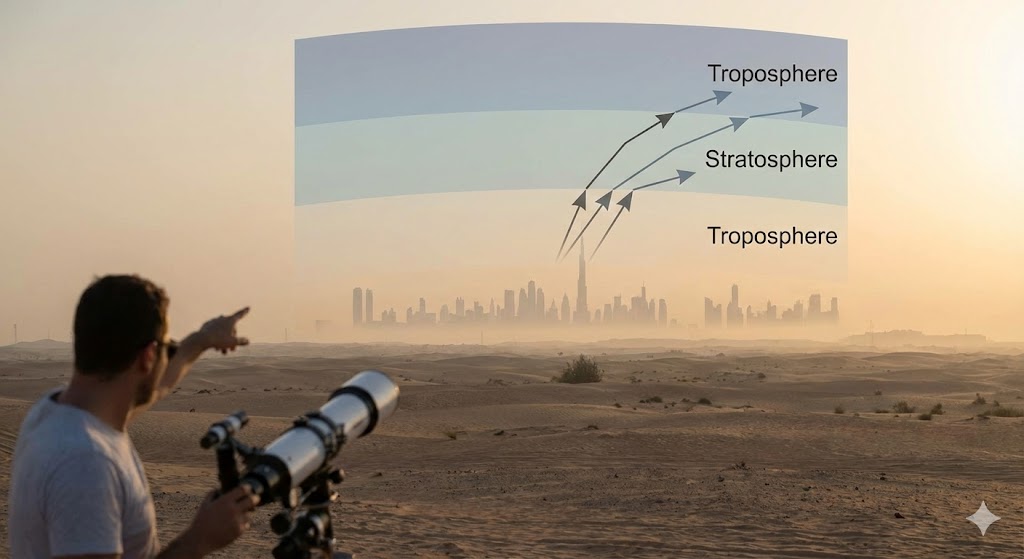
The Earth’s atmospheric layers are typically divided into five distinct regions: the troposphere, stratosphere, mesosphere, thermosphere, and exosphere. Each of these layers has its own unique characteristics and plays a specific role in shaping our visual experience. The troposphere, for example, is the layer closest to the Earth’s surface and is responsible for the majority of the atmosphere’s optical effects. This is due in part to the high concentration of gases and aerosols in the troposphere, which can scatter and absorb light in complex ways.
In contrast, the stratosphere is a relatively stable layer with low levels of aerosols and gases, resulting in a more transparent and less optically active region. The mesosphere, on the other hand, is a layer of great interest to researchers, as it is here that many of the atmosphere’s most spectacular optical effects occur. The aurora borealis, for example, is a phenomenon that occurs in the mesosphere, where charged particles from the solar wind interact with the atmosphere to produce spectacular displays of colored light.
Refraction and the Apparent Position of Objects
One of the most well-known atmospheric effects is the apparent bending of light as it passes through the Earth’s atmosphere. This phenomenon, known as refraction, occurs when light travels from one medium to another with a different optical density. In the case of the atmosphere, refraction causes the apparent position of objects to shift, often in subtle but significant ways. For example, when viewing a distant object such as a mountain or a building, the atmosphere can cause the object to appear slightly displaced from its true position.
This effect is particularly pronounced when viewing objects that are near the horizon, where the atmosphere is most dense. Here, the angle of refraction can be significant, causing objects to appear higher or lower than their true position. This can have important implications for activities such as navigation and surveying, where accurate measurements of distance and angle are critical.
Scattering and the Color of the Sky
Another key aspect of atmospheric optics is the scattering of light by gases and aerosols in the atmosphere. This phenomenon is responsible for the color of the sky, which can range from a deep blue on a clear day to a vibrant orange or red during sunrise and sunset. The color of the sky is determined by the wavelength of light that is scattered in the atmosphere, with shorter wavelengths such as blue and violet being scattered more efficiently than longer wavelengths like red and orange.
The atmosphere’s scattering properties also play a crucial role in determining the visibility of objects, particularly in conditions such as haze or fog. Here, the scattering of light by aerosols and water droplets can reduce the contrast and clarity of the visual scene, making it more difficult to discern objects and features. This can have significant implications for activities such as driving or flying, where visibility is critical for safety.
Mirages and the Apparent Distortion of Objects
Mirages are a fascinating atmospheric phenomenon that can cause objects to appear distorted or displaced from their true position. These effects occur when light is refracted through layers of air with different temperatures and densities, causing the apparent position of objects to shift. There are several types of mirages, including the “inferior mirage” which appears as a distorted or inverted image of an object, and the “superior mirage” which appears as a magnified or enlarged image.
Mirages can be observed in a variety of conditions, from the hot desert roads of the American Southwest to the cold Arctic tundras of Northern Europe. In each case, the atmosphere’s ability to bend and distort light creates a unique and often striking visual effect that can be both beautiful and deceiving. By understanding the mechanisms behind mirages, researchers can gain a deeper appreciation for the complex and dynamic nature of the atmosphere.
Atmospheric Layers and the Greenhouse Effect
The Earth’s atmospheric layers also play a critical role in regulating the planet’s climate, with the greenhouse effect being a key mechanism by which the atmosphere traps heat and maintains a stable temperature. This effect occurs when certain gases in the atmosphere, such as carbon dioxide and water vapor, absorb and re-emit infrared radiation, trapping heat and preventing it from escaping into space.
The greenhouse effect is a vital component of the Earth’s climate system, and is responsible for maintaining a temperature that is hospitable to life. However, human activities such as burning fossil fuels and deforestation have increased the concentration of greenhouse gases in the atmosphere, leading to an enhancement of the greenhouse effect and an increase in global temperatures. By understanding the role of atmospheric layers in the greenhouse effect, researchers can better appreciate the complex interactions between the atmosphere, oceans, and land surfaces that shape our planet’s climate.
The Impact of Atmospheric Deception on Human Perception and Behavior
The atmosphere’s ability to deceive our senses has a profound impact on human perception and behavior, influencing everything from our aesthetic appreciation of the natural world to our ability to navigate and interact with our environment. By understanding the mechanisms behind atmospheric deception, researchers can gain a deeper appreciation for the complex and dynamic nature of human perception, and the ways in which our senses are influenced by the world around us.
Furthermore, the study of atmospheric deception has important implications for a range of fields, from art and design to psychology and neuroscience. By exploring the ways in which the atmosphere influences our visual experience, researchers can develop new insights into the nature of perception and cognition, and the ways in which our brains process and interpret sensory information.
The Earth’s atmospheric layers are a complex and dynamic system, capable of producing a wide range of optical effects that can deceive and mislead our senses. From the stunning displays of the aurora borealis to the more subtle distortions caused by atmospheric refraction, the atmosphere’s influence on our visual experience is a rich and fascinating topic that continues to capture the imagination of researchers and the general public alike.
By exploring the mechanisms behind atmospheric deception, researchers can gain a deeper appreciation for the complex interactions between light, matter, and our visual perception. This knowledge can have important implications for a range of fields, from art and design to psychology and neuroscience, and can help us to better understand the complex and dynamic nature of human perception and cognition.
While the study of atmospheric optics has revealed a wealth of information about the complex interactions between light, matter, and our visual perception, there are also limitations to this field of research. One of the main challenges is the difficulty of predicting and modeling the behavior of the atmosphere, which can be highly variable and unpredictable.
Additionally, the study of atmospheric optics is often limited by the availability of data and the complexity of the phenomena being studied. In some cases, the effects of the atmosphere on our visual experience may be so subtle or fleeting that they are difficult to detect or measure. Nevertheless, despite these limitations, the study of atmospheric optics remains a vital and fascinating field of research, with important implications for our understanding of the natural world and our place within it.
Conclusion
In conclusion, the Earth’s atmospheric layers have a profound impact on our visual experience, influencing everything from the color of the sky to the apparent position of objects. By understanding the mechanisms behind atmospheric deception, researchers can gain a deeper appreciation for the complex and dynamic nature of human perception, and the ways in which our senses are influenced by the world around us.
The study of atmospheric optics is a rich and fascinating field of research, with important implications for a range of disciplines, from art and design to psychology and neuroscience. As we continue to explore and understand the complex interactions between light, matter, and our visual perception, we may uncover new and surprising insights into the nature of reality and our place within it. Ultimately, the atmosphere’s ability to deceive our senses is a reminder of the awe-inspiring complexity and beauty of the natural world, and the importance of continued exploration and discovery.