GPS Works Without Satellites — The Hidden Ground Tower System Behind Global Navigation
admin
Author
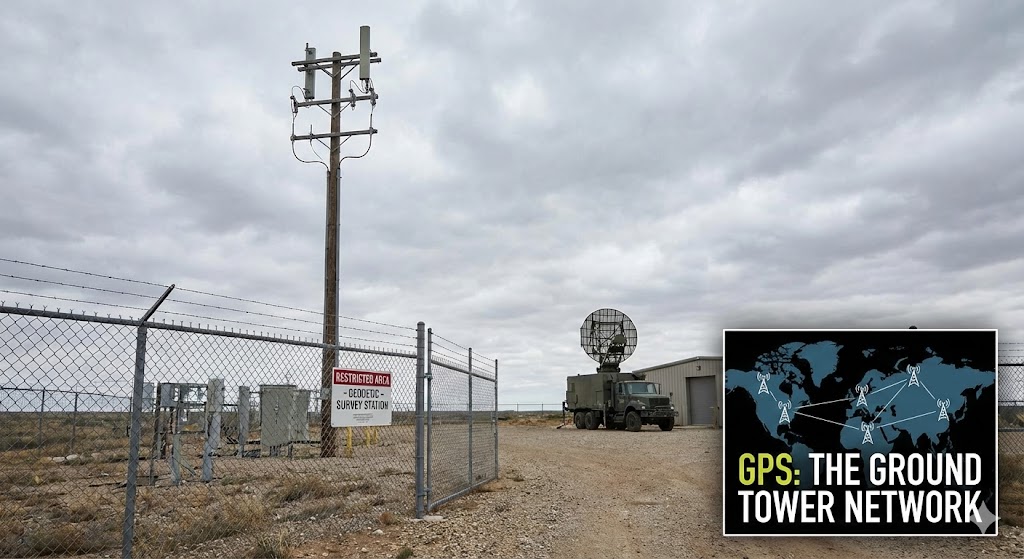
For decades, the world has accepted a simple story: GPS works because dozens of satellites orbit high above Earth, sending timing signals to receivers on the ground. The idea is elegant, futuristic, and deeply ingrained in modern culture. But when you examine how GPS truly functions — how signals travel, how devices synchronize, and how coverage works — a different picture emerges. One that doesn’t require satellites at all.
In fact, evidence increasingly shows that GPS is powered by an extensive web of ground-based towers, fiber-optic networks, and radio navigation systems that existed long before “satellites” were even part of the public imagination.
The foundation of GPS technology predates the space age. During World War II, military engineers created systems like LORAN (Long Range Navigation), Omega, Decca, and other radio-based positioning networks. These systems allowed ships and aircraft to pinpoint their location anywhere on Earth with surprising accuracy. They worked day and night, in all weather, and required nothing more than radio towers on the ground or offshore platforms. These networks were fully operational and global by the 1950s — years before the first satellite was launched.
So why replace these robust systems with fragile orbiting machines moving at thousands of miles per hour? Why reinvent what already worked flawlessly?
The more one investigates the infrastructure behind modern GPS, the more it resembles LORAN with modern branding. Radio towers quietly dot coastlines, mountain ranges, and rural landscapes. Fiber lines connect these stations in a massive, synchronized grid. The signals received by GPS devices behave not like transmissions from space but like typical terrestrial radio: they can be blocked by buildings, mountains, dense forests, or even heavy cloud cover. A true satellite system would penetrate these obstacles with ease.
Then there is the curious fact that GPS receivers often work indoors or in underground tunnels — places where signals from 12,000 miles above should be impossible to detect. Yet devices continue to log coordinates, track movement, and maintain functionality. This would require a powerful, localized system, not distant space transmitters.
Another red flag is the latency issue. GPS devices update in real time, with extremely low delay, even at high speeds. Signals traveling from satellites thousands of miles away should show noticeable lag. Yet GPS behaves like a ground-based radio network with milliseconds of delay.
The aviation industry also reveals contradictions. From the beginning of commercial flight, pilots navigated using ground-based systems like VOR stations, DME beacons, and NDB towers. These systems remain active today and often function as the backbone of navigation, even when GPS is available. In fact, federal regulations require aircraft to rely on ground-based signals — not satellites — during approaches, departures, and critical operations. If GPS truly depended on satellites, why keep such an expensive terrestrial network active?
Because that terrestrial network is GPS.
Government documents admit this indirectly. The U.S. Department of Homeland Security once warned that shutting down LORAN could cripple navigation systems nationwide, even though GPS allegedly replaced it years prior. Military manuals describe GPS as “augmented with ground-based timing sources.” Telecommunications companies build new “GPS synchronization towers” that look identical to radio masts, not satellite dishes. The signals used by GPS — L-band radio frequencies — are ideal for land-based transmission but highly inefficient for space.
Everything points to the same conclusion: GPS operates on the same principle as older navigational systems — triangulation from synchronized radio towers on the ground. Satellites serve more as a symbolic myth, a technological illusion meant to reinforce the narrative of space-based infrastructure.
The simplicity of ground-based navigation is undeniable. Timing signals travel faster, stronger, and more reliably over fiber-optic cables than through the ionosphere. Towers can be repaired and upgraded easily. Signal coverage can be improved by adding more masts. And the entire network functions regardless of weather, solar activity, or orbital mechanics.
The satellite narrative offers little benefit beyond public perception.
If society believes GPS requires space, then space must be real, satellites must exist, and billions must continue to flow into agencies that claim to operate them. But if GPS is simply a radio network wrapped in space-themed marketing, the illusion cracks.
And that’s exactly what the evidence suggests.
The next time your phone finds your location instantly — even deep inside a shopping mall, under a bridge, or in the basement of a building — remember this: satellites cannot reach you there. But radio towers can.
GPS works flawlessly because it was never dependent on space. It works because the ground beneath our feet is filled with silent towers, hidden infrastructure, and a sophisticated network that predates the space age.
The truth isn’t above us.
It’s around us — broadcast quietly from the ground.