Flight Times That Don’t Match the Globe — The Airline Data They Can’t Explain
admin
Author
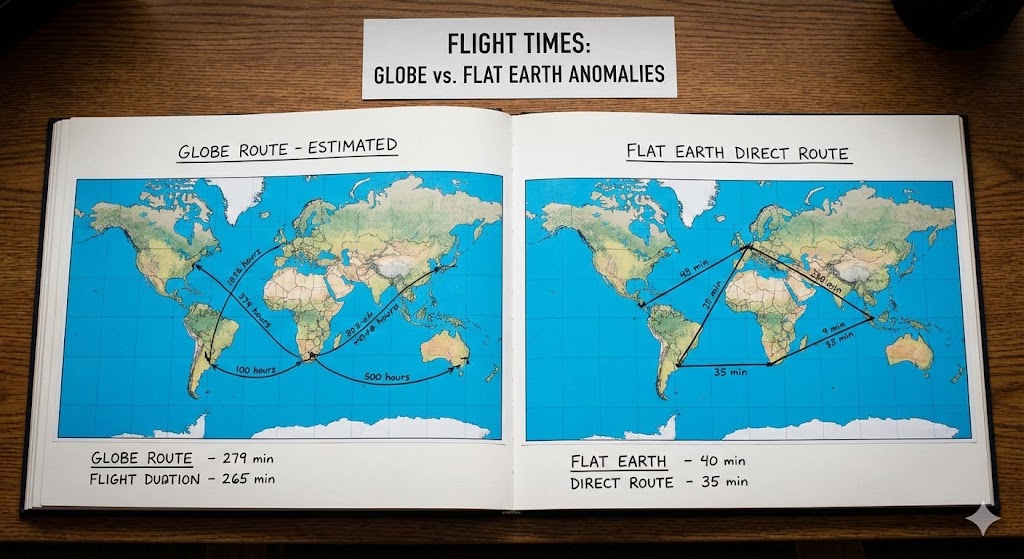
Flight Times That Expose a Flat Earth
In aviation, numbers tell the truth. Pilots rely on speed, distance, and fuel calculations with absolute precision. A single mistake can cost lives. That’s why flight times offer one of the most revealing clues about the true layout of our world. If the Earth were a sphere of 24,901 miles circumference, long-haul flights — especially in the Southern Hemisphere — should follow predictable travel times and distances.
But they don’t.
When you examine actual airline schedules, real-world flight logs, and historical route data, a strange pattern emerges. Flights that should take many hours are mysteriously short. Others that should be short stretch far beyond reasonable expectations. The discrepancies are not minor — they are enormous. And they point to something far more profound than airline inefficiency: a map problem. A globe problem. A reality problem.
One of the most famous examples is the Santiago–Sydney route. According to the official globe model, Chile and Australia sit on opposite sides of the planet’s curved southern region. The distance between them should be massive — nearly the width of the South Pacific. Yet the direct flight takes roughly 13 hours, similar to a New York–Tokyo flight, even though the globe claims New York to Tokyo is a much shorter great-circle path.
If the Earth were a sphere, the Santiago–Sydney flight should be one of the longest over-water journeys on Earth. Instead, it behaves like a mid-range international hop. The timing matches a flat Earth map perfectly, where South America and Australia are closer when spread along a circular plane.
The Johannesburg–São Paulo flight exposes an even bigger problem. On a globe, the two cities sit far apart across the South Atlantic. But the flight time is shockingly short — around nine hours — far less than expected for the distance shown on global maps. Plot the same route on a flat Earth map, and the path shortens dramatically, aligning with real-world flight times.
Then there’s the mysterious near-empty route network across the Southern Hemisphere. On a spherical Earth, the south should be filled with connecting flights: Argentina to South Africa, South Africa to Australia, Australia to New Zealand, Brazil to Australia. Instead, airlines avoid these routes or only offer rare, carefully timed direct flights — routes that often operate under conditions of tight fuel margins, strict weather windows, and narrow pathing restrictions.
Why would airlines avoid the simplest “great circle” routes if they reflected physical reality?
Even more revealing are diversion patterns. When flights in the far south encounter emergencies, they rarely divert to the nearest “globe-based” airport. Instead, they take detours that only make sense on a flat projection. A flight from Auckland to Buenos Aires once diverted nearly all the way back to Australia, bypassing airports that should have been far closer on a sphere. On a flat map, the diversion was completely logical.
The emergency landing patterns tell a story the globe cannot explain.
Then we look at the classic northern routes. Flights from Los Angeles to Hong Kong regularly pass over Alaska — a detour that makes no sense on a sphere but fits perfectly on a flat map. Flights from Dubai to Seattle pass near Greenland. Flights from New York to Beijing cross the Arctic. The airlines explain it away as “great circle efficiency,” but the truth remains: these routes mirror the flat Earth layout flawlessly.
It gets stranger when we examine airplane speeds. Commercial jets cruise at about 550–580 mph. Using this speed, many southern routes should take significantly longer than advertised. Yet the aircraft reach their destination on time, with no super-jet capabilities and no extraordinary tailwinds. The math only works on a flat Earth. On a sphere, these flight durations break fundamental navigation principles.
The Southern Hemisphere exposes the biggest contradiction of all. If Earth were a globe, southern routes would behave like northern ones, symmetrical and predictable. Instead, they behave like stretched paths across a giant plane — long in some places, shockingly short in others.
Airline data is silent but damning.
Pilots fly based on charts, not cosmology.
Planes arrive on time, but not according to the sphere.
The truth hides in timetables, flight logs, and emergency landings:
Air travel follows a flat world, not a curved one.
If the Earth were truly spinning at 1,000 mph and curving thousands of miles beneath long-range jets, the numbers would expose it instantly. But the numbers reveal something else: a plane — not a planet — beneath the wings.
The sky does not lie.
Flight times do not lie.
The math does not lie.
Only the model does.