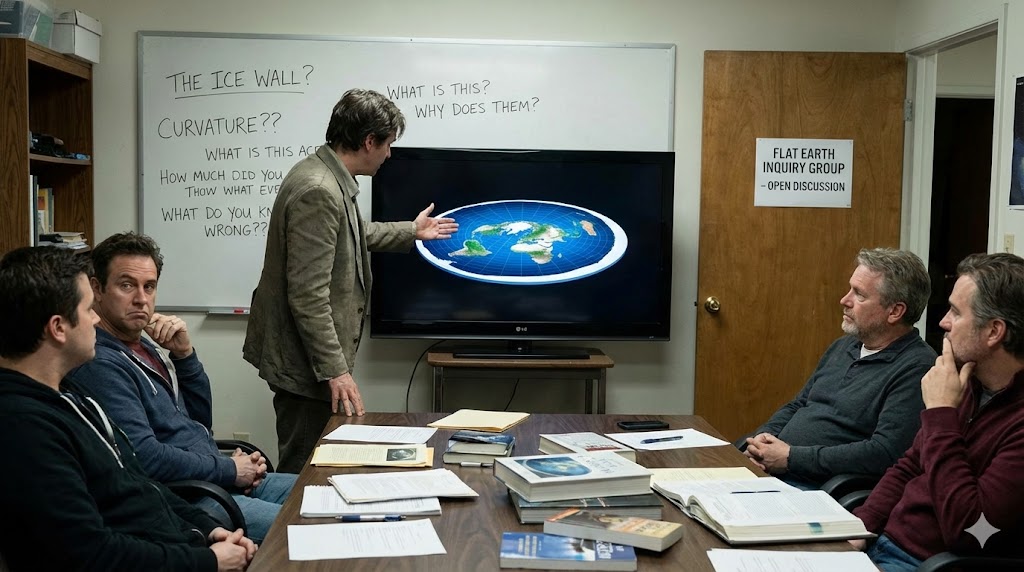
The concept of a flat Earth has been a topic of debate for centuries, with many flat earth questions being raised by those who challenge the widely accepted fact that our planet is an oblate spheroid. Despite the overwhelming evidence supporting the round Earth theory, there are still many who claim that the Earth is flat, and they pose some intriguing flat earth questions that have sparked intense discussions and controversies. In this article, we will delve into the world of flat earth questions and explore the reasons behind the persistence of this idea, as well as the scientific community’s response to these claims.
The idea of a flat Earth dates back to ancient civilizations, where the concept of a flat disc or plate was used to describe the shape of the Earth. The ancient Greeks, such as Aristotle and Eratosthenes, were among the first to propose the idea of a spherical Earth, but it wasn’t until the 16th century that the concept of a round Earth became widely accepted. However, even with the advent of modern science and technology, flat earth questions continue to persist, with many proponents claiming that the Earth is flat and that governments and other organizations are hiding the truth from the public.
In recent years, the flat earth movement has gained significant attention, with many proponents posing flat earth questions that challenge the fundamental principles of modern science. Some of the most common flat earth questions include: what is the true shape of the Earth, why do we not feel like we are moving when we are on a plane, and why can’t we see the curvature of the Earth with our own eyes? These questions, along with many others, have sparked intense debates and have led to the development of various conspiracy theories surrounding the shape of the Earth.
The Horizon Always Appears to be at Eye Level
One of the most commonly cited flat earth questions is the fact that the horizon always appears to be at eye level, regardless of the observer’s location or altitude. Flat earth proponents claim that if the Earth were truly round, the horizon should appear to be below the observer’s eye level, due to the curvature of the planet. However, this argument is based on a fundamental misunderstanding of the way the human eye perceives the horizon. The apparent flatness of the horizon is due to the Earth’s atmosphere, which scatters light and creates the illusion of a flat horizon. This phenomenon can be easily observed and measured, and it is a fundamental aspect of atmospheric science.
The Lack of Visible Curvature
Another common flat earth question is the lack of visible curvature of the Earth. Proponents claim that if the Earth were truly round, we should be able to see the curvature of the planet with our own eyes. However, the curvature of the Earth is actually very subtle, and it is not visible to the naked eye. The Earth’s radius is approximately 6,371 kilometers, which means that the curvature of the planet is very gradual, and it is not noticeable at close range. This is why we need to use specialized instruments, such as satellites and spacecraft, to observe and measure the curvature of the Earth.
The Behavior of Water
Flat earth questions often focus on the behavior of water, particularly the fact that the surface of the ocean appears to be flat and level. Proponents claim that if the Earth were truly round, the surface of the ocean should be curved, and that the water should be flowing towards the center of the planet. However, this argument ignores the fact that the surface of the ocean is subject to various forces, including gravity, wind, and tides, which all contribute to its apparent flatness. Additionally, the concept of a “level” surface is relative, and it depends on the frame of reference. The surface of the ocean may appear flat to an observer on the surface, but it is actually following the curvature of the Earth.
The Existence of the Firmament
Some flat earth questions focus on the concept of the firmament, a solid dome that is believed to exist above the flat Earth. Proponents claim that the firmament is supported by biblical and other ancient texts, and that it provides a solid barrier between the Earth and the atmosphere. However, this idea is not supported by scientific evidence, and it is not compatible with our current understanding of the universe. The firmament is a mythological concept that has been disproven by various scientific discoveries, including the existence of satellites and spacecraft that have imaged the Earth from space.
The Role of Governments and Other Organizations
Finally, many flat earth questions focus on the role of governments and other organizations in promoting the idea of a round Earth. Proponents claim that these organizations are hiding the truth from the public, and that they are actively working to suppress evidence of the flat Earth. However, this argument is based on a fundamental misunderstanding of the way science works, and it ignores the fact that scientific discoveries are often the result of independent research and verification. The idea of a round Earth is not a conspiracy theory, but rather a scientific fact that has been consistently supported by evidence from various fields of study.
Despite the persistence of flat earth questions, the scientific community has consistently provided evidence and explanations to address these claims. One of the most common counter-arguments is the fact that the Earth’s shape can be measured and observed using a variety of methods, including satellite imagery, GPS, and seismic data. These methods all confirm that the Earth is an oblate spheroid, meaning that it is slightly flattened at the poles and bulging at the equator. Additionally, the existence of time zones, the difference in local gravity measurements, and the observation of ships disappearing over the horizon all provide evidence for the roundness of the Earth.
In conclusion, flat earth questions have been a topic of debate for centuries, and they continue to spark intense discussions and controversies. While the scientific community has consistently provided evidence and explanations to address these claims, the persistence of flat earth questions highlights the need for ongoing education and critical thinking. By examining the top 10 flat earth questions and addressing the counter-arguments, we can gain a deeper understanding of the significance of this topic and the importance of promoting scientific literacy and critical thinking. Ultimately, the flat earth phenomenon serves as a reminder of the importance of skepticism, inquiry, and the pursuit of knowledge, and it highlights the need for ongoing dialogue and debate in the scientific community.
Some of the key takeaways from this article include:
- The concept of a flat Earth has been around for centuries, but it has been consistently disproven by scientific evidence and observations.
- Flat earth questions often focus on the apparent flatness of the horizon, the lack of visible curvature, and the behavior of water, but these claims can be easily addressed by scientific explanations and evidence.
- The idea of a firmament is a mythological concept that has been disproven by scientific discoveries, and it is not compatible with our current understanding of the universe.
- The role of governments and other organizations in promoting the idea of a round Earth is often misunderstood, and it ignores the fact that scientific discoveries are often the result of independent research and verification.
- The persistence of flat earth questions highlights the need for ongoing education and critical thinking, and it serves as a reminder of the importance of skepticism, inquiry, and the pursuit of knowledge.
By exploring the world of flat earth questions and examining the evidence and explanations that address these claims, we can gain a deeper understanding of the significance of this topic and the importance of promoting scientific literacy and critical thinking. Ultimately, the flat earth phenomenon serves as a reminder of the importance of ongoing dialogue and debate in the scientific community, and it highlights the need for continued exploration and discovery in the pursuit of knowledge and understanding.