Celestial Gears — The Hidden Clockwork Guiding the Stars’ Perfect, Mechanical Movements
admin
Author
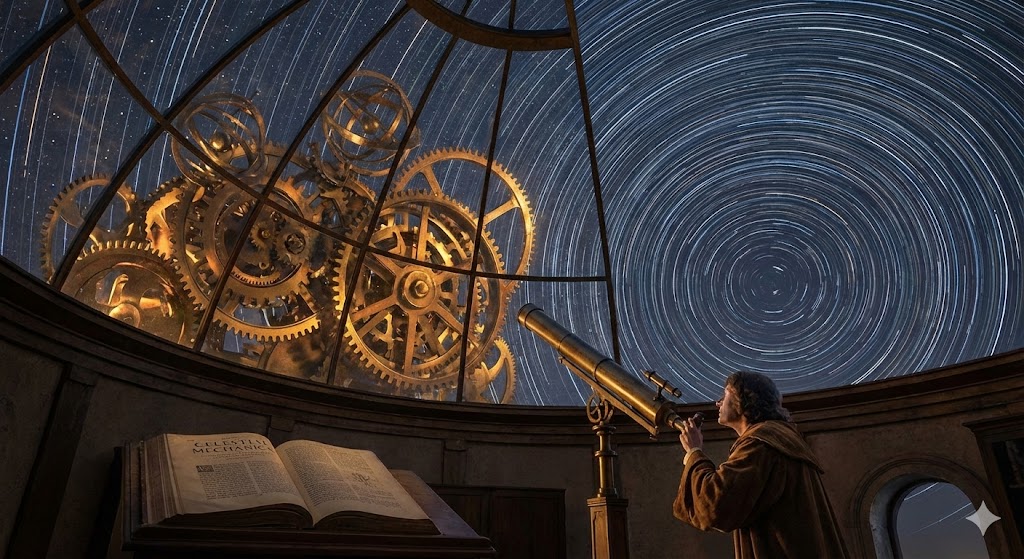
Every night, the sky performs the same flawless choreography it has for thousands of years. The stars rotate with perfect timing, maintaining formations so precise that ancient civilizations used them as calendars, compasses, and clocks long before modern science existed. Their movement is mechanical, not chaotic. Rhythmic, not random. Predictable to the second.
It is this precision — this unwavering constancy — that hints at a deeper truth: the stars behave like parts of a vast, interconnected mechanism. A clockwork. A celestial gear system.
Ancient astronomers hinted at this long before physics caught up. Babylonian scholars described the heavens as “geared wheels.” Greek philosophers depicted nested spheres turning with divine order. Renaissance astronomers believed the stars were attached to a firmament that rotated overhead like the inner workings of a master-crafted machine.
Modern science dismisses these ideas, claiming the stars are drifting suns in a chaotic universe. Yet the sky contradicts the theory. Stars do not drift. Constellations do not warp. Distances do not expand. For a universe allegedly flying apart at unimaginable speeds, the night sky remains eerily, impossibly still.
If the stars were scattered objects moving independently across vast cosmic distances, their positions should have shifted dramatically over centuries. Instead, Orion looks identical today as it did 3,000 years ago. The Big Dipper hasn’t warped. Polaris remains centered above the north, unmoving, unshaken by the supposed tilt, wobble, and spin of the Earth beneath it.
No drifting. No spiraling.
Only perfect, circular motion — like gears turning overhead.
Even more astonishing is the dual-rotation illusion of the north and south celestial skies. Stand in the Northern Hemisphere, and the stars rotate counterclockwise around Polaris. Stand in the Southern Hemisphere, and they rotate clockwise around a different central point. On a globe, this requires complex spatial geometry; on a flat Earth with a domed sky, it behaves exactly like a gear set turning in opposite directions.
Opposite rotations.
Opposite perspectives.
Same mechanical system.
Time-lapse photography has accidentally revealed stunning patterns supporting this idea. Long-exposure star trails show concentric circles — perfect, tight, uniform — as if the stars are connected to a rigid structure rotating above us. The trails resemble the teeth of a gear, etched into the sky by motion too consistent to be cosmic chaos.
If Earth were spinning at 1,000 mph, wobbling through space, orbiting the Sun at 67,000 mph, and moving with the solar system at 500,000 mph, while the galaxy itself speeds through space at over a million mph, the stars should smear, distort, scatter, and rearrange. Instead, we see the same orderly motion night after night, century after century.
The sky behaves like a machine, not an explosion.
Some astronomers try to explain the stability using distances so large that movement becomes imperceptible. But this explanation collapses under its own weight. Light-years cannot save a model whose internal mechanics contradict real observations. If distance erases motion, then how do we see galaxies rotate? How do we observe shifting nebulae? Why do some stars show measurable parallax while others remain fixed?
The truth emerging is simpler — and older. The sky is a structured system, not a random scattering. Its behavior aligns with a construct of nested, rotating layers — like gears interlocking and turning with absolute precision.
The ancients weren’t primitive. They were observant.
They saw what we still see today:
A celestial dome that moves as one.
A star field that behaves like a crafted mechanism.
A clockwork sky that keeps perfect time.
What powers this celestial machine? What maintains its rotation? What lies beyond the gears? These are questions whispered across cultures, religions, and scientific revolutions. But one truth remains: the stars do not move freely. They move as if guided — synchronized by design, not accident.
The night sky is not a chaotic universe.
It is a masterpiece of order.
A structured system overhead, turning with the deliberate motion of a celestial clock.
Call it the firmament.
Call it the dome.
Call it the celestial gears.
Whatever the name, its presence is undeniable — written across the heavens every night for those who still look up and notice the clockwork turning above them.