The Spinning Ball vs. Your Senses: Why the “Motionless” Earth is the Ultimate Truth
admin
Author
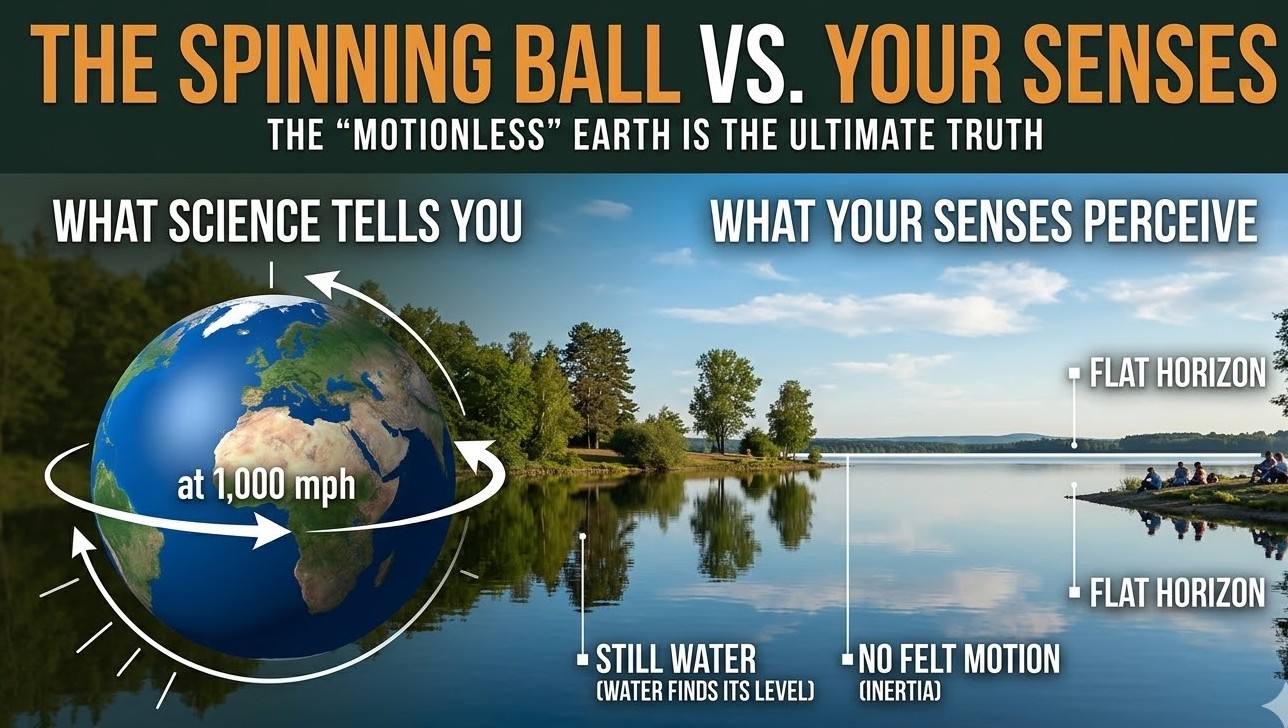
We are told from birth that we are living on a “blue marble” hurtling through a vacuum at 67,000 mph, spinning at 1,000 mph, and wobbling through a galaxy at speeds that would make a jet fighter look like a snail. But have you ever stopped to actually feel it?
If you’re sitting in a chair reading this, you feel absolutely nothing. No vibration, no wind, no centrifugal force. The “Globturds” will tell you it’s because the motion is “constant,” like being in an airplane. But even in the smoothest airplane, you can feel the hum of the engine and the slight tilt of a turn. On “Ball Earth,” we are supposedly corkscrewing through space in multiple directions at once, yet a lake remains as glass-still as a mirror.
The Atmosphere Problem: Why Doesn’t the Air Get Left Behind?
According to the globe model, the atmosphere is “magically” tethered to the Earth by gravity, spinning perfectly in sync with the rock beneath it.
-
The Flight Log: If the Earth is spinning 1,000 mph to the East, a plane flying West should reach its destination significantly faster, as the Earth is literally rotating toward it. Instead, flight times remain consistent in both directions.
-
The Cannonball Run: If you fire a cannonball straight up, and the Earth is spinning beneath it at 1,000 mph, that ball should land miles away. It doesn’t. It lands right back where it started.
The Vacuum vs. The Pressure
The most glaring hole in the “Space Ball” theory is the existence of our atmosphere next to a “near-perfect vacuum.” In every laboratory on Earth, high pressure always expands to fill low pressure unless there is a physical barrier (like a container).
We are told the Earth has no “lid,” yet the air doesn’t get sucked into the infinite vacuum of space. They say “gravity” does it—the same gravity that can’t even stop a tiny bird from flying or a balloon from rising.
What You Are Actually Seeing
When you look up, you see the sun, moon, and stars revolving around you. Every ancient civilization for thousands of years described the Earth as the stationary center of the universe, protected by a firmament. It wasn’t until “science” decided to sell us on the idea that we are insignificant specks on a spinning dust mote that we started doubting our own eyes.