The “Globe-Trotters” vs. The Reality: Why NASA’s Art Department Deserves an Oscar
admin
Author
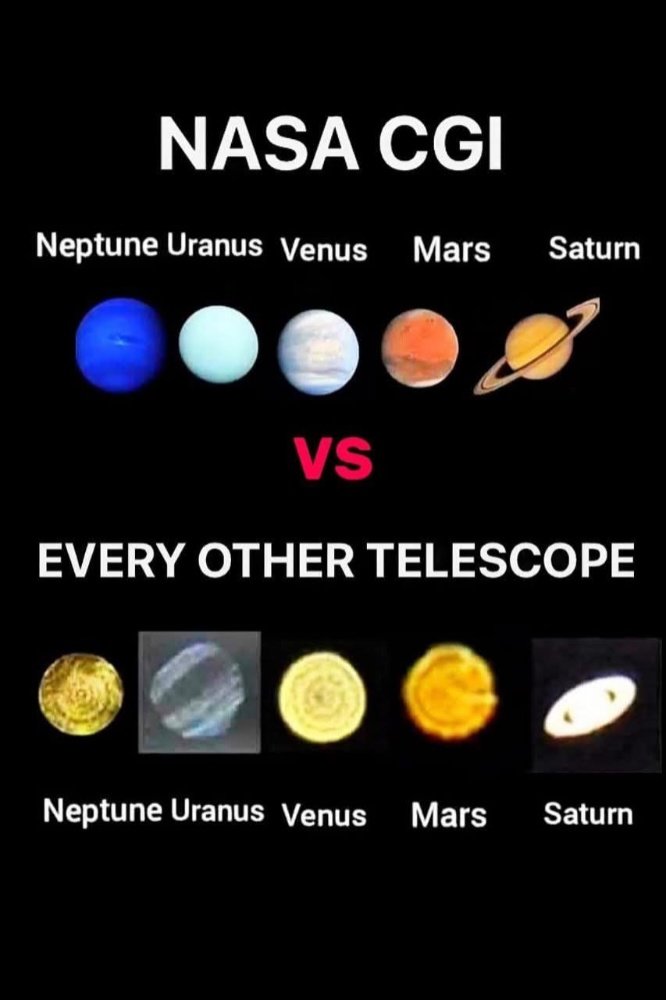
We’ve all seen them: those sleek, marble-smooth, neon-blue spheres NASA pushes out every few months. They call them “planets.” We call them what they actually are—high-budget screen savers. If you’ve ever wondered why your $500 backyard telescope doesn’t show you a 4K rendering of Neptune’s “storms,” but instead gives you a shimmering, vibrating light show that looks like a disco ball underwater, congratulations. You’ve just encountered reality. Welcome to the side of the fence where we don’t need a green screen to explain the horizon.
The CGI “Masterpieces”
According to the “Globe-turds,” NASA is out there snapping high-res selfies of gas giants billions of miles away. Look at the top row of that image. It’s perfect. It’s symmetrical. It’s… suspiciously similar to a Photoshop “gradient fill” tool.
-
Neptune: A deep, royal blue that looks like it was plucked straight from a Gatorade commercial.
-
Saturn: Those rings are so crisp you could slice bread on them.
-
The Problem: Why is it that only NASA’s billion-dollar “space cameras” see these solid objects, while the rest of us see what’s actually there?
The “Backyard” Reality
Now, look at the bottom row. This is what every other telescope on Earth sees. These aren’t solid rocks or gas balls spinning in a vacuum; they are luminaries.
-
The Shimmer: Notice how they look “liquid” or electric? That’s because they aren’t solid spheres millions of miles away; they are lights within the firmament.
-
The Focus: The “Globers” will tell you your telescope is just “out of focus.” Funny how “out of focus” consistently reveals intricate, geometric patterns and pulsing frequencies that look nothing like the cartoons NASA sells us.
-
The Saturn “Blob”: Even Saturn, the poster child for the heliocentric model, looks more like a glowing LED light than a rock with hula hoops.
Why the “Globers” are Glued to the Screen
It’s hard to blame them, really. It’s easier to believe in a beautiful, CGI fairy tale than to admit you’ve been living on a stationary plane your whole life. To the “Globturds,” a composite image made of “data points” is more real than the evidence of their own eyes.
“It’s photoshopped, but it has to be.” — Actual NASA Spokesperson (basically).
They’ll tell you the Earth is a “pear-shaped” spinning ball, yet every photo they show you is a perfect circle. They’ll tell you gravity holds the oceans to a spinning marble, but it can’t keep a butterfly from taking off.
Bottom Line: Trust Your Eyes, Not Their Pixels
If NASA’s “planets” were real, you wouldn’t need a supercomputer to render them. You’d be able to see those crisp edges for yourself. Instead, we get shimmering lights that look more like sonoluminescence than “gas giants.”
Keep your “globes” in the classroom where they belong—next to the other works of fiction. We’ll stay down here on the level ground, watching the real show in the sky.