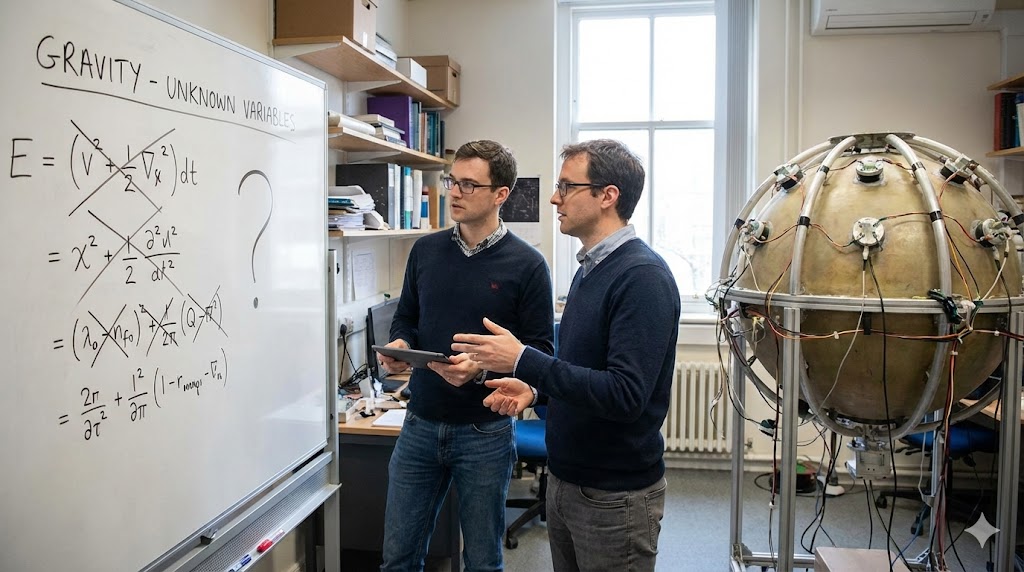
Gravity, the fundamental force that governs the behavior of objects with mass or energy, has long been a cornerstone of our understanding of the universe. From the falling of an apple from a tree to the orbits of planets around their stars, gravity is the underlying mechanism that makes it all possible. However, what if everything we know about gravity is wrong? What if our current understanding of this force is incomplete, or worse, entirely misguided? In this article, we will delve into the dark secret of gravity, exploring the possibilities that our comprehension of this phenomenon is far from accurate.
Our understanding of gravity has undergone significant transformations throughout history. From Aristotle’s concept of natural motion to Newton’s law of universal gravitation, the concept of gravity has been refined and expanded upon. The most significant breakthrough came with Albert Einstein’s theory of general relativity, which introduced the concept of gravity as the curvature of spacetime caused by massive objects. This theory has been widely accepted and has formed the foundation of modern astrophysics and cosmology. However, as we will explore in this article, there are still many unanswered questions and unexplained phenomena that suggest our understanding of gravity may be incomplete.
Gravity is often described as a force that attracts two objects with mass towards each other. The strength of this force depends on the mass of the objects and the distance between them. However, this description only scratches the surface of the complex and multifaceted nature of gravity. Gravity is not just a force; it is also a curvature of spacetime that affects the motion of objects. The more massive the object, the greater the curvature of spacetime around it, and the stronger the gravitational pull. But what if this understanding of gravity is not entirely accurate? What if there are other factors at play that we have not yet considered?
One of the most significant challenges to our current understanding of gravity is the problem of dark matter. Dark matter is a type of matter that does not emit, absorb, or reflect any electromagnetic radiation, making it invisible to our telescopes. Despite its elusive nature, dark matter’s presence can be inferred through its gravitational effects on visible matter. The problem is that the amount of dark matter required to explain the observed gravitational effects is much greater than the amount of visible matter. This discrepancy has led to a re-evaluation of our understanding of gravity and the possibility that there may be other forces at play.
- Dark matter makes up approximately 27% of the universe’s mass-energy density, while visible matter makes up only about 5%.
- The existence of dark matter was first proposed by Swiss astrophysicist Fritz Zwicky in the 1930s.
- Dark matter’s presence can be inferred through its gravitational effects on galaxy rotation curves and the distribution of galaxy clusters.
Gravitational waves are ripples in the fabric of spacetime that were predicted by Einstein’s theory of general relativity. The detection of gravitational waves by the Laser Interferometer Gravitational-Wave Observatory (LIGO) in 2015 confirmed a key prediction of general relativity. However, the observation of gravitational waves has also raised more questions than answers. For example, the amplitude of the detected gravitational waves is much larger than expected, suggesting that our understanding of the sources of these waves may be incomplete.
- Gravitational waves are produced by the acceleration of massive objects, such as black holes or neutron stars.
- The detection of gravitational waves has opened a new window into the universe, allowing us to study cosmic phenomena in ways that were previously impossible.
- The observation of gravitational waves has also raised questions about the nature of gravity and the behavior of matter in extreme environments.
Quantum gravity is the theoretical framework that attempts to merge quantum mechanics and general relativity. However, the two theories are fundamentally incompatible within the framework of classical physics. Quantum gravity is necessary to describe the behavior of matter and energy under extreme conditions, such as those found in black holes or the early universe. However, the development of a consistent theory of quantum gravity has proven to be a significant challenge, and it is unclear whether our current understanding of gravity is compatible with the principles of quantum mechanics.
- Quantum gravity is necessary to describe the behavior of matter and energy at the Planck scale, where the effects of gravity and quantum mechanics are both significant.
- The development of a consistent theory of quantum gravity has been an active area of research for decades, with several approaches being explored, including loop quantum gravity and string theory.
- Quantum gravity may require a radical rethinking of our understanding of space, time, and matter, and may have significant implications for our understanding of the universe.
Gravity is the weakest of the four fundamental forces of nature, and its strength is difficult to explain. The strength of gravity is measured by the gravitational constant (G), which is a fundamental constant of nature. However, the value of G is difficult to measure with high precision, and its value may vary depending on the location and the objects being measured. This uncertainty has significant implications for our understanding of the universe, particularly on large scales.
- The gravitational constant (G) is a fundamental constant of nature that describes the strength of gravity.
- The value of G is difficult to measure with high precision, and its value may vary depending on the location and the objects being measured.
- The uncertainty in the value of G has significant implications for our understanding of the universe, particularly on large scales, where gravity plays a dominant role.
Alternative theories of gravity, such as MOND (Modified Newtonian Dynamics) and TeVeS (Tensor-Vector-Scalar), have been proposed to explain the observed behavior of galaxies and galaxy clusters without the need for dark matter. These theories modify the law of gravity on large scales, introducing new forces or fields that affect the motion of objects. While these theories are still highly speculative, they have sparked a lively debate about the nature of gravity and the role of dark matter in the universe.
- Alternative theories of gravity, such as MOND and TeVeS, have been proposed to explain the observed behavior of galaxies and galaxy clusters without the need for dark matter.
- These theories modify the law of gravity on large scales, introducing new forces or fields that affect the motion of objects.
- The debate about alternative theories of gravity has sparked a re-evaluation of our understanding of the universe and the role of dark matter in its evolution.
While the idea that our understanding of gravity may be incomplete or incorrect is intriguing, there are also many arguments in favor of the status quo. The current understanding of gravity, based on general relativity and the standard model of particle physics, has been incredibly successful in explaining a wide range of phenomena, from the motion of planets to the expansion of the universe. The introduction of alternative theories or modifications to the law of gravity would require significant changes to our understanding of the universe, and it is unclear whether these changes would be supported by empirical evidence.
- The current understanding of gravity, based on general relativity and the standard model of particle physics, has been incredibly successful in explaining a wide range of phenomena.
- The introduction of alternative theories or modifications to the law of gravity would require significant changes to our understanding of the universe.
- Any alternative theory or modification would need to be supported by empirical evidence and would require a significant amount of experimental and observational data to confirm its validity.
In conclusion, the idea that our understanding of gravity may be incomplete or incorrect is a fascinating and complex topic that has sparked a lively debate among physicists and cosmologists. While our current understanding of gravity, based on general relativity and the standard model of particle physics, has been incredibly successful in explaining a wide range of phenomena, there are still many unanswered questions and unexplained phenomena that suggest that our comprehension of this force may be far from accurate. As we continue to explore the universe and push the boundaries of our knowledge, it is possible that we may uncover new and unexpected aspects of gravity that challenge our current understanding and force us to re-evaluate our understanding of the cosmos.
- The study of gravity is an active area of research, with many scientists working to refine our understanding of this force and its role in the universe.
- The discovery of new phenomena, such as gravitational waves and dark matter, has opened up new avenues of research and has the potential to significantly advance our understanding of the universe.
- Ultimately, the study of gravity is a complex and multifaceted field that requires the collaboration of scientists from many different disciplines, including physics, astronomy, and mathematics.