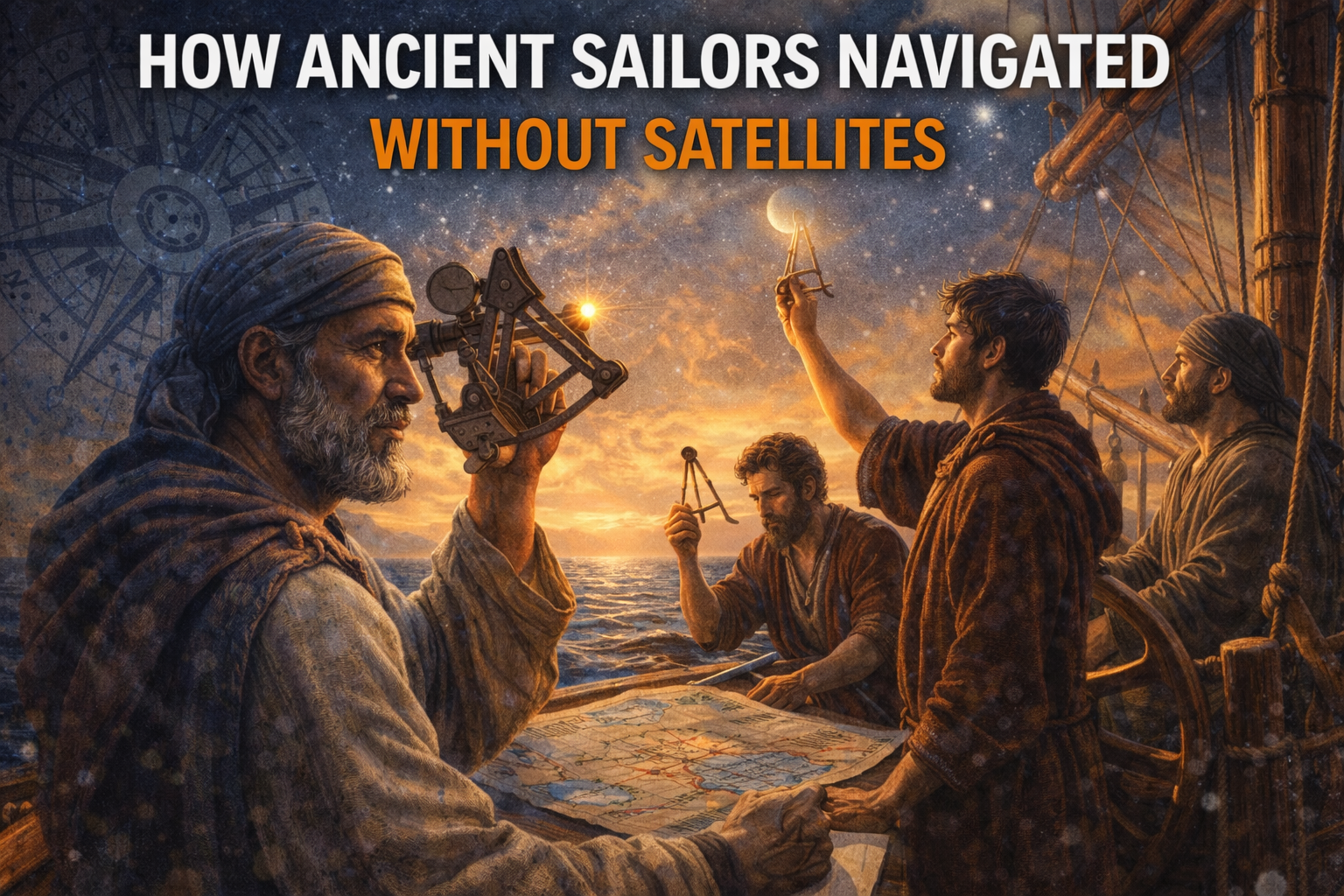
Modern navigation relies heavily on satellites, digital maps, and real-time positioning systems. Yet thousands of years before these technologies existed, ancient sailors successfully crossed oceans, discovered distant lands, and maintained trade routes spanning continents. Their ability to navigate without satellites was not accidental—it was the result of careful observation, accumulated knowledge, and sophisticated techniques passed down through generations.
Understanding how ancient sailors navigated offers insight into early scientific thinking and humanity’s long-standing relationship with the natural world.
The Importance of Observation
Ancient navigation began with close observation of the environment. Sailors studied the sky, sea, winds, and wildlife, learning to interpret subtle patterns that indicated direction and location. Over time, these observations formed reliable systems that allowed for long-distance travel.
Navigation was not based on a single method, but on combining multiple cues to confirm a vessel’s position.
Celestial Navigation and the Stars
One of the most important tools for ancient sailors was the night sky. Stars move in predictable patterns, and certain stars maintain fixed positions relative to Earth’s axis.
Key techniques included:
-
Using the North Star to determine latitude in the Northern Hemisphere
-
Tracking the rising and setting positions of specific stars
-
Memorizing star paths associated with seasonal travel routes
Polynesian navigators, for example, developed detailed star maps passed down orally, allowing them to travel between islands with remarkable accuracy.
The Sun and Shadow Tracking
During daylight hours, sailors used the sun’s position to determine direction. By observing the sun’s arc across the sky and the length and angle of shadows, navigators could estimate both time and orientation.
Simple tools such as shadow boards and marked staffs helped sailors track solar movement and maintain a steady course.
Wind and Current Knowledge
Ocean winds and currents follow consistent seasonal patterns. Ancient sailors learned these patterns through experience and used them to plan voyages.
Examples include:
-
Monsoon winds used by Indian Ocean traders
-
Trade winds relied upon by early Atlantic explorers
-
Coastal currents used for predictable return routes
Understanding these forces allowed sailors to travel efficiently and avoid unnecessary risk.
Reading the Sea and Wildlife
Experienced sailors observed the behavior of waves, cloud formations, and marine life. Certain wave patterns indicated nearby land, while the presence of specific birds suggested proximity to shore.
Floating vegetation, water color changes, and temperature variations also provided valuable navigational clues.
Dead Reckoning and Distance Estimation
Dead reckoning involved calculating a vessel’s position based on speed, direction, and time traveled. Sailors estimated speed by observing water movement along the hull or by timing objects drifting past the ship.
Although not perfectly precise, dead reckoning was effective when combined with environmental observations and celestial guidance.
Early Navigation Instruments
Over time, sailors developed instruments to improve accuracy, including:
-
The astrolabe for measuring star angles
-
The quadrant for calculating latitude
-
Early compasses for directional reference
These tools enhanced existing knowledge rather than replacing observational skills.
Oral Knowledge and Training
Navigation knowledge was often passed orally through stories, songs, and apprenticeship. This ensured that complex information could be memorized and preserved even without written charts.
In many cultures, navigators were highly respected specialists who trained for years before leading voyages.
Conclusion
Ancient sailors navigated without satellites by relying on careful observation, celestial patterns, environmental awareness, and accumulated experience. Their success demonstrates that long-distance navigation was possible through disciplined study of nature and systematic knowledge transfer.
These early methods laid the foundation for modern navigation and remain a testament to human ingenuity long before digital technology.