You Won’t Believe What Earth Looked Like 250 Million Years Ago!
admin
Author
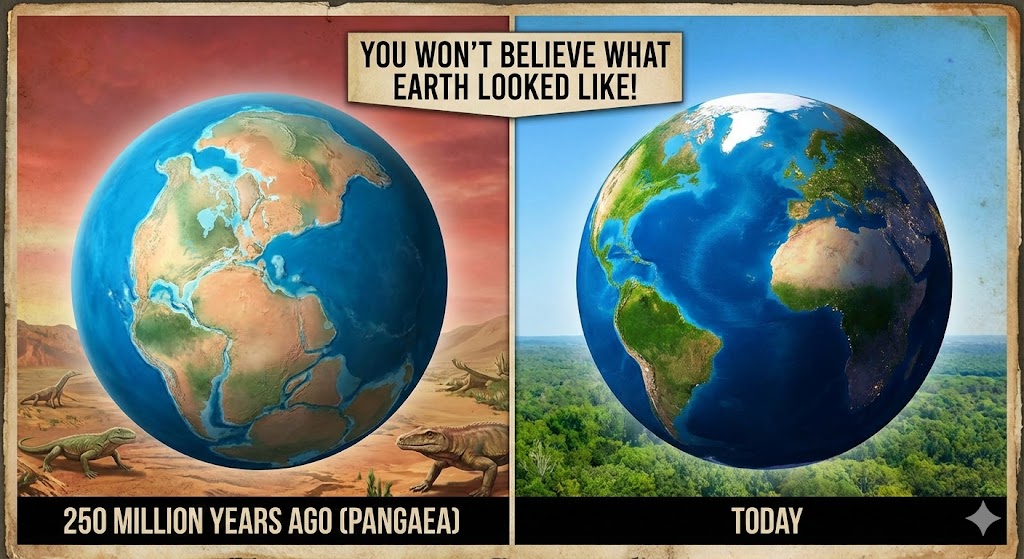
Imagine a time when Earth’s continents were merged into a single supercontinent, surrounded by a global ocean. This was the reality 250 million years ago, during the Paleozoic and Mesozoic eras. The Earth’s landscape has undergone significant transformations over the past few billion years, shaped by tectonic forces, volcanic activity, and changes in the climate. In this article, we will delve into the history of our planet, exploring what Earth looked like 250 million years ago, and how it has evolved over time. From the formation of the supercontinent Pangaea to the current configuration of Earth’s continents, we will examine the geological and paleontological evidence that has helped us reconstruct the Earth’s past.
Historical Context: Understanding Earth’s Continents
The study of Earth’s history is a complex and multidisciplinary field, involving geology, paleontology, and geophysics. By analyzing fossils, rocks, and geological structures, scientists have been able to reconstruct the Earth’s past, including the movement of Earth’s continents. The theory of continental drift, first proposed by Alfred Wegener in the early 20th century, suggests that Earth’s continents have moved over time, occasionally merging to form supercontinents. One of the most significant supercontinents in Earth’s history was Pangaea, which began to form around 300 million years ago and started to break apart about 200 million years ago.
Earth’s Continents: The Supercontinent Pangaea
Pangaea was a massive supercontinent that encompassed all of Earth’s continents, including Africa, Antarctica, Asia, Australia, Europe, North America, and South America. The supercontinent began to take shape during the Paleozoic era, as the continents collided and merged. Pangaea was surrounded by a global ocean, known as the Panthalassic Ocean, which covered much of the Earth’s surface. The formation of Pangaea had a significant impact on the Earth’s climate, leading to the creation of vast deserts and mountain ranges. The supercontinent also played a crucial role in the evolution of life on Earth, as it provided a platform for the diversification of species.
The Breakup of Pangaea and the Formation of Modern Earth’s Continents
The breakup of Pangaea marked the beginning of a new era in Earth’s history, as the supercontinent slowly fragmented into several smaller continents. This process, known as continental rifting, occurred over millions of years, as tectonic forces pulled the continents apart. The breakup of Pangaea led to the creation of new oceans, including the Atlantic Ocean, which now separates the Americas from Europe and Africa. The modern configuration of Earth’s continents is a result of this process, which continues to shape our planet today.
Section 1: The Paleozoic Era – Earth’s Continents in the Early Days
The Paleozoic era, which spanned from about 541 to 252 million years ago, was a time of significant geological and biological change. During this era, Earth’s continents were still in the process of forming, and the supercontinent Pangaea was beginning to take shape. The Paleozoic era saw the evolution of complex life forms, including fish, amphibians, and early reptiles. The era also witnessed significant geological events, including the formation of mountain ranges and the creation of vast coal deposits. The Paleozoic era laid the foundation for the modern Earth, including the formation of Earth’s continents and the creation of the atmosphere.
Section 2: The Mesozoic Era – The Age of Reptiles and Earth’s Continents
The Mesozoic era, which lasted from about 252 to 66 million years ago, is often referred to as the Age of Reptiles. During this era, dinosaurs dominated Earth’s landscapes, and Earth’s continents continued to evolve. The supercontinent Pangaea began to break apart, leading to the creation of new oceans and the modern configuration of Earth’s continents. The Mesozoic era also saw significant geological events, including volcanic eruptions and the formation of mountain ranges. The era came to an end with the mass extinction event that wiped out the dinosaurs, paving the way for the evolution of mammals and eventually, humans.
Section 3: The Cenozoic Era – The Age of Mammals and Modern Earth’s Continents
The Cenozoic era, which spans from about 66 million years ago to the present, is often referred to as the Age of Mammals. During this era, Earth’s continents have continued to evolve, with the formation of new mountain ranges and the creation of modern landscapes. The Cenozoic era has also seen significant changes in the Earth’s climate, including the formation of ice ages and the development of modern ecosystems. The era has been marked by the evolution of complex life forms, including humans, who have had a significant impact on the Earth’s environment and the configuration of Earth’s continents.
Section 4: The Geological Record – Uncovering the History of Earth’s Continents
The geological record provides a wealth of information about the history of Earth’s continents. By analyzing rocks, fossils, and geological structures, scientists have been able to reconstruct the Earth’s past, including the movement of Earth’s continents. The geological record shows that Earth’s continents have undergone significant changes over the past few billion years, including the formation and breakup of supercontinents. The record also provides evidence of significant geological events, including volcanic eruptions, earthquakes, and the creation of mountain ranges.
Section 5: The Future of Earth’s Continents – What’s Next?
The future of Earth’s continents is uncertain, as the planet continues to evolve and change. The process of plate tectonics, which has shaped the Earth’s surface over billions of years, is still ongoing, and the continents will continue to move and change. The future may see the formation of new supercontinents, or the breakup of existing ones. The Earth’s climate will also continue to play a significant role in shaping the planet, with potential changes in sea levels, ocean currents, and the formation of new landscapes. As humans, we must be aware of these changes and work to mitigate the impact of our activities on the Earth’s environment and the configuration of Earth’s continents.
Counter-Arguments: Challenges to the Theory of Continental Drift
While the theory of continental drift is widely accepted, there are still some challenges and counter-arguments to the idea. Some scientists argue that the evidence for continental drift is not conclusive, and that other factors, such as changes in sea levels or the formation of ice ages, could have played a role in shaping the Earth’s surface. Others argue that the process of plate tectonics, which is thought to drive continental drift, is not well understood, and that more research is needed to fully comprehend the mechanisms behind the movement of Earth’s continents. However, the overwhelming evidence from geology, paleontology, and geophysics supports the theory of continental drift, and the idea that Earth’s continents have moved over time.
Conclusion: The Ever-Changing Earth’s Continents
In conclusion, the Earth’s continents have undergone significant transformations over the past few billion years, shaped by tectonic forces, volcanic activity, and changes in the climate. The theory of continental drift provides a framework for understanding these changes, and the evidence from geology, paleontology, and geophysics supports the idea that Earth’s continents have moved over time. As we look to the future, it is essential to recognize the dynamic nature of the Earth’s surface and the ongoing process of plate tectonics, which will continue to shape the planet and the configuration of Earth’s continents. By understanding the history of our planet, we can better appreciate the complex and interconnected systems that support life on Earth, and work to mitigate the impact of human activities on the environment and the Earth’s continents.
- The Earth’s continents have undergone significant transformations over the past few billion years.
- The theory of continental drift provides a framework for understanding these changes.
- The evidence from geology, paleontology, and geophysics supports the idea that Earth’s continents have moved over time.
- The process of plate tectonics, which drives continental drift, is still ongoing and will continue to shape the planet.
- Understanding the history of our planet is essential for appreciating the complex and interconnected systems that support life on Earth.
As we continue to explore and understand the Earth’s history, we are reminded of the dynamic and ever-changing nature of our planet. The story of Earth’s continents is a complex and fascinating one, full of twists and turns that have shaped the course of life on Earth. By studying the Earth’s past, we can gain a deeper appreciation for the intricate web of relationships that exist between the planet’s systems, and work towards a more sustainable future for all.