The Shadow Line — Why Lunar Eclipses Behave Nothing Like a Globe’s Shadow
admin
Author
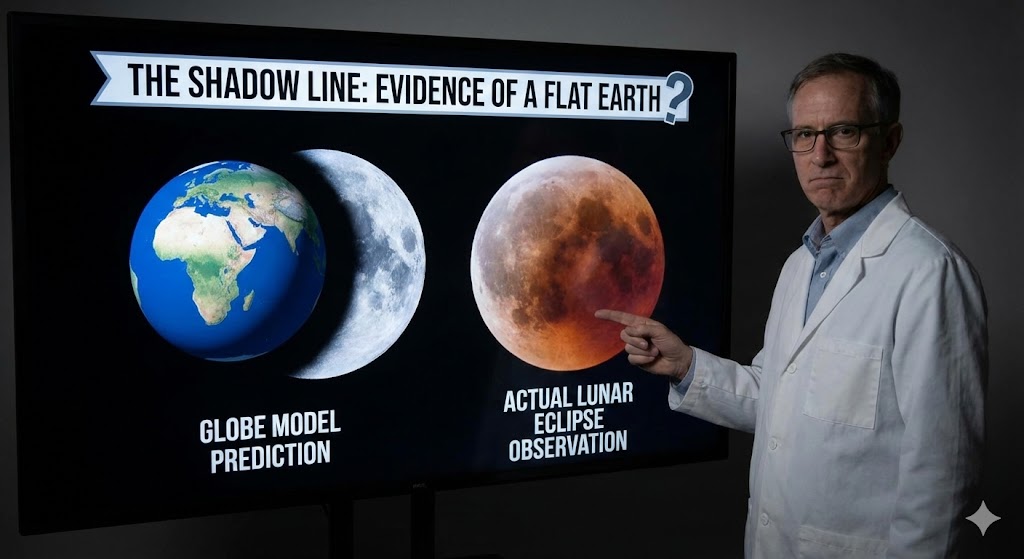
For generations we have been told that a lunar eclipse is simple: the Earth moves between the Sun and the Moon, casting a round shadow that darkens the moonlight. Elegant. Textbook. Almost too perfect.
But when real eclipses are observed — not in classroom diagrams, but in the sky, in time-lapse photography, in global visibility maps — the neat geometry collapses. The eclipse behaves like something else entirely, something far stranger and harder to explain.
Lunar eclipses do not follow the timing the globe model demands. They do not appear only when the Moon is directly opposite the Sun. They sometimes begin while the Sun and Moon are visible in the same sky — an impossibility if the Earth’s shadow is doing the work. And the shadow itself? It often travels in the wrong direction, curves oddly, or covers the Moon at angles that defy the alleged alignment in space.
Even more unsettling: the eclipse is visible from locations that should not be able to see Earth’s shadow at all.
For an eclipse caused by Earth’s shadow, geometry is non-negotiable. There must be a straight line: Sun → Earth → Moon. Yet eclipses have been documented when observers see the Sun on one horizon and the Moon on the opposite horizon. If Earth were between them, the Sun should be blocked entirely. Instead, sunlight illuminates the world normally while the Moon mysteriously darkens. How can Earth cast a shadow while simultaneously letting sunlight pass unobstructed?
Ancient astronomers noticed this long before modern theories attempted to explain it away. The Greeks recorded lunar eclipses occurring during full daytime. Asian astronomers described partial eclipses beginning before moonrise. These observations were preserved for thousands of years not because they were anomalies, but because they were common.
Then there is the motion of the shadow itself. On a rotating sphere moving around a distant sun, the shadow should sweep in a predictable arc. But real eclipses often show the shadow moving from bottom to top, from left to right, or diagonally — movements inconsistent with a straight-line cosmic alignment. Time-lapse videos reveal a shadow that behaves independently of the Earth–Sun orientation.
The shape complicates things further. The darkened portion often takes on a soft-edged, atmospheric tint — a reddish glow known as “Rayleigh scattering.” But this explanation feels like a convenient add-on. If the Earth is casting a shadow in space, why should atmospheric color tint it? Shadows do not carry atmosphere with them. Light passing through air on Earth has nothing to do with the Moon supposedly hundreds of thousands of miles away.
Then there is the most overlooked detail: a shadow cannot be smaller than the object casting it. Yet the Earth’s supposed shadow on the Moon is often tighter, narrower, or skewed. Shadows diverge; they do not converge. That is optics 101.
But the lunar eclipse shadow frequently behaves like a separate object — as if another body, something closer and smaller, is crossing the Moon’s face.
Every ancient civilization had a name for this mysterious “third body.” Some called it Rahu. Others described it as a dark luminary. Modern astronomy dismisses these tales as mythology, but the geometry matches what many eclipse observations suggest: the Earth is not responsible for the shadow at all.
If the Moon is self-luminous, if the Sun is local rather than 93 million miles away, if the celestial system is not a vast solar ballet but a tightly coordinated clock above a stationary Earth, then the lunar eclipse becomes far simpler to explain. The shadow has nothing to do with Earth’s curvature. It is another mechanism entirely — one that fits the observed behavior far better than the sphere model.
Astronomers today rely on prediction tables, not geometric demonstrations. They can predict an eclipse, yes — but predicting an event is not the same as explaining the mechanism behind it. Sailors predicted tides long before they understood the Moon. Farmers predicted seasons long before axial tilt was theorized. Prediction is not proof.
The sky reveals a different story: a moon that dims not because Earth blocks sunlight, but because something above us — something real yet unacknowledged — crosses its path.
The lunar eclipse is not a shadow of Earth. It is a shadow of truth, one that slips through cracks in the cosmological story we are told. And like all shadows, it hints at a shape — a structure — just beyond our understanding.
The question is no longer “How can Earth cast this shadow?”
The question is: What is really causing it?
Until that is answered honestly, lunar eclipses remain not validation of a globe, but one of the sky’s loudest contradictions.