Wallace’s Failed Experiment: The Round Earth Proof That Backfired
admin
Author
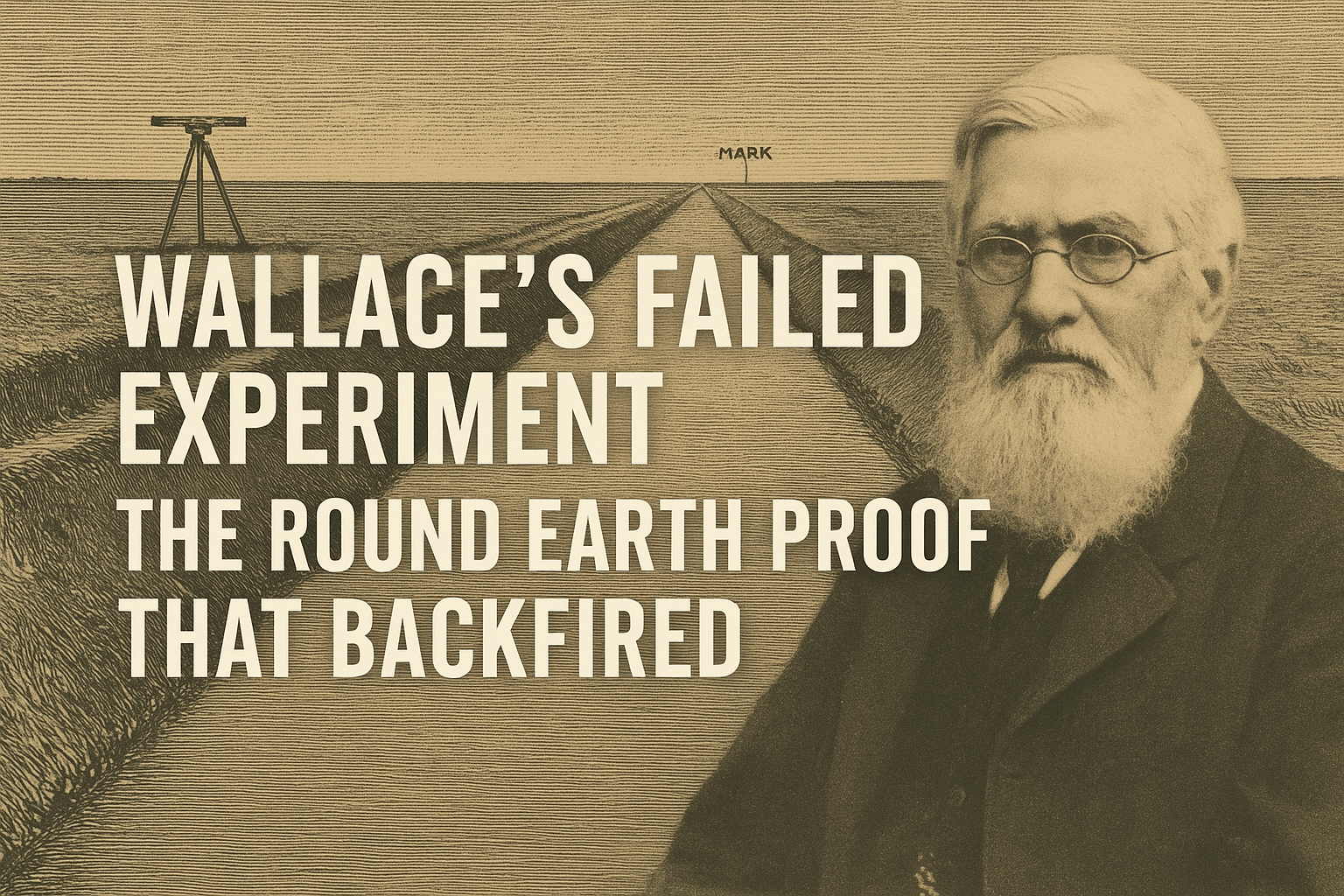
Wallace’s Failed Experiment: The Round Earth Proof That Backfired
The shape of the Earth has been a topic of fascination and debate for centuries. While modern science unequivocally supports the fact that Earth is round, historical experiments seeking to prove this were often fraught with challenges, misunderstandings, and sometimes unexpected outcomes. One such notable attempt was by Alfred Russel Wallace, a 19th-century naturalist and explorer, whose experiment aimed to provide irrefutable evidence of Earth’s curvature but instead became a case study in how scientific endeavors can sometimes backfire.
In this article, we will delve into Wallace’s failed experiment, explore the context behind it, understand why it didn’t go as planned, and examine its impact on the discourse around the Earth’s shape.
—
Who Was Alfred Russel Wallace?
Before diving into the experiment itself, it’s essential to know who Alfred Russel Wallace was. Wallace was a British naturalist, explorer, geographer, and biologist, best known for independently conceiving the theory of evolution through natural selection alongside Charles Darwin. His contributions to biology and geography were significant, but he also had an active interest in physics and the shape of the Earth.
Wallace was a man of empirical observation, often conducting field experiments to prove or disprove scientific ideas. His attempt to provide new evidence of the Earth’s curvature was in line with his scientific approach.
—
The Purpose of Wallace’s Experiment
In the mid-19th century, although the roundness of the Earth was widely accepted in scientific circles, flat Earth theories and skepticism still had pockets of followers. Wallace aimed to conduct a simple, observable experiment that could demonstrate Earth’s curvature to the public and skeptics alike.
The basic principle behind Wallace’s experiment was to use a long, straight waterway and observe whether objects at a distance disappeared from view due to the Earth’s curve. If the Earth was flat, distant objects should remain visible regardless of distance, but if it was curved, the curvature would obscure parts of objects at a distance.
—
The Experiment Setup: The Long Waterway Observation
Wallace chose a canal or a long, narrow stretch of water for his test, reasoning that water, which conforms to the Earth’s surface, would visibly demonstrate curvature if it existed. He positioned observers at precise points along the waterway and used markers or poles placed at equal heights above the water.
By measuring the visibility of these markers from various points, Wallace intended to provide visual, empirical proof of the Earth’s curvature. The expectation was that the markers further away would gradually disappear from view, starting from the bottom, confirming the spherical nature of Earth.
—
Why Wallace’s Experiment Failed: The Atmospheric Refraction Factor
Despite meticulous planning, Wallace’s experiment yielded confusing results. Instead of clearly demonstrating the Earth’s curvature, the observations clouded the issue and, in some cases, seemed to contradict the curvature theory.
The main culprit? Atmospheric refraction.
Atmospheric refraction occurs when light rays bend as they pass through layers of air with varying temperatures and densities. Over long distances, especially near water, this bending of light can cause objects that should be hidden behind the curve to appear visible, or vice versa.
In Wallace’s experiment, the observers noticed that some distant markers, which should have been obscured by the Earth’s curvature, remained visible. Sometimes, the bottom parts of distant poles appeared bent or distorted instead of gradually disappearing.
This optical illusion made it difficult to interpret the results accurately and led some to mistakenly argue against the Earth’s roundness based on Wallace’s findings.
—
The Science Behind Atmospheric Refraction and Its Impact on Curvature Experiments
Atmospheric refraction significantly affects visual experiments on Earth’s curvature. The Earth’s atmosphere is not uniform; temperature gradients, humidity, and air pressure can create a refractive index gradient. This gradient bends light rays downward or upward.
– Superior mirages can make objects appear higher than they are.
– Inferior mirages can make objects appear lower or inverted.
– Light bending can extend the visible horizon, making it seem as if the surface is flatter than it truly is.
Modern understanding of this phenomenon explains why many early round Earth experiments, including Wallace’s, produced ambiguous results.
—
The Aftermath: Lessons from Wallace’s Backfired Proof
While Wallace’s experiment did not provide the definitive, straightforward evidence of Earth’s curvature he had hoped for, it served an important role in scientific progress.
1. Recognition of Atmospheric Effects
Scientists and observers became more aware of atmospheric refraction and its critical role in experiments involving distant visual observations.
2. Encouragement of More Rigorous Methods
The failure prompted the development of more sophisticated experimental techniques, such as using lasers, precise leveling instruments, and measurements taken from higher altitudes to minimize atmospheric distortion.
3. A Reminder of Science’s Complexity
Wallace’s experiment reminds us that empirical science can be messy; data can be misinterpreted, and experiments can fail, but such failures are often learning opportunities.
—
Modern Verification of Earth’s Roundness
Today, the roundness of Earth is confirmed through a multitude of methods far beyond simple visual observations on water:
– Satellite imagery and GPS technology provide precise, real-time data on Earth’s shape.
– Circumnavigation by air, sea, and space confirms a spherical Earth.
– Photographs from space missions show Earth as a globe.
– Mathematical models of gravity and physics rely on a spherical Earth to predict phenomena accurately.
Wallace’s failed experiment is a historical footnote, showing how early science wrestled with natural phenomena and optical illusions.
—
Conclusion: Wallace’s Experiment and the Journey to Understanding Earth’s Shape
Alfred Russel Wallace’s attempt to offer a straightforward, empirical proof of Earth’s curvature through waterway observations is a fascinating chapter in the history of science. Though his experiment backfired due to atmospheric refraction, it highlighted the complexities of conducting such experiments and encouraged future scientists to refine their methods.
Today, we stand on the shoulders of scientists like Wallace, whose curiosity and persistence helped pave the way for our current understanding. Wallace’s failed experiment reminds us that science is a journey filled with trial, error, and eventual triumph — and that sometimes, even failure can be a powerful proof of progress.
—
Interested in the history of scientific experiments and Earth sciences? Stay tuned for more stories uncovering the fascinating trials behind our scientific truths.