Introduction
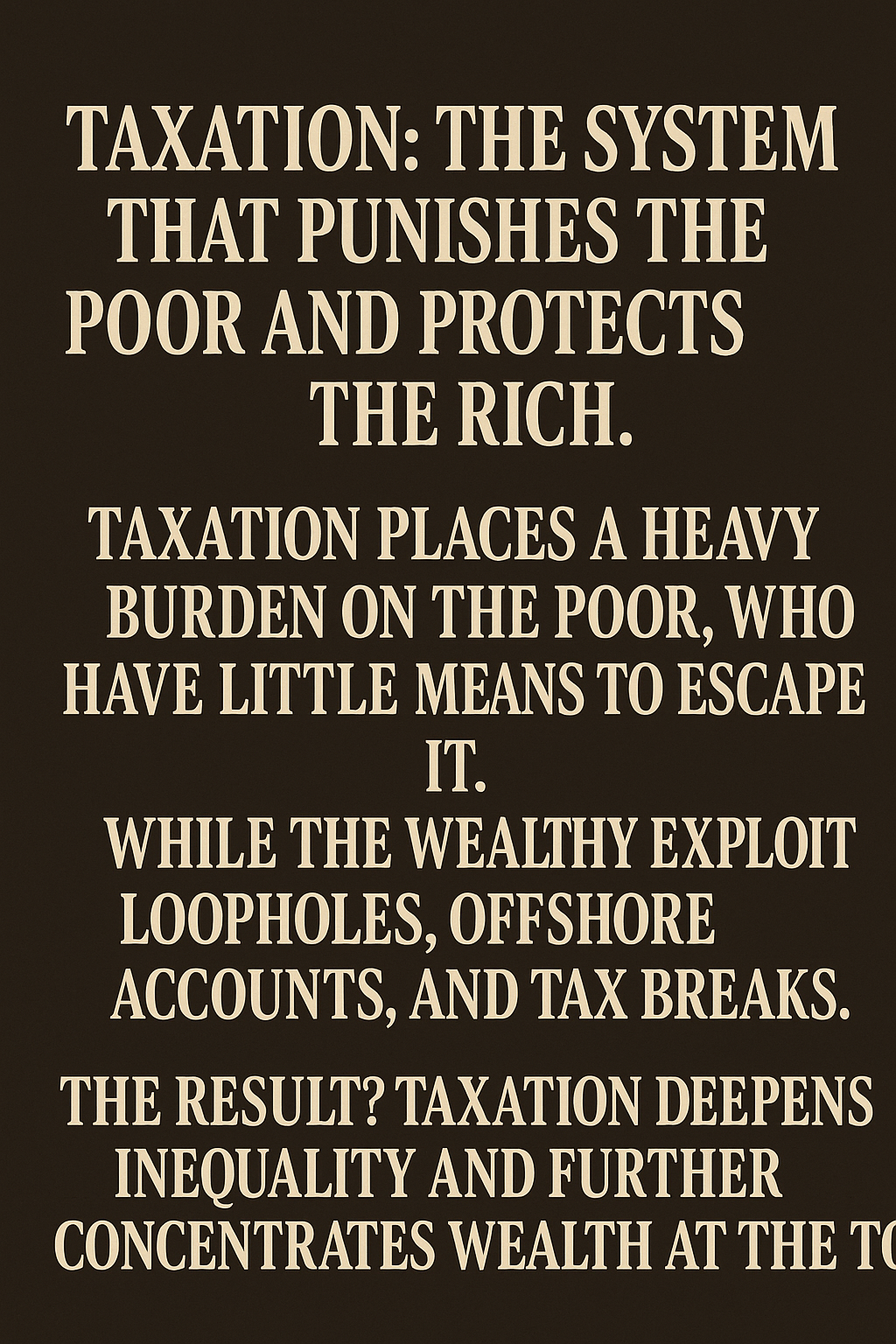
Governments proudly declare taxation as the great equalizer — a system where everyone contributes fairly to society. Yet, in practice, taxation does the opposite. Instead of reducing inequality, it cements it. The poor carry the burden, while the wealthy enjoy loopholes, offshore shelters, and influence over the very laws meant to hold them accountable. Taxation is not leveling society; it’s widening the divide.
The Burden on the Poor
For working families, taxes are inescapable. Income tax strips wages before they are even received. Sales tax and VAT take another cut every time money is spent. Fuel, utilities, and even groceries carry hidden levies. By the time a paycheck is stretched across rent, food, and bills, the government has already taken multiple bites.
For the poor, there are no “tax shelters.” Every cent is exposed. They cannot shift wealth offshore, hide it in complex trusts, or funnel it through shell companies. Their lives are fully visible to the system, and the system extracts relentlessly.
The Escape Routes of the Rich
The wealthy live under the same tax codes — but with very different results. They have lawyers, accountants, and lobbyists who bend the system in their favor. Billion-dollar corporations pay less tax, proportionally, than a street vendor.
-
Profits are routed through offshore accounts.
-
Shell companies hide ownership.
-
Lobbyists write tax breaks directly into law.
While the poor are forced to obey or face penalties, the rich play the game and win.
A System Built on Inequality
This is not accidental — it is by design. Governments depend on the middle and lower classes to fund public coffers, because they are the easiest to tax and the least able to resist. Meanwhile, politicians are financed by the very corporations and billionaires they should be taxing.
The result? Tax codes that look strict on paper but are full of hidden escape doors for the elite. The poor pay for public services they barely receive, while the rich enjoy luxuries without contribution.
The Cycle of Poverty Through Taxation
High taxation on the poor does more than reduce disposable income — it traps families in cycles of poverty.
-
Wages are taxed, leaving less for savings.
-
Savings are taxed again through inflation and bank fees.
-
Inheritance taxes ensure wealth rarely transfers upward.
At the same time, the wealthy grow richer simply by holding assets. Their wealth multiplies through investments, stocks, and real estate — all of which are taxed lightly, if at all. The worker pays with sweat; the wealthy profit while they sleep.
The Psychological Control of “Fair Share”
Perhaps the cruelest trick is convincing the poor that taxation is fair. “Everyone must pay their share” is the slogan repeated endlessly. But while the poor give their labor, the rich give only fractions of their fortune. Equality in principle, inequality in practice.
This illusion keeps society obedient. People argue about tax rates without realizing the game itself is rigged.
Conclusion: The Hidden Truth
Taxation is not the great equalizer. It is the silent engine of inequality. The poor are drained to keep the system running, while the rich escape with wealth intact, protected by the very governments they fund.
As long as this cycle continues, the gap between rich and poor will not close — it will widen. The truth is simple and devastating:
🔎 Taxation doesn’t unite society. It divides it.