💊 Do You Know… Fake Medicine Is Now a $200 Billion Industry?
admin
Author
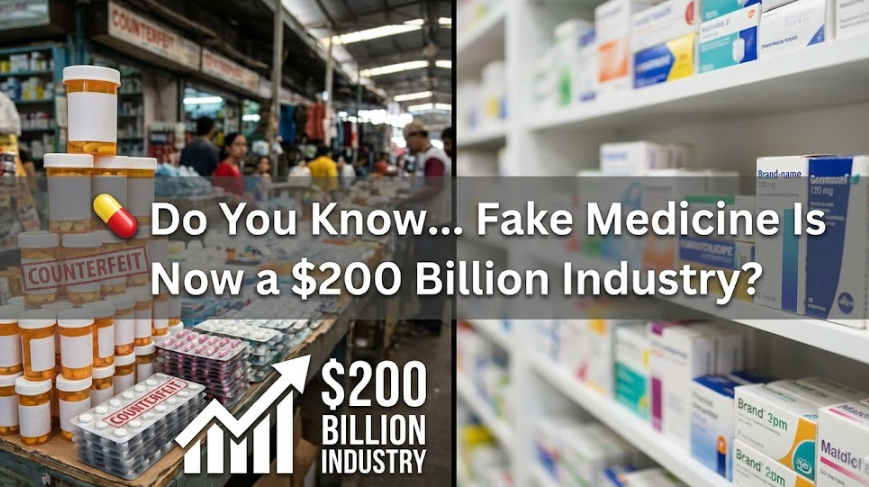
Most people trust that the pills they buy — whether from a pharmacy, a hospital, or even online — are real. But behind the scenes, a massive underground economy has emerged, turning counterfeit medicine into a $200 billion global industry. It is larger than the illegal arms trade and nearly as profitable as narcotics. And unlike drugs or weapons, fake medicine hides in plain sight.
The World Health Organization estimates that 1 in 10 medical products in circulation across developing nations is fake or dangerously substandard. Yet the problem is not limited to poor countries. Counterfeit antibiotics, painkillers, supplements, insulin, heart medication, and even cancer drugs have been discovered across Europe, the U.S., and Asia — slipping quietly into official supply chains.
These fakes often look identical to the real thing.
Same packaging.
Same seals.
Same labeling.
But instead of healing, they contain chalk powder, industrial chemicals, weak dosages, or harmful toxins. Some contain no active ingredients at all. Others contain too much — leading to overdoses, organ failure, or death.
And the most disturbing part?
The global distribution network behind counterfeit medicine is vast, organized, and deeply connected — spanning rogue manufacturers, corrupt distributors, fake pharmacies, and digital marketplaces that operate across borders without regulation.
The rise of online shopping only accelerated the problem. Thousands of websites claim to sell “authentic” medicine without prescriptions. Many ship products that bypass safety checks entirely. Postal systems deliver these fake pills straight to consumers’ homes with no way to verify their origin.
Criminal networks love counterfeit medicine because it carries low risk and high reward.
There are no dramatic raids, no visible crimes, no street-level deals.
Just silent damage — millions of people taking pills that don’t work, or worse, pills that cause harm while pretending to heal.
Hospitals unknowingly receive fake supplies.
Clinics unknowingly administer them.
Patients unknowingly consume them.
This is the hidden epidemic: a silent threat spreading across continents, killing slowly, quietly, invisibly.
Some governments try to combat it, but the networks adapt quickly — changing packaging, shifting suppliers, printing barcodes, even forging holograms. Every time a new security feature is introduced, counterfeiters replicate it within months.
The world is facing a truth it doesn’t want to confront:
Counterfeit medicine isn’t rare. It’s everywhere.
And unless global systems evolve, billions of people will continue trusting pills that may never have seen the inside of a real laboratory.
Fake medicine is more than a criminal business — it is a shadow health system, one that grows stronger every time legitimate medicine becomes expensive, unavailable, or inaccessible.
The real question isn’t how these criminals operate.
The real question is:
How many people have already taken fake pills without ever knowing?