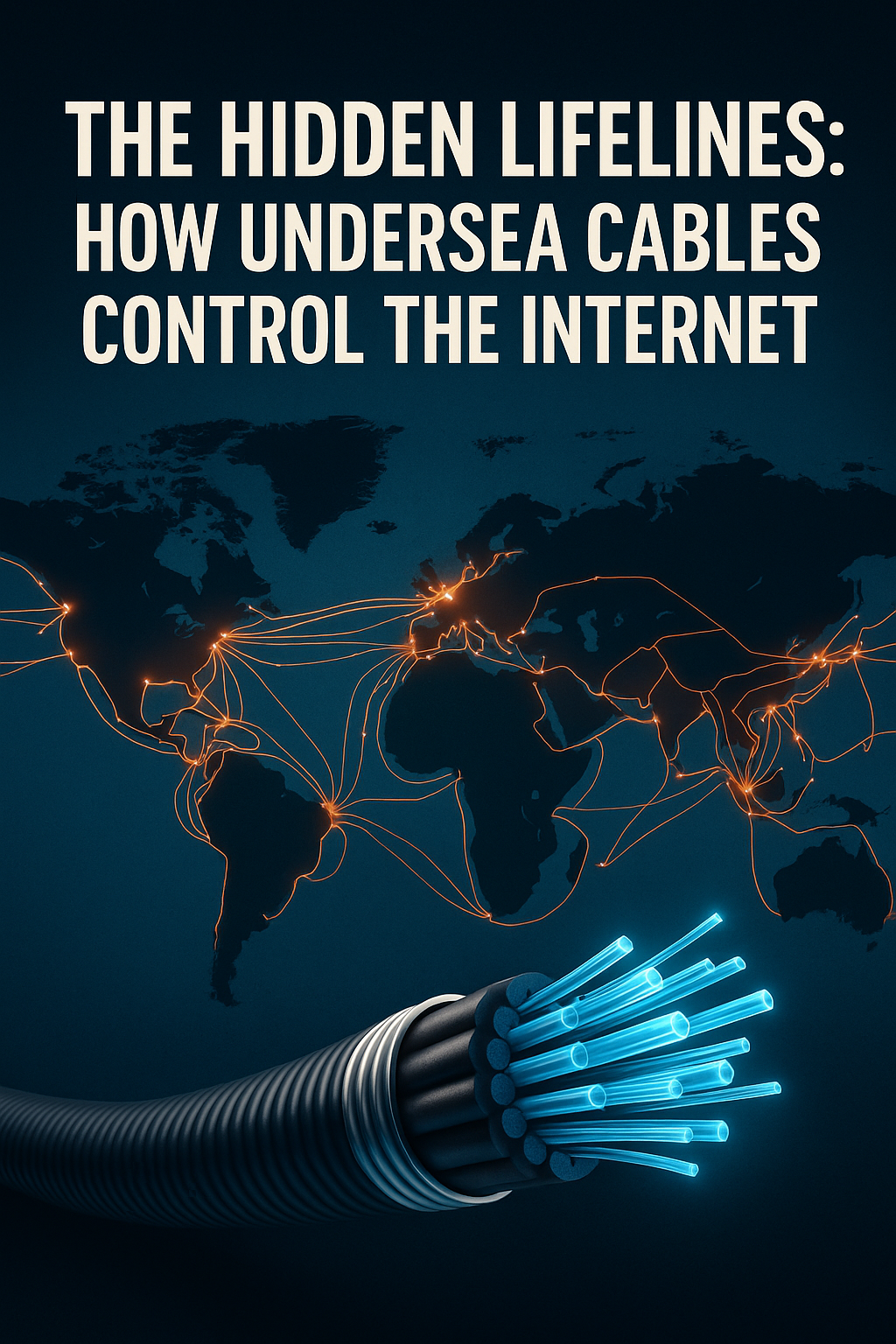
Introduction: The Internet Illusion
We’re told the internet is wireless, floating invisibly through satellites and signals. But the truth is far stranger — and more concerning. Over 99% of all international internet traffic flows through undersea fiber-optic cables stretching across the ocean floor. Every message, transaction, and call passes through these fragile wires, quietly controlled by a few powerful entities.
The “cloud” isn’t in the sky. It’s on the ocean floor. And whoever controls the cables, controls the flow of information.
1. The Cables Beneath Our Feet
There are more than 500 active submarine cables, spanning nearly 1.5 million kilometers across the seabed. Each is thinner than a garden hose, yet carries terabytes of data every second — enough to power the entire global economy.
Cables are laid by specialized ships, connecting continents like invisible arteries. Without them, the internet would collapse in an instant.
2. Satellites Are a Myth of Convenience
Despite popular belief, satellites carry less than 1% of internet traffic. They are slow, expensive, and impractical for global data. Fiber cables dominate because they are faster, cheaper, and more reliable.
This raises a chilling question: why are we told satellites power the internet, when in truth, it’s cables? The myth keeps people distracted from the fragile and centralized reality.
3. Control, Surveillance, and Vulnerability
If 99% of the world’s data passes through cables, then monitoring, tapping, or even cutting them becomes a weapon of immense power.
-
Intelligence agencies have a history of secretly tapping cables for surveillance.
-
Nations can be crippled by cutting or disrupting cables.
-
A few companies and governments decide where cables land and who has access.
The cables are both lifelines — and choke points.
4. The Geopolitics of Fiber Cables
Control of cable routes is now a silent battleground of global politics.
-
The U.S. and China race to secure cable networks for influence.
-
Small nations become dependent on landing stations controlled by larger powers.
-
Wars of the future may not target cities — but the cables beneath the seas.
5. The Fragile Backbone of Digital Life
We live in a world that feels wireless, yet is tethered to fragile glass strands at the bottom of oceans. These cables can be damaged by anchors, earthquakes, or sabotage. A single break can disrupt entire countries.
Digital life is not as invincible as we think. It is a delicate system, held together by cables we rarely hear about.
Conclusion: The Question Few Ask
If the internet — the backbone of modern civilization — depends almost entirely on undersea cables, then who really controls our digital lives? And if these cables are so vulnerable, what would happen if they were cut, manipulated, or taken over?
The internet is not free, open, or invincible. It is fragile. It is controlled. And it runs through hidden wires most people never think about.