🌕 Do You Know… NASA Lost the Original Moon Landing Footage?
admin
Author
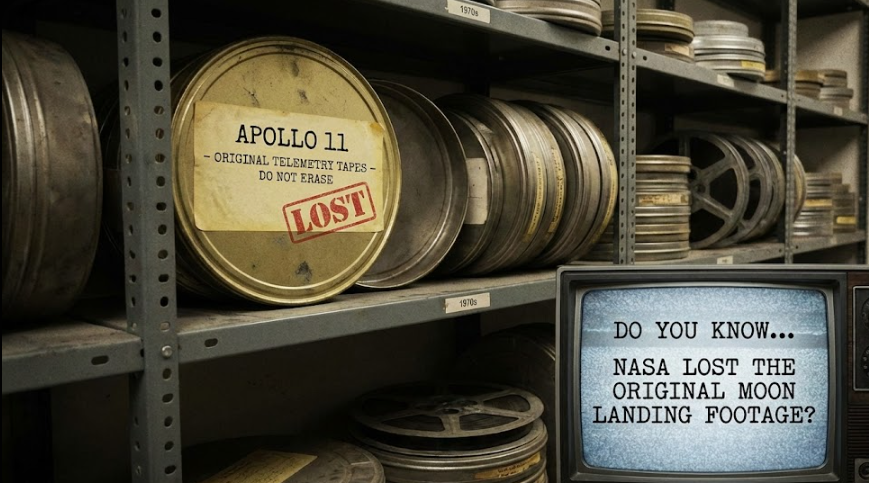
In 1969, over 600 million people watched Neil Armstrong take “one small step for man” — the moment considered humanity’s greatest technological triumph. But what most people don’t know is this: NASA no longer has the original footage of that historic event.
The original tapes — higher quality than anything ever broadcast — were recorded over, erased, and reused.
NASA’s official explanation?
They were cleaning tape drives and recycling magnetic reels due to budget limitations.
The world’s most valuable scientific recording — the first time humans allegedly walked on another celestial body — was treated like an old VCR tape.
Even stranger, when researchers and engineers requested the original footage for restoration, NASA admitted they couldn’t find it. After a lengthy investigation, NASA confirmed the tapes were gone — likely destroyed in the 1980s.
So if the original footage no longer exists, what did the world watch?
Only copies of copies, degraded by transmission errors, static interference, and low-resolution broadcast technology. The archival version we see today is not the original recording — it’s a reconstructed composite created from backup broadcasts and film cameras pointed at screens.
The clearest, sharpest, highest-quality footage ever captured on the Moon?
Gone forever.
This has fueled public skepticism for decades. How could NASA misplace — or overwrite — something of such historical and scientific importance? Why weren’t the tapes secured in vaults? Why did it take 30 years for the agency to reveal the loss? Nothing else from the Apollo program “accidentally disappeared,” only the most important evidence of all.
Some believe it was simply poor management.
Others think it raises deeper questions.
Why were the tapes stored so casually?
Why did NASA never release raw footage in high definition?
Why did they not protect the only visual proof of mankind’s greatest achievement?
Whether the loss was accidental or intentional, one thing is clear:
The greatest moment in the history of space exploration no longer exists in its original form.
All we have left are noisy, blurry duplicates.
And the world is left asking a question no science agency should have to answer:
How do you lose the Moon landing?